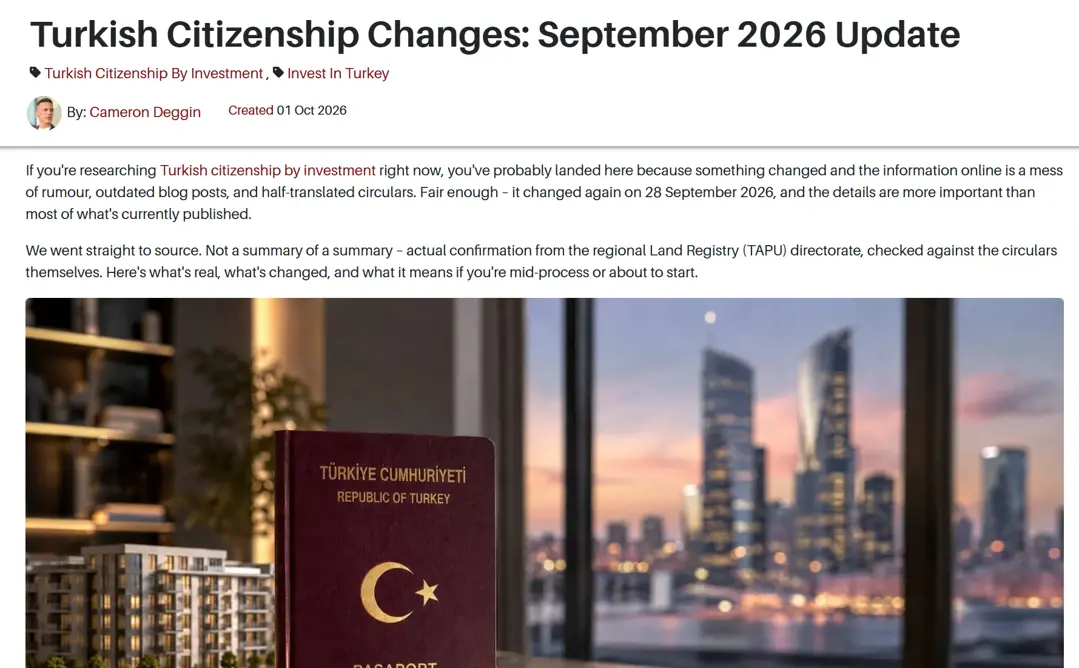
Recently, applicants inquiring about Turkish citizenship almost invariably ask the same question: "Has the threshold been raised?" In fact——On September 28, 2026, in a batch of official reply letters issued by the General Directorate of Land Registry and Cadastre of Turkey, the USD 400,000 investment threshold remained completely unchanged; what truly changed was the verification system governing "how to prove you qualify" beneath that threshold.
In other words, the "ticket price" for Turkish immigration has not changed, but the "ticket validation process" has become substantially more rigorous. WorldWay reminds that for applicants currently applying or interested in applying, understanding the details of this round of changes is far more important than focusing solely on the price.
The USD 400,000 real estate investment threshold has been in place since June 13, 2022, and this official reply made no adjustment to it. The real change lies in the verification method: in the past, some applicants understood it as "as long as the total across various items reaches 400,000, it is sufficient," whereas the new rules explicitly require——
✦ Foreign Exchange Purchase Certificate (DAB) amount
✦ Declared transaction price in the title deed
✦ Valuation report (TTB) amount
✦ Total funds actually paid to the seller
These four items must individually reach USD 400,000, with none falling short. This means that operational structures previously common in the industry—such as "underdeclaring the price and routing the difference via a separate transaction"—are no longer viable under the new verification logic. Any discrepancy in these figures may cause the application to be hindered.
▼ Relaxations: Validity Period and Institutions
The validity period of the valuation report (TTB) from issuance to the submission of the land registry application has been extended from 6 months to 12 months; the restriction in place since March 2024 stipulating that "valuations could only be issued by GEDAŞ" has also been lifted. Any valuation institution holding an SPK license and registered in the WebTapu and TADEBİS systems is eligible to practice.
▲ Tightening: Liability and Scope
The new rules clarify: The Land Registry Directorate will only conduct formal reviews, and the accuracy of the valuation figures shall be borne by the valuation institution and the signing appraiser. If figures do not reconcile, the case will be escalated to the Ankara General Directorate for manual re-examination.
In addition, purchasing properties through a Real Estate Investment Trust (GYO) is no longer exempt from valuation requirements. Applicants must either obtain a newly issued independent valuation report or adopt the valuation data publicly disclosed by the GYO on the KAP platform—even state-backed entities like Emlak Konut are no exception. For applicants, this increases not only valuation costs, but also the time commitment.
The new rules do not provide transitional clauses. Determining whether the old or new rules apply depends on three milestone dates: the investment threshold looks at the purchase date, the valuation validity looks at the application submission date, and the fund flow looks at the foreign exchange conversion date.
🔑 The most crucial rule: It is determined strictly by the issuance date of the Certificate of Conformity (TYTB), not the signing date of the preliminary sales contract. That is to say, even if the preliminary sales contract was signed before the September new rules took effect, as long as the TYTB has not yet been issued, the new rules shall apply without exception. The previous workaround under preliminary sales contract structures of "adding another small property unit to bridge a minor valuation shortfall" has been completely eliminated.
This is by no means theoretical. In August this year, the Turkish Ministry of Interior announced that during an operation across 16 provinces, the Certificates of Conformity of 1,150 investors were revoked, leading to the cancellation of status for 5,391 individuals including family members; an additional 743 individuals had their status revoked due to public security assessments. Notably, such retrospective reviews often occur several years after approval—at which point whether a complete chain of evidentiary documents can be produced directly determines whether the status can be preserved.
Currently, there are mainly two pathways for Turkish citizenship planning, operating on fundamentally different rationales:
Property Acquisition Route
USD 400,000 real estate purchase, with a title deed annotation prohibiting transfer for three years; properties may be owner-occupied or leased out, following an "asset + status" bundled model.
Bank Deposit Route
USD 500,000 equivalent in Turkish Lira deposited for three years, without involving real estate or valuation procedures; the workflow is lighter, but one must bear three-year exchange rate fluctuation risks, with bank-issued certification documents serving as the sole evidentiary basis.
Choosing between the two routes depends on whether capital is intended to be anchored in real estate or if the preference is to maintain liquidity over three years. Whichever route is chosen, applicants are advised to perform a self-check against the following four items:
① Who issued the valuation report? Verify whether institutional qualifications and report expiration dates are compliant;
② DAB amount, title deed declared price, TTB valuation, and actual payment amount: do each of the four independently clear the threshold?
③ If purchasing GYO properties, does the KAP publicly disclosed valuation correspond to the declared figures?
④ Are remittance slips, foreign exchange transaction records, and payment receipts retained as a complete file?
The signal delivered by this policy adjustment is clear: Turkey welcomes investment, but is implementing more rigorous verification to screen out applications where "numbers do not reconcile." For applicants, when it comes to status planning, speed has never been the advantage—stability is. Undergoing a thorough document health check prior to submission is far more manageable than dealing with retrospective reviews after the fact. Welcome to contact WorldWay consultants / customer service for a one-on-one assessment.