On November 13, 2026, a tax law amendment officially passed by the Hellenic Parliament is altering the cost structure for non-EU buyers entering the Greek residential property market.
According to Law 5355/2026, effective from July 1, 2027, for natural persons from non-EU and non-EEA countries purchasing residential property in Greece, the property transfer tax will be increased from the current 3% to 15%.
This is by no means a minor adjustment. Calculated on a property with a taxable value of €250,000, the difference between the current transfer tax and that under the new policy is more than €30,000. Converted into RMB, the increase in tax liability alone approaches RMB 220,000. WorldWay advises that for families viewing property purchase as a route to securing Greek residency status, this additional expense directly raises the barrier to entry.
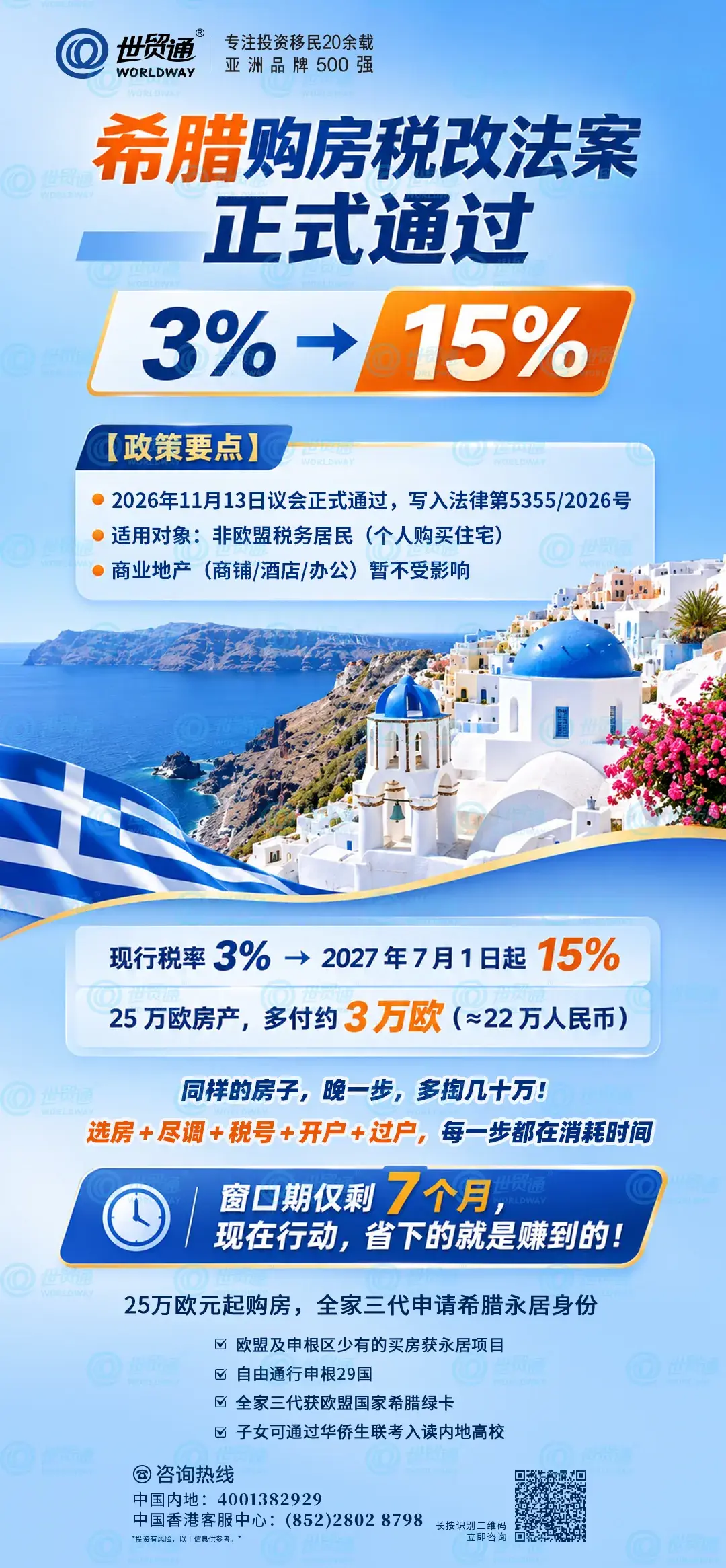
The key to understanding this policy lies in the definition of the scope of exemptions. The new 15% tax rate does not cover all non-EU buyers. Legal entities, Greek expatriates, and third-country nationals already holding a Greek long-term residence permit can still apply the original rules. The exemption applies only to transfers for residential use; commercial properties, land, and non-residential real estate are not subject to the tax increase.
This means that for most non-EU natural person buyers who have not yet obtained Greek long-term resident status, completing a residential property transfer after July 1, 2027 will inevitably trigger the 15% tax rate. The policymakers' intention is clear: to cool external property purchasing demand and relieve price pressures on the local residential market. In 2025, third-country nationals invested approximately €1.2 billion in Greek real estate, of which approximately €800 million flowed into the residential sector. Tax mechanisms were selected as the regulatory gate to channel this capital flow.
Shifting focus away from the single variable of the transfer tax, the overall landscape of the Greece Golden Visa program has undergone a structural shift over the past two years. Starting from August 31, 2024, the single Golden Visa threshold of €250,000 was divided into three tiers:
◆ €800,000 | Attica Region (including Athens), Thessaloniki, Mykonos, Santorini, and islands with a population exceeding 3,100
◆ €400,000 | All other regions across the country
◆ €250,000 | Reserved exclusively for two specialized pathways: "commercial-to-residential conversion" projects and the restoration of listed historic buildings; not applicable to spot transactions of standard residential properties
At the same time, Golden Visa properties are explicitly prohibited from short-term rentals under 60 days; violations incur a penalty of €50,000 and even the risk of residency revocation. The once-popular formula of "purchase property — short-term lease — cover holding costs" has become invalid from a regulatory compliance standpoint.
The effective date of the tax reform is set: July 1, 2027. However, the practical window of opportunity does not equal the remaining days on the calendar. From property selection, legal due diligence, and notarization to the final completion of title transfer registration, real estate transactions in Greece inherently require a substantial timeframe; moreover, Golden Visa applications also entail the immigration authority's processing backlog.
💡 For families wishing to lock in the current 3% transfer tax rate, the truly available time is not simply "more than 7 months," but depends on whether all statutory procedures can be completed prior to the deadline after initiating the process immediately.
The pace of European immigration policy shifts has exhibited a clear pattern over the past few years: elevating thresholds, narrowing pathways, and refining compliance criteria, often advancing in alternating cycles of several years. Greece's transition from a single €250,000 threshold to three-tiered pricing, followed by the differentiated increase in transfer tax for non-EU natural persons, represents the latest chapter of this pattern.
For family residency planning, what truly matters is not catching the "last minute," but completing compliance assessments, budget projections, and pathway verifications before the policy officially takes effect. If you still wish to secure Greek residency through property investment under the current policy, it is recommended to initiate a professional assessment as early as possible to avoid bearing higher tax costs due to delayed property closing milestones.
WorldWay has been engaged in promoting the Greek Golden Visa program since 2013, standing as one of the early professional institutions introducing Greek real estate investment immigration to the Chinese market. In response to continuous policy adjustments in Greece, WorldWay advises investors to take compliance as the foundation, comprehensively evaluate family budgets, property types, title transfer schedules, and long-term plans, and rationally seize the current policy window for Greek Golden Visa property investments.