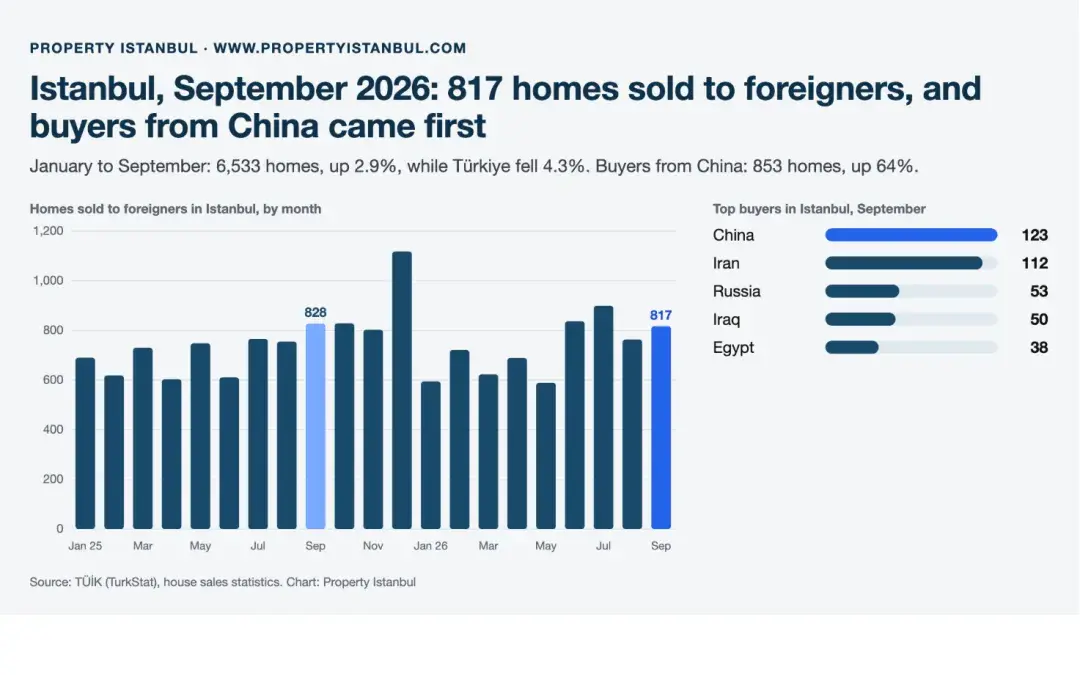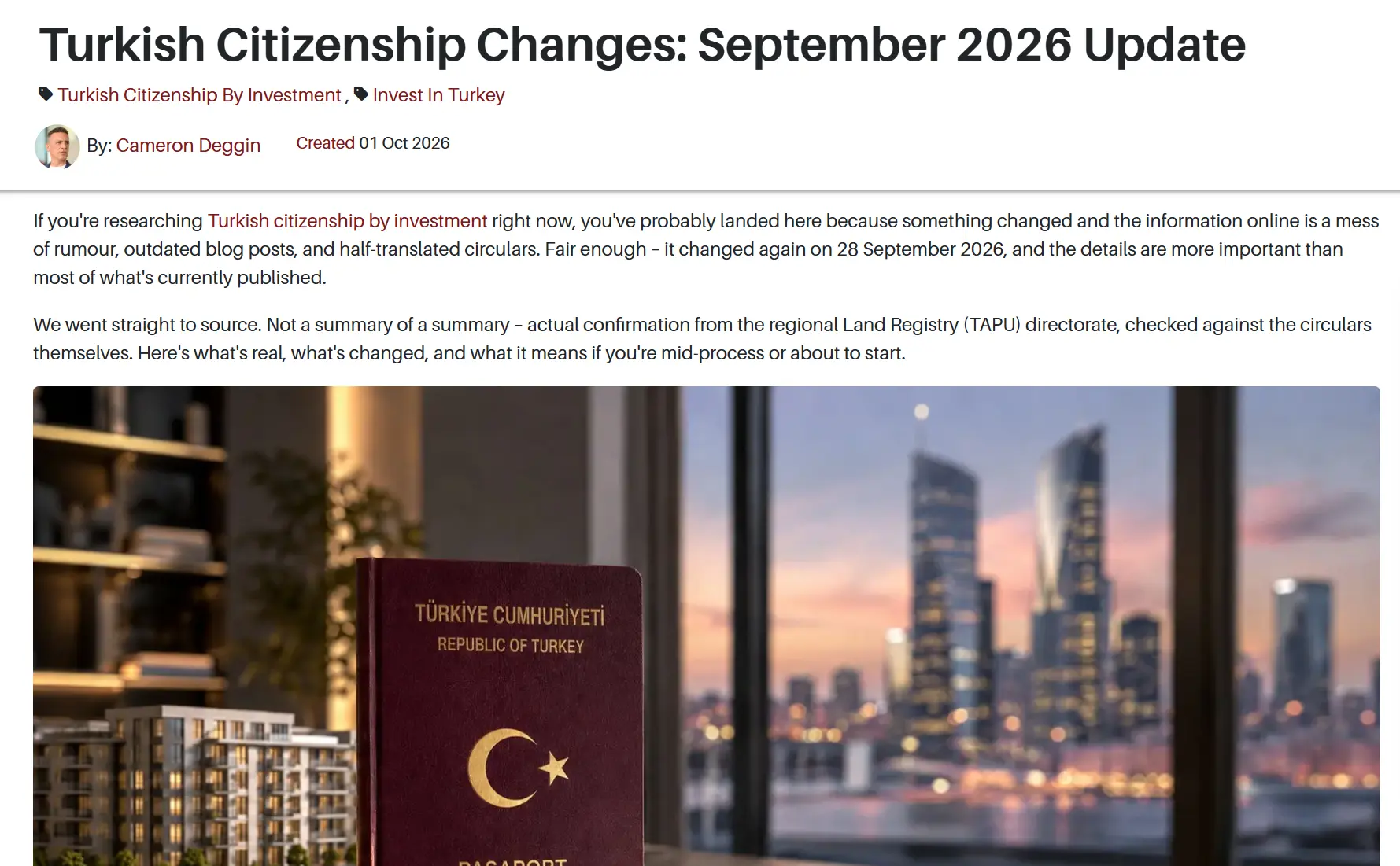
In September 2026, Chinese buyers ranked first among foreign buyers in monthly home purchases in Istanbul. Turkish immigration is currently primarily achieved through the $400,000 real estate investment citizenship program. According to the provisions of the Turkish Citizenship Law, applicants who purchase qualifying real estate and hold it for at least 3 years can obtain Turkish citizenship in one step, with no physical presence requirement, no residency requirement, and visa-free access to 120 countries and regions. For Chinese applicants, this program has a clear capital threshold and a relatively expeditious process, making it an essential option for high-net-worth families undertaking global identity planning.
Comprehensive Analysis of Turkey's Immigration Policy: Application Requirements and Procedures for the $400,000 Real Estate Investment for Citizenship
Turkey Citizenship by Real Estate Investment Program: Starting from $400,000, obtain citizenship in one step. Under Turkey's current naturalization policy, foreign investors who purchase Turkish real estate valued at no less than $400,000 and commit to holding it for 3 years can apply for Turkish citizenship for the entire family. The primary applicant may include their spouse and children under 18 years of age. This program has no language, education, business background, or residency requirements for applicants, nor does it require complex documentation explaining the source of funds, presenting clear overall application criteria.
Application Criteria
- At least 18 years of age with no criminal record;
- Purchase Turkish real estate with a total value of no less than $400,000, with payment completed via bank transfer;
- The property must have a valuation report issued by an officially recognized Turkish appraisal institution showing a valuation of no less than $400,000;
- Commit to holding the real estate for at least 3 years, with the option to sell after 3 years;
- May include spouse and children under 18 years of age in the joint application.
Processing Procedure
The typical Turkish immigration process includes: selecting the property and signing a purchase agreement, completing property payment and title transfer, applying for the Certificate of Eligibility, submitting the residence permit application, submitting the citizenship application, capturing biometric data, and collecting the passport upon approval. The entire cycle typically takes around 6 to 10 months, with the exact duration subject to the immigration bureau's adjudication pace. Applicants generally only need to enter Turkey 1 to 2 times, primarily for opening bank accounts, property title transfer, and biometric data collection.
Value of a Turkish Passport: Visa-Free Access to Over 120 Countries/Regions and G20 Power Identity Advantages
A Turkish passport provides visa-free or visa-on-arrival access to over 120 countries and regions, including Japan, South Korea, Singapore, Malaysia, Brazil, and Argentina, facilitating business travel and tourism. Turkey itself is a member of the G20, boasting a relatively dynamic economic system and a strategic geographic location at the crossroads of Europe and Asia; its identity value offers distinct competitiveness among citizenship-by-investment programs.
Furthermore, Turkey is a US E-2 visa treaty country, allowing Turkish citizens to apply for the US E-2 investor visa to operate businesses and reside long-term in the United States. For families seeking to enter the US, this is a path worthy of attention. However, note that an E-2 visa is not a green card, and applicants must still satisfy business operation and renewal requirements.
Turkish Immigration Fee Breakdown: Property Purchase Price, Taxes, and Holding Costs at a Glance
In addition to the $400,000 property purchase price, applicants must also budget for taxes and holding costs. Below is an overview of common fee items; actual amounts are subject to real transaction specifics and official fee schedules.

| Fee Item | Approximate Amount / Ratio | Description |
|---|---|---|
| Property Purchase Price | No less than $400,000 | Must be paid via bank transfer and backed by an official valuation report |
| Title Deed Transfer Tax | Approx. 4% of property value | Usually shared equally at 2% each by buyer and seller, subject to negotiation |
| Value Added Tax (VAT) | Depends on property type | Usually exempt for resale properties; new properties may be subject to a 1% or 20% tax rate |
| Legal Fees | Approx. 1%—2% | For contract review, title investigation, and transfer assistance |
| Valuation Report Fee | Several hundred US dollars | Issued by an officially recognized appraisal institution |
| Residence Permit & Citizenship Application Fees | Several hundred to several thousand US dollars | Paid according to official fee schedules |
| Holding Costs | Several hundred to several thousand US dollars per year | Includes property management fees, property taxes, insurance, etc. |
Taking a $400,000 property as an example, transaction-stage taxes and legal fees typically require an additional reserve of approximately $20,000 to $30,000. Applicants should allocate sufficient budget to prevent inadequate proof of funds from affecting the application progress.
Property Selection and Risk Mitigation in Turkish Immigration: Key Points on Location, Title, and Compliance
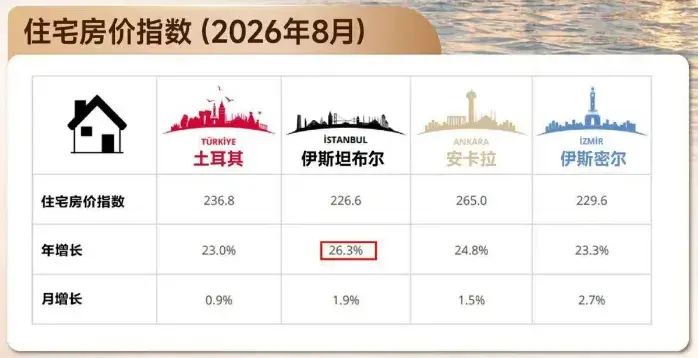
Property selection directly affects the compliance of the citizenship application and subsequent asset disposal. It is recommended to prioritize mature locations in core cities such as Istanbul, Ankara, and Izmir, focusing on transportation, education, commercial amenities, and rental demand. In terms of title, it is essential to verify that the property is free of mortgages and seizures, holds an independent title deed, and that the developer possesses lawful sales qualifications.
Key risk mitigation points include: verifying that the property valuation report is issued by an officially recognized institution; confirming that the property payment route complies with Turkish banking regulatory requirements; avoiding the purchase of properties with ambiguous title or ongoing disputes; understanding the restrictions on selling within the 3-year holding period; and choosing an agency with on-the-ground local service capabilities to assist with due diligence. WorldWay Immigration has an overseas customer service center in Turkey, capable of assisting clients with property due diligence, legal document review, and subsequent settlement services.
Latest Turkish Immigration Data: Chinese Buyers Reach the Top in Istanbul
The latest data from the Turkish Statistical Institute (TÜİK) reveals that in September 2026, foreign buyers purchased a total of 817 residential properties in Istanbul. Among them, Chinese buyers purchased 123 units, ranking ahead of Iran (112 units) and Russia (53 units), taking first place among foreign buyers for that month. This also marks the second time Chinese buyers have claimed the top spot since statistics began in 2013.
The core reason so many families are focusing on Turkey is its citizenship-by-real-estate-investment pathway. By purchasing compliant real estate valued at $400,000 or more and holding it for 3 years, one can apply for Turkish citizenship. This route does not require long-term residency, involves no language examinations, and Turkey permits dual citizenship. In addition, Turkey is a US E-2 treaty country, and qualified individuals can apply for an E-2 investor visa after naturalization. For families seeking to configure an additional identity, both the threshold and timeframe are exceptionally favorable.
Latest Turkish Immigration Policy: September 28 New Regulations, Three Major Adjustments
On September 28, 2026, the General Directorate of Land Registry and Cadastre (TKGM) of Turkey revised the valuation regulations for citizenship through property purchase. Three points are of paramount importance to applicants.
First, the selection of appraisal institutions has expanded, but qualification criteria are stringent.
Previously, valuation reports for citizenship could only be issued by a single designated institution. Now, as long as an appraisal institution simultaneously satisfies three conditions—holding a license from the Capital Markets Board of Turkey (SPK), maintaining membership in the Turkish Appraisers Association (TDÜB), and being registered in the Real Estate Valuation Information System (TADEBİS)—it may issue reports. Institutions are selected and submitted through the official Web Tapu platform. Currently, the authorities have not released an "approved institution list," making the choice of valuation agency even more critical than before.
Second, GYO projects are no longer exempt from valuation.
GYO refers to Turkish Real Estate Investment Trusts. In the past, purchasing real estate from a GYO did not require an independent valuation; this exemption has now been revoked. Prior to title transfer, a new independent valuation report must be provided, or the valuation published by the GYO on the Public Disclosure Platform (KAP) must be used. If a KAP valuation is used, the documents will be transferred to the Ankara General Directorate for review. A review does not signify rejection, but it will take more time. State-backed Emlak Konut GYO is likewise subject to this rule without exception.
Third, TTB validity has been extended from 6 months to 12 months.
The TTB is the citizenship investment amount certification document issued based on the valuation report. Previously, delays due to banking, translations, or appointment queues frequently caused the TTB to expire, requiring applicants to restart the process. With the validity period doubled, such risks are substantially reduced. Note that only the TTB validity has been extended; the validity periods of other application materials remain unchanged.
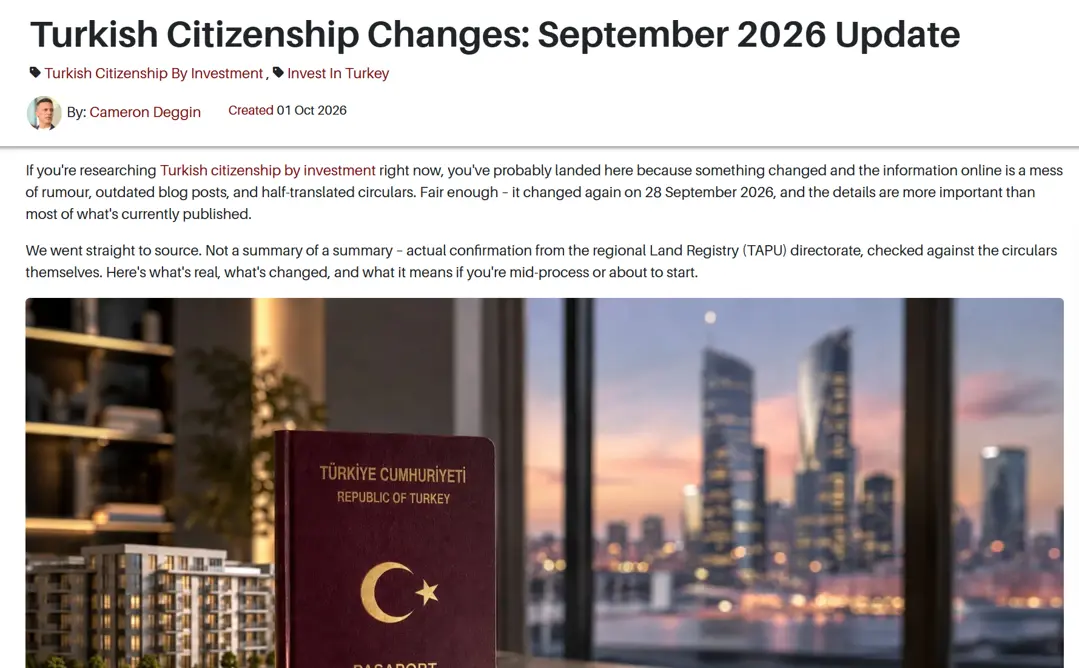
Turkish Immigration vs. Global Identity Planning: Comparison with US EB-5, Portugal, Malta, and Other Programs
Different identity planning programs suit different family goals. The following comparison covers investment amounts, identity types, residency requirements, and other dimensions for reference.

| Program | Minimum Investment | Identity Type | Residency Requirement | Features |
|---|---|---|---|---|
| Turkey Citizenship by Real Estate Investment | $400,000 | Citizenship | No physical presence requirement | Direct passport issuance, visa-free access to 120+ countries/regions, eligible to apply for US E-2 visa |
| US EB-5 Immigrant Investor Program | $800,000 (adjusting upward to $900,000—$950,000 starting January 1, 2027) | Green Card | Must meet residency requirements | Reserved visa categories with no waiting line, I-526E approval in approx. 8 months, green cards for the entire family in one step |
| Portugal Immigration | €500,000 fund subscription or €200,000 donation | Residence Permit leading to Permanent Residency / Citizenship | Must meet residency requirements | EU member state and Schengen area, travel freely across 29 Schengen countries, one applicant covers three generations |
| Malta Permanent Residence | MPRP subject to official announcement | Permanent Residence | No mandatory residency requirement | Four-in-one state, invest after approval, children enjoy British-style education |
For families seeking to swiftly obtain a second citizenship, convenient visa-free travel, and no residency requirements, the Turkish program offers high cost-effectiveness. For families aiming for long-term settlement in the United States, EB-5 immigrant investment remains the direct route. Portugal and Malta are more suitable for families valuing EU education, healthcare, and living environments. A comprehensive evaluation based on family asset structure, children's education planning, and tax arrangements is recommended.
WorldWay Immigration's Professional Services: 28 Years of Experience and On-the-Ground Support Network in Turkey
WorldWay Immigration (WORLDWAY) originated in Hong Kong, China in 1998. As of 2026, it has been deeply engaged in the investment immigration industry for 28 years and has been selected among Asia's 500 Most Influential Brands. Its domestic branch offices cover Beijing, Shanghai, Shenzhen, Qingdao, Hong Kong, China, and Macau, China, while overseas customer service centers include the United States, Canada, Portugal, and Turkey, providing clients with comprehensive support from project selection to local settlement.
In Turkish immigration projects, WorldWay Immigration assists clients with property due diligence, legal document review, bank account opening, and submission of residence permit and citizenship applications, with subsequent landing services provided by our local team in Turkey. WorldWay adheres to the service philosophy of "Integrity as the Foundation, Customer First" and maintains the project standard of "Prudent Project Selection, Professional Customer Service."
WorldWay —— One of the Earliest Immigration Agencies to Promote the Turkish Citizenship-by-Investment Program in China
WorldWay, an active promoter of European investment immigration projects, has introduced multiple European immigration programs to China. In April 2019, WorldWay joined hands with the Turkish Embassy in China, the Consulate General in Shanghai, and the Consulate General in Guangzhou to concurrently hold the "Official Press Conference and China Launch Ceremony for the Turkish Citizenship-by-Investment Program" in Beijing, Shanghai, Shenzhen, and Qingdao, officially introducing the highly anticipated Turkish citizenship-by-investment program to China—a pioneering event that will be permanently recorded in history!
Senior executives of WorldWay have met with high-ranking dignitaries including the Director General of the General Directorate of Civil Registration and Nationality of the Turkish Ministry of Interior, the Head of the Migration Policy Office of the Ministry of Interior, the Turkish Ambassador to China, the Consul General of the Consulate General in Guangzhou, the Consul of the Consulate General in Shanghai, and the Commercial Counselor.
Common Misconceptions and Practical Recommendations for Turkish Immigration: Critical Milestones from Contract Signing to Passport Receipt
Common Misconception 1: Believing that buying property automatically grants citizenship. In reality, applicants must still pass official valuation, complete residence permit and citizenship application procedures, and the property valuation must meet the $400,000 threshold.
Misconception 2: Overlooking the 3-year holding period restriction; selling prematurely may result in revocation of status.
Misconception 3: Underestimating taxes and holding costs, leading to budget shortfalls.
Misconception 4: Purchasing property through informal channels, resulting in defective title deeds.
Practical Recommendations: Verify developer credentials and property title before signing contracts; ensure property funds are paid via bank transfer and retain complete payment vouchers; engage professional legal counsel to review contracts; stay informed on immigration bureau policy updates; and select an agency with a local service network to assist with processing. From contract signing to passport receipt, critical milestones include property title transfer, valuation reports, residence permits, citizenship applications, and biometric data collection, with strict compliance required at every step.
Frequently Asked Questions
If you are considering Turkish immigration, we recommend first completing an initial match through the Free AI Immigration Assessment on the WorldWay Immigration official website, or contacting a consultant directly for a personalized plan. For more project details, please visit the Turkish Immigration Page or call our service hotline: 400-138-2929.