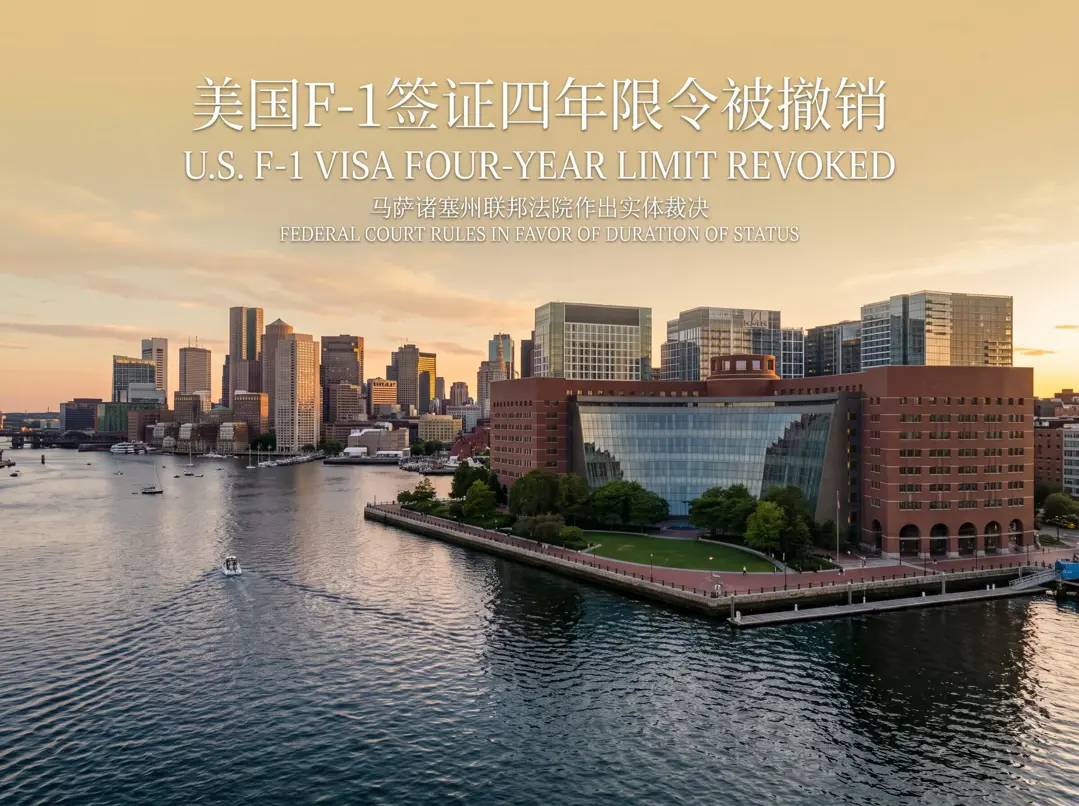
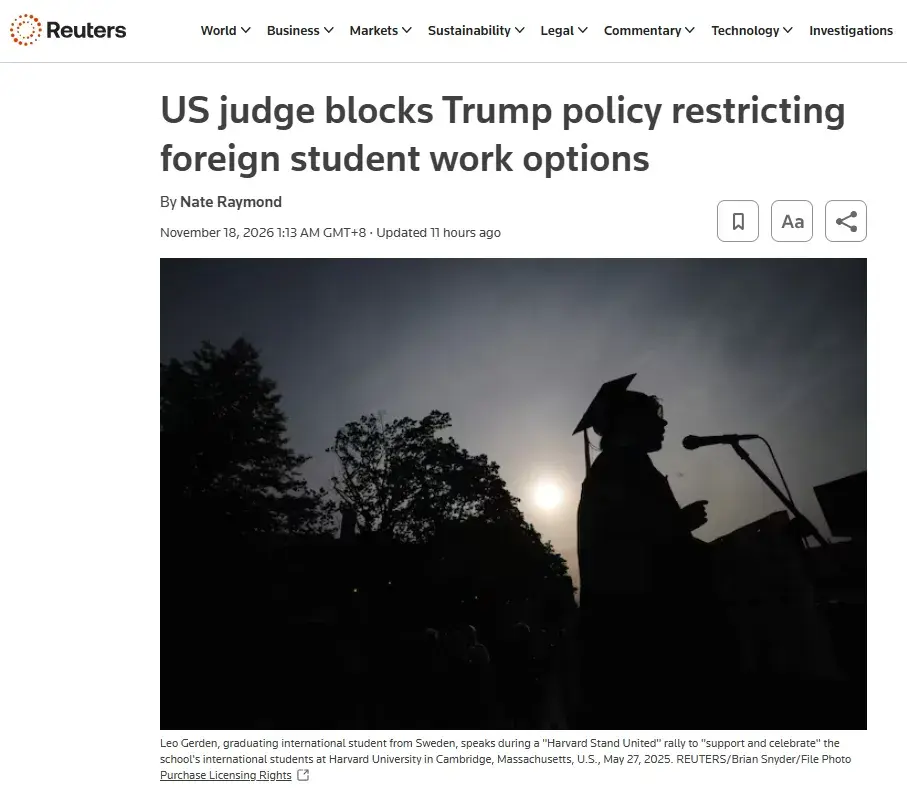
According to a Reuters report on November 17, 2026, a U.S. federal court halted the guidance issued in August by the U.S. Department of Homeland Security (DHS) that tightened Curricular Practical Training (CPT) for F-1 international students; credit-bearing elective internships meeting original criteria will continue to be reviewed and authorized by schools.
For international students currently enrolled in U.S. universities who rely on CPT to secure corporate internships, this offers a "breathing window." However, taking a long-term view, the conclusion is clear: this relaxation alters the immediate enforcement stance, not the long-term regulatory trajectory. WorldWay notes that this judicial battle surrounding student internship rights has once again brought an old question to the forefront—policies keep changing, and planning your U.S. immigration status must be proactive.
Part 1 · Why the CPT Restrictions Were Halted by the Court
On August 12 and 24, 2026, the Student and Exchange Visitor Program (SEVP) under the U.S. Department of Homeland Security (DHS) released two guidance updates reinterpreting federal regulations: CPT must be an integral, mandatory internship for all students in that degree program; elective internships that earn credit but are not required for graduation would no longer qualify.
On October 5, the Association of American Universities (AAU), NAFSA, the Presidents' Alliance on Higher Education and Immigration, and the Association of Independent Colleges and Universities in Massachusetts—four higher education organizations—jointly filed a lawsuit against DHS. On November 17, U.S. District Court Judge for the District of Massachusetts Julia Kobick issued a preliminary injunction and stayed implementation, on the grounds that SEVP altered policy without acknowledging its departure from a 35-year interpretation maintained since 1991, without explaining the rationale for the change, and without considering the reliance interests of schools and students, thus likely constituting an action that is "arbitrary and capricious."
|
|
|
|---|---|
|
|
|
|
|
|
|
|
Federal court issues preliminary injunction, staying implementation |
According to ICE data cited by Reuters, in 2024 a total of 140,775 F-1 visa holders were authorized to participate in CPT, with Amazon and Tesla being the two largest employers hosting CPT students. It should be noted that this ruling is a preliminary injunction rather than a final judgment, and litigation is ongoing; furthermore, the court did not automatically guarantee CPT approval for every student, and schools must continue reviewing applications on a case-by-case basis.
Part 2 · The Status Dilemma of F-1 International Students
Although the court's intervention restored the prior framework, it cannot eliminate a deeper underlying reality: A path to staying in the U.S. that begins with F-1 status remains highly vulnerable to the swings of administrative interpretation.
The common denominator across the CPT, OPT, and H-1B trajectory is that all are built entirely on a "non-immigrant intent" framework. Administrative agencies hold substantial discretion and room for reinterpretation within this framework—rules can be tightened with a single guidance notice, just as they can be suspended by a single court ruling.
From its August release to its November halt, policy direction shifted multiple times within three months. For international student families navigating this system, the volatility itself is the greatest risk. Anchoring legal status to a single internship authorization, the sponsorship willingness of an employer, or the luck of a lottery means that every policy swing can disrupt an already paved journey.
Part 3 · In an Era of Policy Shifts, Secure Certainty Early
When policy volatility becomes the norm, planning logic must transition from "gambling on trends" to "locking in certainty." Within the current U.S. immigration framework, the EB-5 immigrant investor program is among the rare pathways established directly by Congressional legislation, with core thresholds written into statutory law. Created by Congress in 1990, it underwent comprehensive reform through the EB-5 Reform and Integrity Act (RIA) of 2022, which codified key provisions such as investment thresholds and reserved visa categories into statutory text. Subsequent adjustments must follow statutory formulas and are not subject to immediate change by administrative discretion.
|
|
|
|
|---|---|---|
|
|
|
Congressional legislation, thresholds codified in statute |
|
|
|
Individual investment, independent of employers |
|
|
|
Reserved visa categories can significantly reduce waiting time |
For international students, the operational advantages of EB-5 lie in two key aspects: first, it does not depend on employer sponsorship or lotteries, bypassing the uncertainties of the H-1B process; second, the three reserved visa categories created by the RIA (20% for rural areas, 10% for high unemployment areas, and 2% for infrastructure) have separate visa allocations. For applicants born in mainland China, India, and other backlogged regions, selecting a qualifying reserved project means shorter waiting times. For students already studying in the U.S., filing for adjustment of status while on F-1 to prevent academic disruption has become a proven path adopted by many families in recent years.
Part 4 · A Critical Milestone: January 1, 2027
At present, EB-5 immigrant investors face a cost factor that cannot be overlooked: under the automatic inflation adjustment mechanism of the EB-5 Reform and Integrity Act (RIA), effective January 1, 2027, the minimum investment threshold for EB-5 Targeted Employment Areas (TEAs) is projected to increase from the current $800,000 to $900,000, with the final figure subject to official publication by USCIS in the Federal Register.
The crucial rule is: locking in the current threshold depends on the formal acceptance of the petition by USCIS—that is, completing the filing of the I-526E before December 31, 2026. Merely signing project documents or depositing funds into an account does not lock in the threshold across the entire case cycle. For families already in the U.S. or planning to arrive, and considering long-term residency, working backward from the January 1, 2027 effective date for the inflation adjustment—source of funds documentation, project evaluation, and application preparation all require sufficient lead time, leaving little time for hesitation.
The CPT stay provides a temporary reprieve, not permanent stability;
The EB-5 threshold increase brings a predictable cost hike, not vague rumors.

Conclusion
The courts can hit the pause button, but they cannot pause the calendar. Students won this round on CPT, but no one can guarantee when the policy will shift next or what form it will take. In an environment of frequent policy changes, predictable milestones demand advance planning all the more. Certainty in U.S. immigration status never belongs to those who act on impulse.
WorldWay has continuously tracked U.S. immigration policies and status planning. If you wish to build an actionable timeline for your child's pathway to the U.S., please contact a WorldWay consultant or client services representative for a one-on-one consultation.