— WorldWay · U.S. Immigration Policy Observatory—
On November 16, 2026, the U.S. Department of Labor (DOL) announced a proposed rule aimed at conducting the most extensive overhaul in 20 years of the PERM Labor Certification process, a mandatory step for employer-sponsored employment-based permanent residency (green cards).
Core changes include: extending the recruitment advertising period from 30 days to at least 90 days; restricting employers with a record of layoffs in similar positions within the past two years from filing applications; and eliminating recruitment test exemptions (Schedule A) for occupations such as professional nurses, physical therapists, and individuals of exceptional ability in the sciences or arts.
It should be noted that this proposed rule was published in the Federal Register on November 17 and is currently in the public comment period, which ends on January 19, 2027. When the final rule will officially take effect remains to be seen.
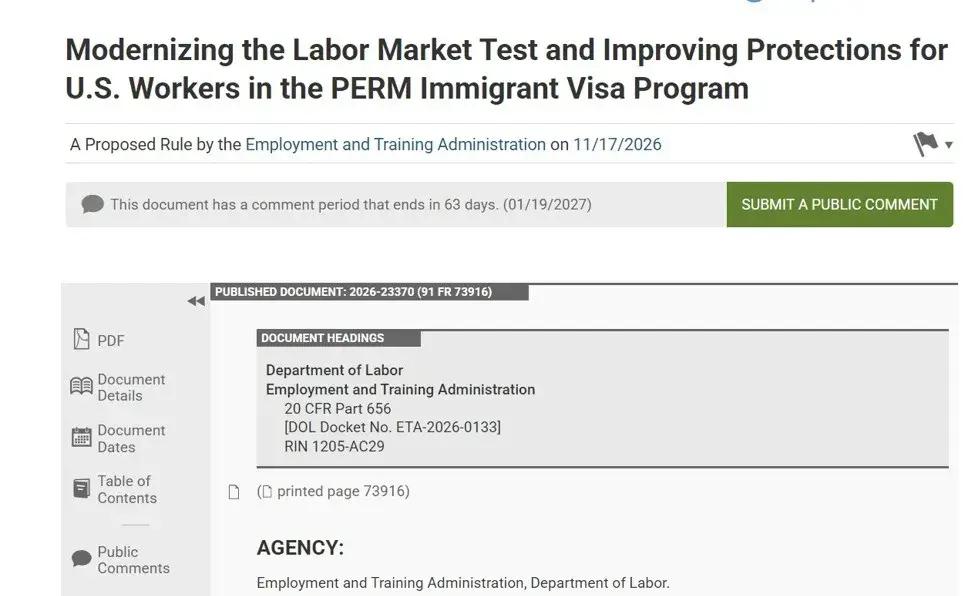
(Source: Screenshot from the U.S. Federal Register)
WorldWay reminds that while the proposal has not yet taken effect, the signal is clear: in the context of continuous adjustments to U.S. immigration policy, securing U.S. legal status requires advance planning and multi-pathway strategies, rather than passively relying on a single channel.
PERM (Program Electronic Review Management), the U.S. electronic labor certification management system, officially came into effect on March 28, 2005. It serves as the prerequisite stage for U.S. employment-based immigration categories EB-2 and EB-3. Employers must first demonstrate to the Department of Labor that "there are no qualified and willing U.S. workers available" before they can file an immigration petition for a foreign employee, and they must certify that the hiring will not adversely affect the wages and working conditions of similarly employed U.S. workers.
In other words, this system was never designed for foreign applicants from the outset—it is an "examination" oriented toward the U.S. labor market, where the employer is the test-taker, and the foreign worker is merely the beneficiary of the test results.
1. Extended timeline: The recruitment test must last at least 90 days and be completed within 30 to 60 days prior to filing; with the recruitment report required upon filing, preliminary preparation alone could take several additional months;
2. Higher barrier: The two-year layoff restriction (the current rule only looks back 6 months) means companies that recently conducted layoffs, such as in the tech industry, may temporarily lose sponsorship eligibility, prompting employers to reconsider their willingness and costs to cooperate;
3. Exemption eliminated: Occupations long exempt from PERM, such as nurses and physical therapists, will also have to complete the full recruitment process, sharply increasing the pressure on relevant applicants;
4. Stricter oversight: Newspaper advertisements will transition to all-online recruitment, salary ranges must be disclosed in advertisements, audit authority will be expanded, and penalties for violations will extend to attorneys and agents.
For applicants, the takeaway is simple: The time costs and uncertainties of employer-sponsored green cards are rising simultaneously. For international students holding H-1B visas, the gap between "an employer willing to sponsor" and "sponsorship successfully accomplished" is widening.
Looking back at recent policy trends—H-1B lottery rule reforms, visa bulletin retrogression and fluctuations in employment-based immigration, and now the proposed PERM rule—they all point to one clear trend: employer-dependent pathways to remain in the U.S. are characterized by rapid rule changes, weak personal bargaining power, and numerous uncontrollable factors.
A mature planning mindset does not mean "betting everything" on a single path; rather, it involves securing a backup channel that relies neither on an employer nor on lottery luck alongside the primary route. Combining immigration tools is superseding the obsession with a single pathway.
The EB-5 Immigrant Investor Program is an employment-based immigration category that does not rely on employer sponsorship and does not involve a lottery. In the context of the continued tightening of employer-sponsored channels, EB-5 investment immigration has become an alternative route worthy of serious evaluation. Under the new statutory framework, several features of EB-5 are worth noting:
1. Reserved visa categories: The law reserves approximately 32% of visas annually for rural areas, high-unemployment areas, and infrastructure projects. To date, these three categories remain "Current" (no visa backlog) for applicants born in mainland China, in sharp contrast to the multi-year backlogs typical of EB-2/EB-3;
2. "Concurrent Filing" mechanism: Applicants physically present in the U.S. in lawful status can concurrently file the I-526E immigrant petition and the I-485 adjustment of status application. Eligible applicants can obtain an Employment Authorization Document (EAD) and Advance Parole (combo card) within a few months to legally work and live in the U.S., without having to rely on H-1B as their sole "lifeline";
3. One application for the whole family: Spouses and unmarried children under 21 can obtain green cards concurrently, and children can qualify for in-state tuition. The application has no requirements for language, education, or business experience; the core thresholds are the investment capital (starting at $800,000 in TEA areas) and complete documentation verifying the lawful source of funds.
Simply put, as employer-sponsored timelines stretch longer, EB-5 provides a parallel solution of "securing legal status first while advancing the investment on schedule." This is precisely why many international student families have incorporated it into their "status portfolio" in recent years.
⚠ Please note that according to the automatic inflation adjustment mechanism under the EB-5 Reform and Integrity Act (RIA), starting January 1, 2027, the minimum investment threshold for EB-5 Targeted Employment Areas (TEA) is expected to increase from the current $800,000 to $900,000. The final amount is subject to official publication in the Federal Register by USCIS.
Policy winds may shift again: proposed rules can be revised, postponed, or even withdrawn. Experience over the past several years shows that U.S. immigration policy is never static. From H-1B lottery reforms to PERM recruitment restructuring, from OPT fee proposals to EB-5 Regional Center reauthorization, every juncture can rewrite the planning trajectory for families pursuing U.S. residency. Rather than waiting for policies to clarify before acting, it is better to complete arrangements before the variables arrive. The value of status planning lies in locking in your options before rules are set in stone.
For international students, professionals in the U.S., and families evaluating long-term plans to live in the U.S., instead of hastily reacting after rules take effect, it is better to assess three things early: residency goals, financial arrangements, and time windows—aligning all three aspects will open up broader possibilities.
If you would like to learn more about the latest U.S. immigration policy developments and compare different pathways, you are welcome to consult WorldWay consultants/client services for one-on-one professional advice, compliance assessments, and customized plan design, establishing your status strategy well before changes take place.