U.S. Four-Year Limit Rule for F-1 Visas Vacated

U.S. Four-Year Limit Rule for F-1 Visas Vacated

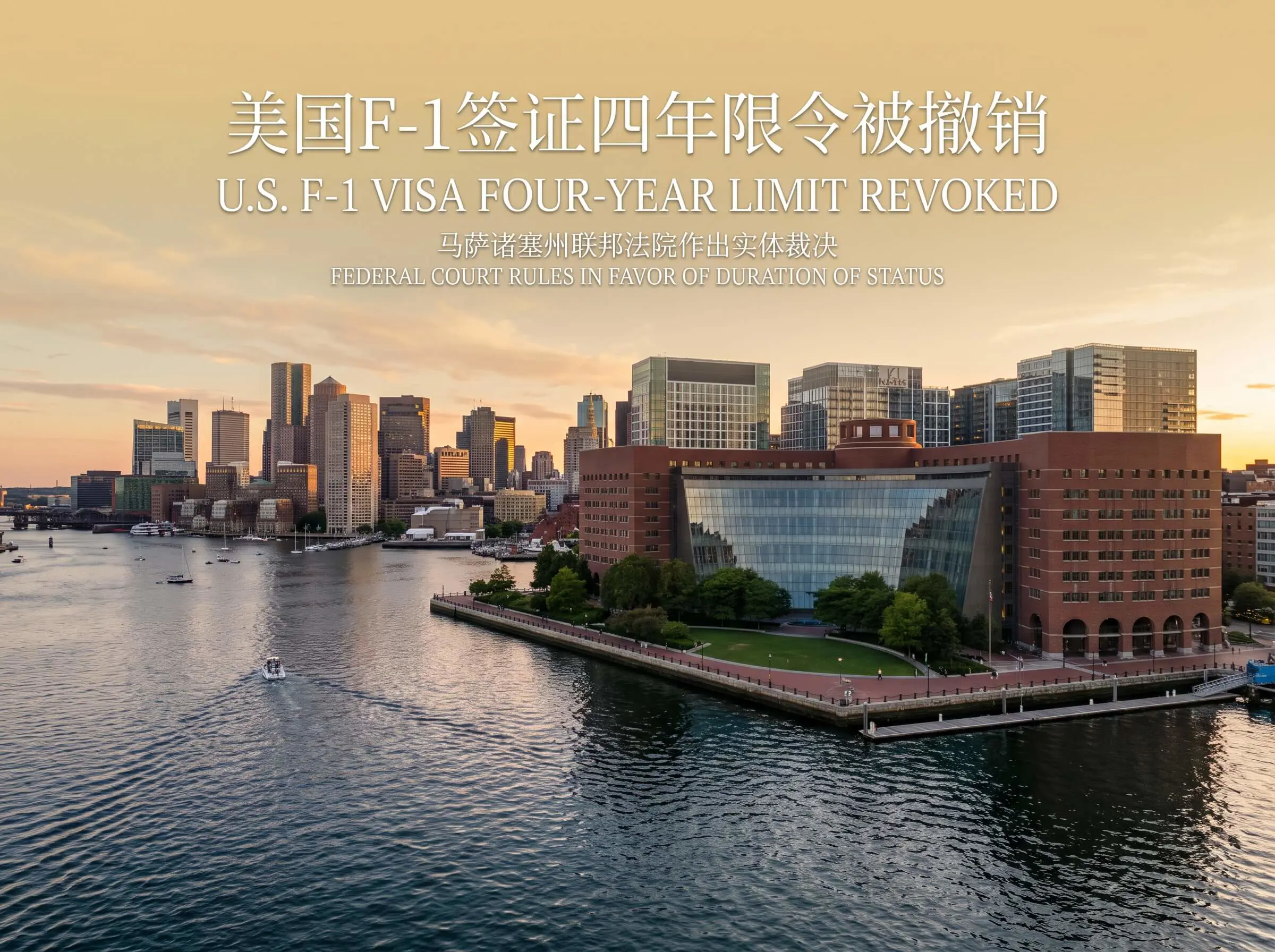
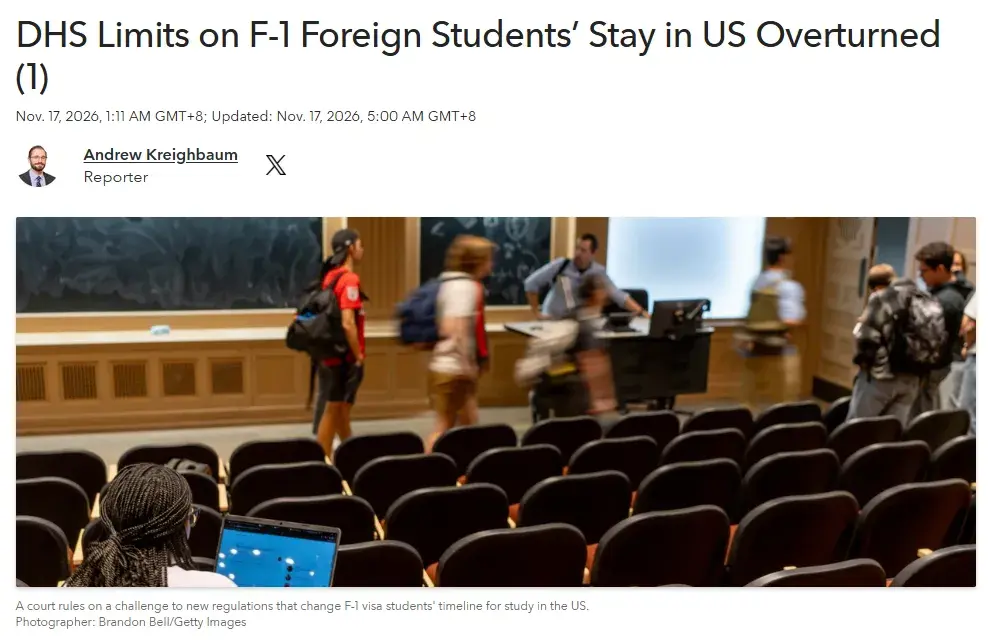
On November 16, 2026, Judge F. Dennis Saylor IV of the U.S. District Court for the District of Massachusetts issued a substantive ruling: the Department of Homeland Security's (DHS) proposed new rule replacing the "Duration of Status" (D/S) framework for international students with a fixed period of stay was determined to be "in excess of statutory authority" and "arbitrary and capricious," and was vacated.

世贸通移民847 reads

WorldWay · U.S. Immigration Policy Insights
 
On November 16, 2026, Judge F. Dennis Saylor IV of the U.S. District Court for the District of Massachusetts issued a substantive ruling: the Department of Homeland Security's (DHS) new fixed-period-of-stay rule, which was designed to replace the "Duration of Status" (D/S) system for international students, was struck down and vacated as being "in excess of statutory authority" and "arbitrary and capricious."
U.S. Four-Year Limit Rule for F-1 Visas Vacated
 
—— WorldWay Perspective ——
For more than one million international students in the United States, this represents an interim positive development—yet the policy pendulum has by no means stopped swinging. Rather, this serves as a wake-up call: the rules for staying in the United States are in constant flux, and those who can secure their plans in advance never rely on luck, but on retaining the power of choice in their own hands ahead of time.
IWhat the Ruling Means
The D/S system has been in effect since 1978: as long as a student maintains full-time enrollment and an active SEVIS record, they can legally reside in the United States until the completion of their studies without needing to apply for separate extensions of stay.
By contrast, the new DHS rule announced in 2025 and originally scheduled to take effect on September 15, 2026, sought to change the stay of F-1 students and J-1 exchange visitors to a fixed period—up to a maximum of 4 years for undergraduates, after which an application for an extension of stay would have to be submitted to USCIS, and under certain circumstances, changing majors or transferring schools would be prohibited.
▸ The Court Stated Two Core Reasons
① Excess of Authority The authority to set terms of admission belongs to Congress, and the DHS rule "conflicts with the congressional statutory scheme to encourage foreign students to study in the United States";
② Procedural Defects DHS failed to demonstrate how a fixed period would effectively prevent visa fraud, and failed to consider lower-cost alternatives such as technological enhancements to the SEVIS system, thereby rendering the rule "arbitrary and capricious" under the Administrative Procedure Act.
II"Vacatur" Does Not Mean "Finality"
It is worth noting that this litigation (Presidents' Alliance v. DHS) had previously undergone two legal battles: in September 2025, the court issued a nationwide preliminary injunction; DHS then proceeded with a final rule, which was halted again on the eve of taking effect, culminating in this substantive vacatur.
However, DHS can still appeal or re-draft the rule—in fact, a similar fixed-period proposal was introduced during the first Trump administration, and the 2018 version of the rule was ultimately withdrawn due to procedural issues.
The same issue cycling through legislative and judicial procedures repeatedly over four years illustrates precisely that policy volatility itself has become the norm.
IIIWhy Early Planning Matters: The "Fragility" of Non-Immigrant Status
For international student families, this legal victory is cause for celebration, but it is even more important to recognize a structural reality:
F-1, OPT, and H-1B are all non-immigrant statuses whose legality is perpetually tied to specific conditions like enrollment or employment. Once these conditions shift (graduation, unemployment, policy adjustments), the status immediately faces window pressure;
With every wave of policy oscillation, the greatest impact is felt by those who happen to be in a transition period: approaching graduation, awaiting the H-1B lottery, or around the expiration of OPT;
In contrast, employment-based immigration pathways (such as EB-5) lead to permanent resident status—once obtained, it is no longer dependent on academic progress or employer continuation, resulting in significantly lower vulnerability to specific policy changes.
Each pathway has its appropriate scenarios. The key is understanding the underlying logic of status planning: non-immigrant status addresses "immediate legality", while immigrant status addresses "long-term certainty". They address different natures of risk.
For families studying in the U.S. who seek "certainty," EB-5 warrants priority evaluation: it avoids the lottery game of chance associated with H-1B, is free from constraints tied to academic progress or employer continuation, and categories without visa backlogs currently permit concurrent filing of immigrant petitions and adjustment of status within the United States, allowing it to be initiated while still in school.
IVThe EB-5 Window: Time Is Cost
U.S. immigration policy has historically fluctuated with changes in administrations, and the frequency of rule adjustments for student visas and work visas has risen markedly in recent years. The value of planning lies not in predicting the next policy shift, but in preserving the power of choice for oneself.
If policy volatility proves the necessity of "acting early," the explicit calendar milestones currently in place for EB-5 turn "acting early" into a calculable figure:
Increase in Investment Threshold Pursuant to the EB-5 Reform and Integrity Act of 2022 (RIA), starting from January 1, 2027, the minimum investment amount will be automatically adjusted upward based on the CPI-U inflation index, and every five years thereafter. The current threshold for Targeted Employment Area (TEA) projects is USD 800,000, and is expected to rise to approximately USD 900,000 (subject to official announcement); this is a statutory adjustment that can only increase, not decrease;
Price Lock-In Rule The required investment amount is determined by the standard in effect on the date the I-526E is filed and remains locked for the entire case lifecycle—it recognizes the filing date, not the agreement signing date.
Prior to January 1, 2027 · I-526E Filing Window
Current TEA Threshold
USD 800k
→
Estimated Post-Increase
USD ≈900k
Completing the I-526E filing before January 1, 2027 locks in the current USD 800,000 threshold;
starting one step later could add approximately USD 100,000 just in principal.

( * Final figures are subject to official publication by USCIS in the Federal Register.)
◆ Conclusion ◆
The court vacated a new administrative rule, but it cannot vacate the policy cycle itself. From F-1 to a Green Card, the core of planning one's future in the United States has always centered on one word: "certainty." Non-immigrant status resolves immediate needs; the EB-5 Green Card provides long-term certainty. Right now, the countdown to the EB-5 investment threshold adjustment has already begun—rather than reacting passively to every rule change, it is far better to seize the open window and place EB-5 status planning at the very top of the study-abroad checklist. Certainty is always created through early planning.
U.S. Four-Year Limit Rule for F-1 Visas Vacated


Investment involves risks, the above information is for reference only

Custom Plan

One-on-one service from senior consultants

Your information is strictly protected

Further reading

Related questions

View All

What Are the Common Risks in the Immigration Process?

Common risks fall into four categories: policy change risk, processing time uncertainty risk, source of funds risk, and project developer/intermediary risk. Actionable steps to mitigate risks: select an institution whose legal entity can be verified, verify terms against official documents, prepare comprehensive proof of source of funds in advance, and clearly define service boundaries and fee structures in the contract. Tip: Risks can be reduced by choosing an established, reputable institution with 28 years of industry experience like WorldWay Immigration, verifying official documents, and properly preparing source of funds documentation.

Read the full answer General Updated

What Is the Minimum Investment Amount for U.S. EB-5?

The minimum investment amount for the U.S. EB-5 Targeted Employment Area (TEA) is $800,000, and $1.05 million for non-TEA. According to the relevant arrangements under the EB-5 Reform and Integrity Act of 2022, the minimum TEA investment amount is expected to be adjusted upward to the range of $900,000—$950,000 starting January 1, 2027 (Source: USCIS proposed adjustment criteria, subject to announcement by 2026). It is necessary to distinguish between the "investment amount" and the "total cost": the aforementioned amounts represent the principal investment itself; in addition, there are government filing fees, professional service fees, etc. The invested funds must remain "at risk" throughout the entire process, with no promised return, and no guarantee of principal preservation or profits. When selecting a Regional Center project, the public filing status such as the project sponsor's Form I-956F should also be verified. Compliance Notice: The investment amount is subject to the latest official USCIS policy and individual assessment.

Read the full answer United States Updated

Who is Eligible to Apply for the U.S. NIW National Interest Waiver?

NIW falls under the U.S. National Interest Waiver category, intended for individuals with advanced degrees or exceptional professional abilities who demonstrate the potential to contribute to the national interest of the United States. Assessment Note: Applicability depends on the applicant's background and supporting evidentiary materials, subject to formal consultant evaluation.

Read the full answer United States Updated

Who is eligible for the EB-1A Alien of Extraordinary Ability immigration?

EB-1A is a U.S. Alien of Extraordinary Ability category intended for individuals with extraordinary ability in the fields of science, arts, education, business, or athletics. Assessment Note: Determining whether one meets the criteria for "Extraordinary Ability" depends on the evidence presented against the ten USCIS criteria and is subject to professional evaluation.

Read the full answer United States Updated

What are the basic requirements for applying for the U.S. EB-5 Immigrant Investor Program?

EB-5 is an immigrant investor program that requires meeting the corresponding investment amount (a minimum of US$800,000 for TEA and US$1.05 million for non-TEA, as of 2026, source: USCIS). Applicants must prove the lawful source of investment funds and create the required jobs (in accordance with USCIS regulations). Factual note: Complete application requirements are subject to official USCIS regulations and consultant evaluations.

Read the full answer United States Updated