Recently, Ivy League schools such as Princeton, Harvard, Yale, and Columbia have released their admission data for the Class of 2029. A clear trend has emerged: admission rates have slightly rebounded, and the proportion of international students remains stable or has even increased slightly, indicating that top U.S. universities continue to welcome outstanding students from around the world.
However, for many families, an Ivy League acceptance is only the first step; the real source of anxiety is whether their children will be able to stay and establish themselves in the future.

01
International Student Admissions
Opportunities Still Exist
• Stable proportion of international students: Despite policy pressures, the proportion of international students remains stable. The international student ratio is 14.1% at Princeton University, 15.8% at Harvard University, 10% at Yale University, and 16% at Columbia University. Renowned institutions continue to actively attract global talent.
• High academic requirements remain: The SAT/ACT ranges for admitted students remain at the top tier, with most class rankings in the top 10%. Strong academic performance combined with an impressive background remains the core competitive advantage.
• More friendly financial aid: With Princeton's "full coverage for families earning under $150,000," Harvard's "tuition-free for families earning under $100,000," and 54% of Columbia's freshmen receiving financial aid, Ivy League schools are expanding their assistance. For applicants from low-to-middle-income families, there is no need to give up on Ivy League schools due to "tuition concerns"; fully utilizing financial aid policies can significantly improve the cost-effectiveness of the application.
In other words, while admission is difficult, international students are not being excluded. The real challenge often arises after enrollment.

02
The Shared Anxiety of International Students
The Status Dilemma
Entering a prestigious school is just the beginning; to establish a foothold in the U.S. after graduation, one must face the issue of legal status.
• OPT is only a transition: F-1 students typically enter the workforce after graduation using OPT work authorization, but OPT is temporary. Especially for non-STEM majors, students may face the risk of it being shortened or even eliminated.
• H-1B is highly uncertain: The lottery is no longer just about "luck"; salary levels have become a key variable. The higher the salary, the greater the chance of being selected, leaving recent graduates and entry-level professionals with almost no opportunity. Employer scrutiny is becoming increasingly strict, and many companies simply prefer to hire locals directly. Even if an H-1B is obtained, it is only valid for 6 years, during which time one must pursue a Green Card, or risk being forced to leave the country. Furthermore, the H-1B application fee has skyrocketed by $100,000, which is no longer just a threshold, but a wall.
• Green Card backlogs are endless: Even for those who reach the H-1B stage, most have to wait 10 years or longer to obtain a Green Card, during which time any policy change could render their efforts futile.
This is the sense of powerlessness felt by many international students: despite having the ability, they are forced to leave simply because they lack status.
03
Status Is the True Foundation for Staying in the U.S.
——The Fast Track of EB-5
Compared to constant worry about visas and waiting for lottery results, a Green Card is the fundamental way to provide peace of mind for children and families. With a Green Card:
• You no longer rely on an employer; losing a job does not mean losing your status.
• You have better access to educational resources, with in-state tuition, scholarships, and financial aid fully available.
• You have the freedom to work or start a business; children can choose to develop in any industry or city.
• The whole family benefits, as parents and children can obtain status simultaneously.
And now, EB-5 investment immigration is facing unprecedented opportunities:
• Rapid Green Card acquisition: Under the new law, rural EB-5 projects are exempt from backlogs and enjoy priority processing.
• Concurrent filing: EB-5 applicants already in the U.S., including international students, can simultaneously file the I-526E immigrant petition and the I-485 adjustment of status application, allowing them to obtain a Combo card in about 3 months.
This means that while children are applying to Ivy League schools and planning their studies, families can also secure the certainty of their status in advance. Rather than pinning hopes on the luck of OPT or H-1B, it is better to seize the current policy window of EB-5 and firmly hold your status in your own hands.
In EB-5 investment, locking in a priority date as early as possible is the first step to success. Now is the golden period for immigrating to the U.S.; seize the opportunity and act quickly!
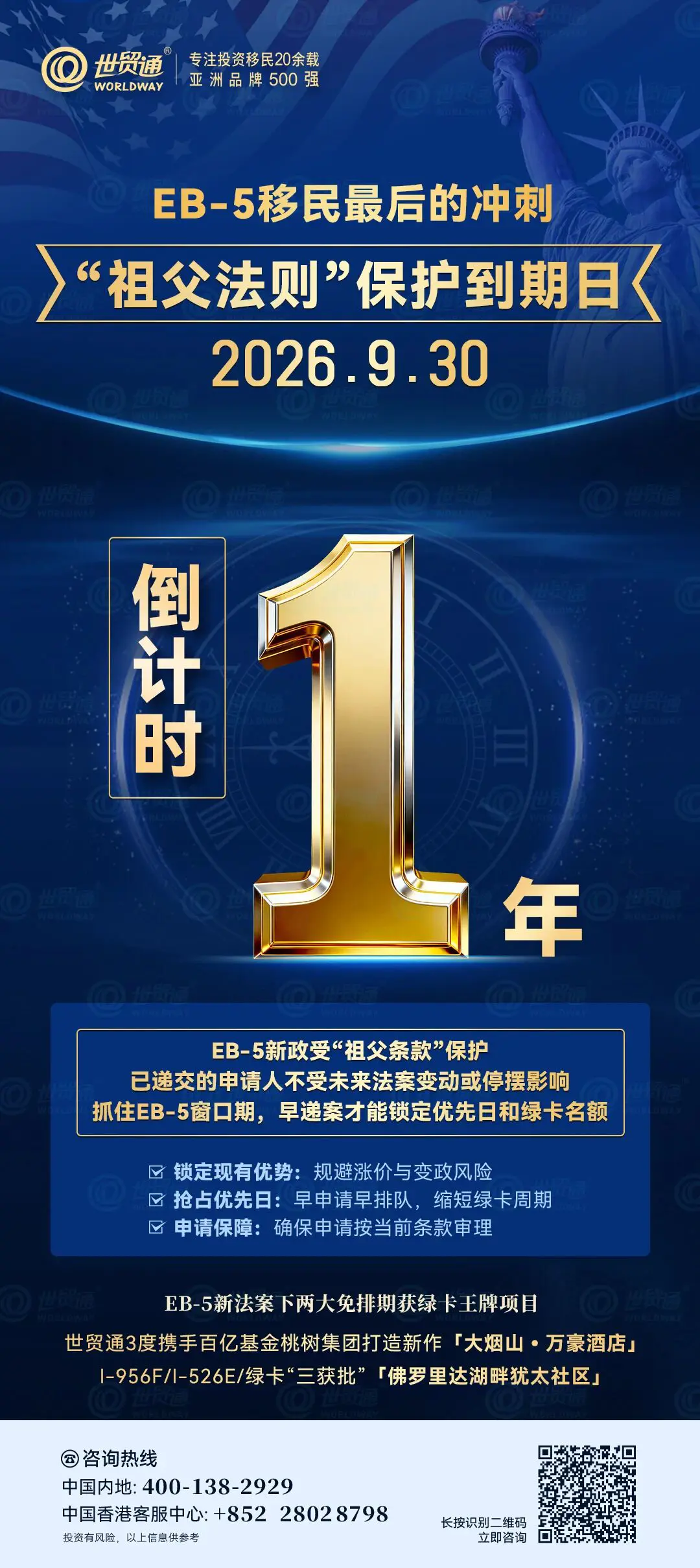
EB-5 "Grandfather Clause"
Entering the Final 1-Year Countdown
At the same time, the EB-5 grandfather clause has entered its final one-year countdown! The clause expires on September 30, 2026, which means the final window for investors to lock in policy protection has entered the sprint phase.


Trump's "Gold Card Immigration" Project
A New Pathway to U.S. Immigration
In addition to EB-5 investment immigration, another focal point of recent U.S. immigration policy is the "Gold Card Immigration" project. Worldway Group, in collaboration with two top U.S. law firms, proudly launches the Trump "Gold Card Immigration" project, which features five unique highlights: an investment amount similar to EB-5; no job creation requirement; a one-step process to a permanent Green Card; no need to worry about the expiration of the act or the grandfather clause; and sufficient visa quotas, up to 8.5 times the EB-5 quota.
Worldway has opened the pre-sale channel for the Trump "Gold Card Immigration" project. Register now to submit your application ahead of others. Once the project launches, we will help you secure your submission spot first, putting you one step ahead in obtaining a U.S. Green Card.
For inquiries in Mainland China: 400-138-2929, Hong Kong Customer Service Center: (852)2802 8798