U.S. Immigration Life • WorldWay Insights
Which American city is best for work? The answer is: Boston.
In the past, when mentioning U.S. job opportunities, many first thought of major cities like Silicon Valley, San Francisco, and New York. However, the "Best Cities for Work 2026" ranking released by the global job platform Indeed presents a different answer: the Boston-Cambridge-Newton metropolitan area ranks No. 1 in the U.S., surpassing traditional popular job hubs to become the best-performing U.S. metropolitan area overall for employment in 2026.
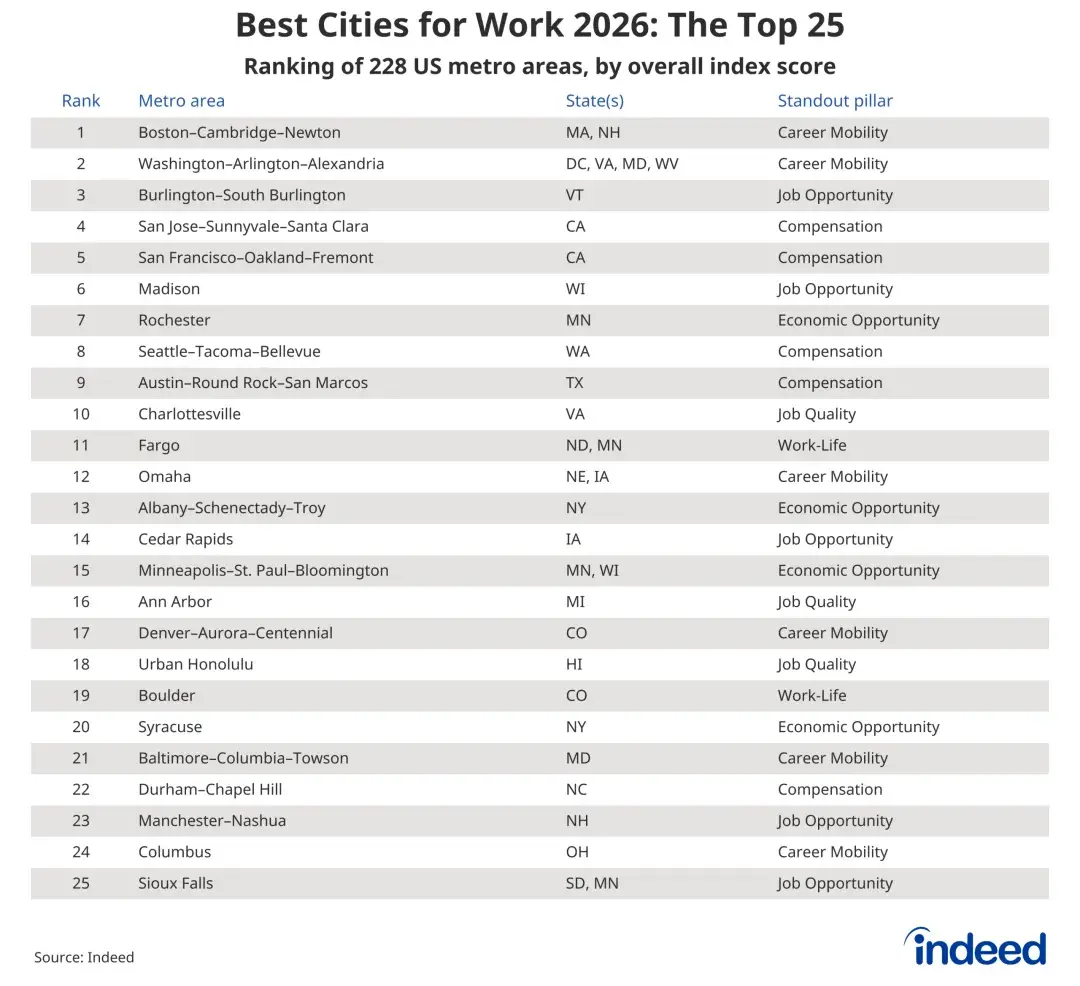
WorldWay Immigration has noted that this ranking not only reflects Boston's competitiveness in the job market, but also draws renewed attention to this city with its deep educational and scientific research heritage.
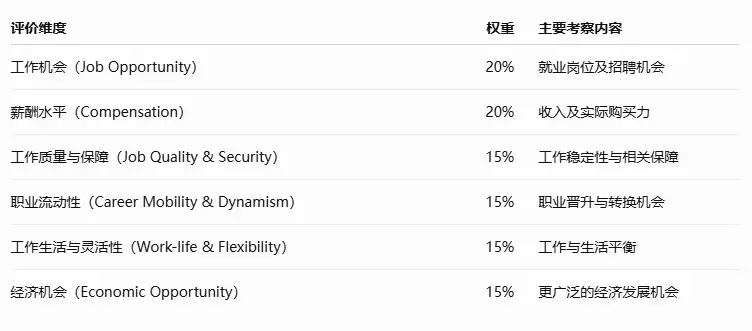
This ranking covered 228 metropolitan areas across the U.S. with populations exceeding 200,000, utilizing 40 specific metrics to comprehensively evaluate cities' job environments across six key dimensions.
Unlike traditional city rankings that focus on economic scale, corporate growth, or commercial investment, this list pays more attention to the actual experience of job seekers: whether they can find a job, earn a competitive income, achieve career advancement, and balance work and life.
Looking at the rankings, Boston comes in first, Washington ranks second, Burlington third, while traditional tech employment hubs San Jose and San Francisco rank fourth and fifth, respectively. Notably, New York ranked only 55th this time, failing to enter the top 25. This also demonstrates that a city's brand recognition and economic scale do not entirely equate to the overall employment value job seekers can obtain.
OVERALL RANKING TOP 5
01 Boston-Cambridge-Newton
02 Washington
03 Burlington
04 San Jose
05 San Francisco
The ranking uses six key dimensions and 40 specific metrics to generate comprehensive scores, with the following weightings:
The sub-rankings for the Boston-Cambridge-Newton metropolitan area are as follows:
Among them, ranking 2nd in the nation for career mobility is Boston's most prominent advantage. This metric reflects not only whether one can land their first job, but also future opportunities to switch roles, seek career promotions, and expand developmental space through professional capability enhancement.
At the same time, ranking 6th for compensation, 7th for job quality and security, and 5th for economic opportunity also demonstrates Boston's overall competitiveness in income, work environment, and economic development.
Data shows that Boston is not first in any single category, but it maintains a balanced performance across all six dimensions, ultimately earning the top overall spot. As Indeed noted regarding this ranking: "In a ranking that rewards well-rounded performance, the most balanced city wins."
Boston's ability to achieve such an outstanding overall ranking is inseparable from its mature local industrial base and rich educational and research resources. According to the Indeed report, key local industries include healthcare, biotechnology and life sciences, higher education, and technology and professional services.
1. Healthcare Industry: Outstanding Healthcare Resources and Scientific Research Strength
Mass General Brigham is a key healthcare and research institution in Boston, covering clinical care, medical research, and specialized medical services, providing diverse healthcare and research positions for the local area.
2. Biotechnology and Life Sciences: A Cluster of Innovative Enterprises
Boston and the neighboring Cambridge area form an important U.S. biotechnology and life sciences industry cluster, bringing together a vast number of biopharmaceutical companies and scientific research institutions involved in drug R&D, biomedicine, and gene technology.
3. Higher Education: Home to World-Famous Universities
Harvard University and the Massachusetts Institute of Technology (MIT) are the most iconic world-class universities in the Boston area. They hold profound strength in medicine, business, humanities, social sciences, science, engineering, and artificial intelligence, providing vital support for local research innovation and talent cultivation.
4. Technology and Professional Services: A Gathering of Major Enterprises and Professional Institutions
Fidelity Investments is a well-known U.S. financial services and investment management institution and a major employer in Boston. In addition, the region brings together tech companies, financial institutions, and professional services firms, offering employment opportunities across multiple fields such as finance, software development, data analytics, and corporate consulting.
The mutual support among diverse industries, combined with abundant higher education and research resources, forms a crucial foundation for Boston to continuously attract talent and maintain career vitality.
Boston's top rank this time has also drawn attention to the performance of the traditional high-paying employment center, the Bay Area. San Jose ranked 1st in the nation for compensation and San Francisco ranked 4th, yet the overall rankings for both fell short of Boston's.
This reflects an underlying reality: income level is one thing, but how much actual lifestyle value that income ultimately translates to is another.
This ranking also reflects a shift in the U.S. job market: job seekers' evaluation criteria are shifting from solely pursuing high salaries to focusing more on actual purchasing power, career development, and quality of life. There are two notable reasons behind this.
1. Shift in Job Seeker Mindset: High Salary Is No Longer the Sole Standard
In the past, Silicon Valley and San Francisco attracted numerous job seekers thanks to their tech industry and high-paying jobs. However, as housing, taxes, and daily living costs receive closer scrutiny, people are starting to re-evaluate the true value of their income.
For example, an annual salary of $150,000 in San Francisco may not necessarily yield a higher quality of life than $120,000 in Boston. After deducting rent, taxes, and daily expenses, actual disposable income can yield very different outcomes.
2. Growth of Remote Work: Greater Flexibility in Job Location Selection
The growth of remote and hybrid work models has, to some extent, broken down the constraints between work location and corporate headquarters. Some companies allow employees to work remotely in compliance with company policies, enabling job seekers to choose work locations based on a combination of pay levels, cost of living, and personal needs.
For families planning to study, work, and develop long-term in the U.S., Boston offers rich university resources and diverse career development opportunities. However, from studying abroad to graduation, job hunting, and long-term living in the United States, immigration status planning is equally an essential step that cannot be overlooked.
For international students, career choices after graduation are often constrained by immigration status conditions, requiring careful consideration of requirements at different stages such as OPT, STEM OPT, and H-1B. Planning ahead for U.S. permanent resident status grants greater flexibility in future education, employment, and career advancement.
WorldWay Immigration Reminder
Choosing a city suitable for learning and development is a step toward planning your U.S. future; making long-term status arrangements in advance opens up more possibilities for education, career, and family life.