The 2025 U.S. undergraduate application season has seen a new trend of divergence in international student data:
Overall international applications fell year-on-year for the first time after years of remaining at high levels, but Chinese applicants bucked the trend and reclaimed the position as the largest source of students; international freshman applications to the University of California (UC) system increased significantly; meanwhile, there were slight fluctuations in the number of F-1 visas and SEVIS active students.
These seemingly scattered figures actually reveal a reality: "An increase in applicants does not mean that everyone will successfully obtain a visa and enter school." For Chinese families, this is not only about admission opportunities, but also about whether their children can start their studies in the United States smoothly and stably.
International applications decline, China grows against the trend
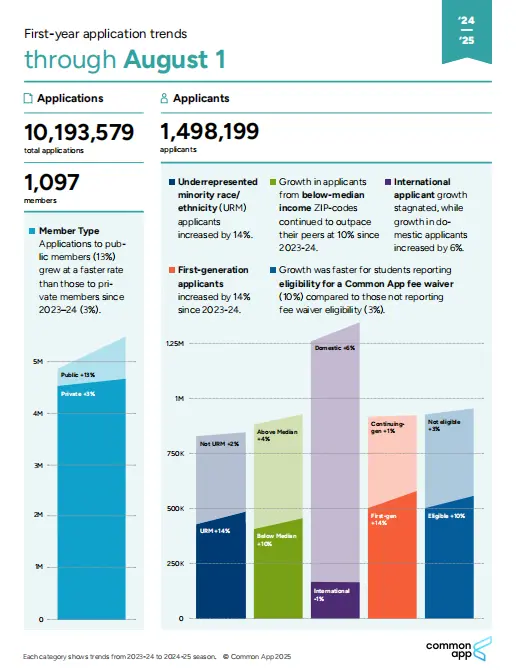
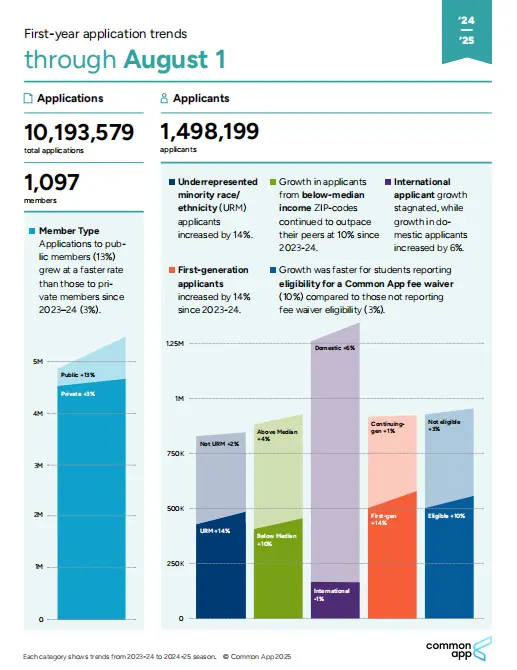
According to the end-of-season report for the 2024-25 academic year released by Common App:
• Total applications reached 10,193,579, a year-on-year increase of 8%;
• The total number of applicants was 1,498,199, a year-on-year increase of 5%;
• The number of international applicants decreased by 1%, the first decline since the 2019-20 academic year;
• However, Chinese applicants increased by 7% year-on-year, continuing to firmly occupy the position as the largest source of international applicants.
Against the backdrop of a contraction in the international total, the upward trend of Chinese applicants is particularly prominent.
University of California: International applications remain strong
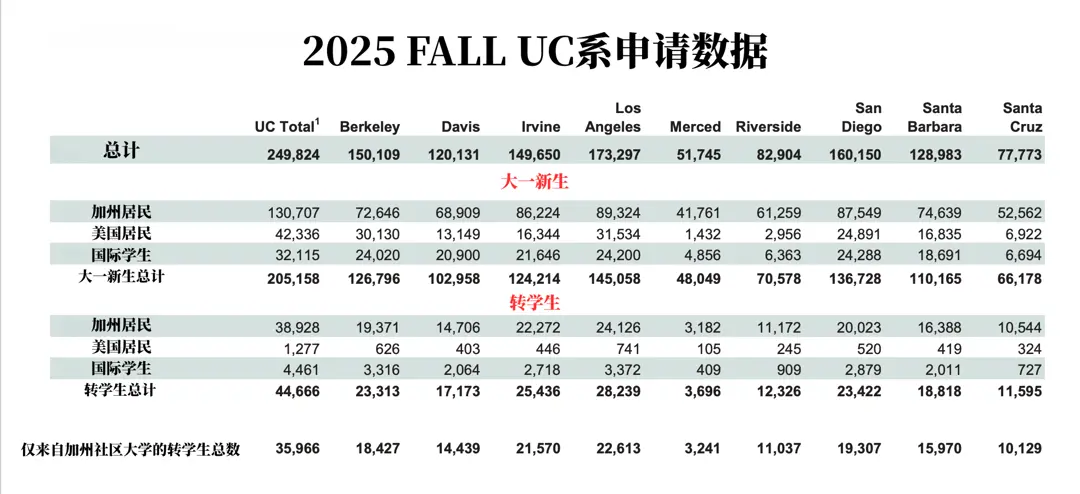
For the fall of 2025, there were a total of 249,824 applicants to all UC campuses, a decrease of approximately 0.5% compared to 2024.
However, international student applications bucked the trend and grew, reaching 32,115, an increase of 8.5%!
This means that while the overall numbers remained flat or slightly declined, international students brought growth to the UC system, and the opportunities for Chinese applicants have not narrowed, but rather expanded.
Visas and enrollment: Admission ≠ Enrollment
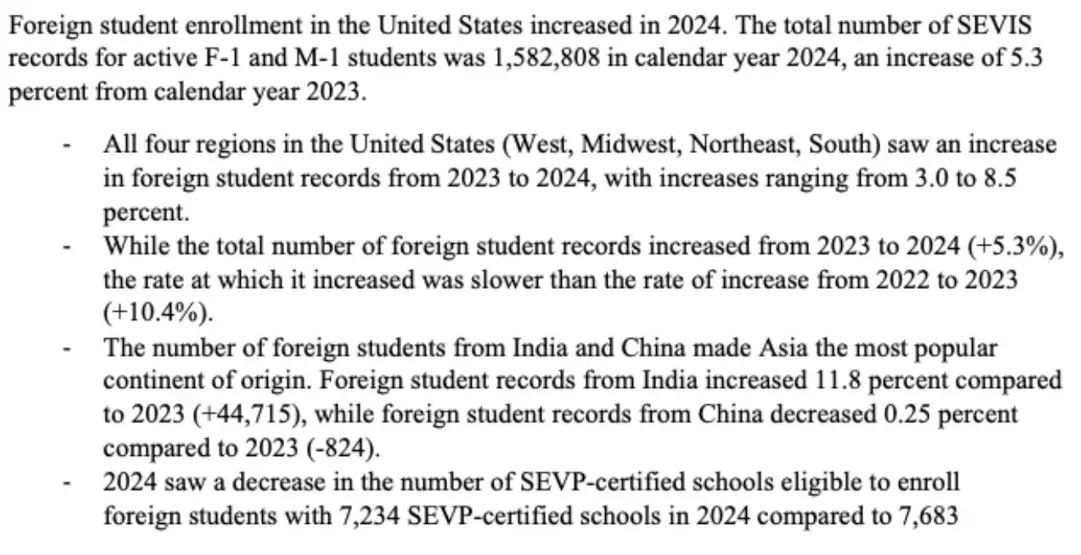
SEVIS: The total number of active students in 2024 was 1,582,808, a year-on-year increase of 5.3%, but the number of Chinese students decreased slightly by 0.25%, while the number of Indian students increased significantly by 11.8%.
F-1 Visa: Monthly data released by the Department of State showed that visa issuance declined for a period this summer, sparking concerns among some families about "whether they can enroll on time."
In other words, even if the application and admission are successful, whether one can successfully go to the U.S. to enroll depends on whether the visa and entry processes go smoothly.
Major selection:
STEM is popular, business is stable with new developments
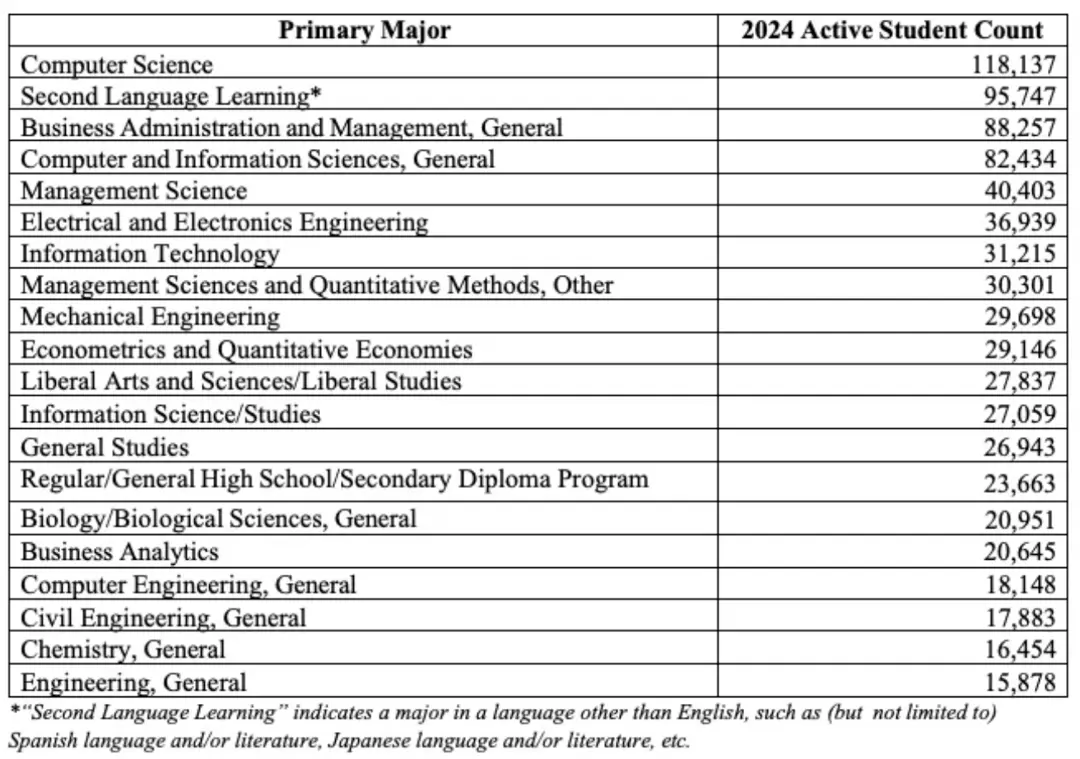
According to Open Doors data:
Chinese students are mainly concentrated in Mathematics and Computer Science (23%), Engineering (17%), and Business and Management (13%);
Computer Science leads the way, with the number of active students reaching 118,137, far exceeding other majors, making it the most concentrated field for Chinese students studying abroad;
Engineering is flourishing in many areas, with stable scale in electronics, electrical, mechanical, civil, and other directions;
Business is expanding from traditional management to interdisciplinary subjects such as Data Science, Quantitative Methods, and Business Analytics.
The overall trend is: STEM is highly popular with strong competition; business is stable with new developments, leaning more towards data and application orientation.
Beyond studying abroad:
EB-5 immigration provides another channel
When competition for study abroad applications intensifies and there is uncertainty in the visa process, more and more Chinese families are paying attention to EB-5 investment immigration — a secure path that balances education and status.
• No lottery required: Invest from $800,000 to get a green card for the whole family;
• Current no-visa-bulletin advantage: Rural projects have a 20% reserved quota and are currently in a no-visa-bulletin status;
• Concurrent filing: File the I-526E immigration petition and the I-485 adjustment of status application at the same time, and you can get a Combo card in about 3 months;
• Policy locking: Applications filed before September 30, 2026, are protected by the "grandfather clause" and are not affected by future policy changes.
For many Chinese families planning their children's education and family future, studying abroad and immigration are no longer an "either-or" choice, but two paths that can complement and guarantee each other.
New focus: Trump's "Gold Card Immigration" program
In addition to EB-5 investment immigration, another focus of U.S. immigration policy recently is the "Gold Card Immigration" program. WellTrend Group, in collaboration with two top U.S. law firms, has grandly launched the Trump "Gold Card Immigration" program, which has five unique highlights: investment amount similar to EB-5 investment; no job creation requirement; one-step permanent green card; no need to worry about the expiration of the bill or the grandfather clause; and sufficient visa quotas, up to 8.5 times the EB-5 quota.
WellTrend has opened the pre-sale channel for the Trump "Gold Card Immigration" program. Register now to submit early. Once the project is launched, we will help you secure your submission quota in advance, allowing you to be one step ahead in obtaining a U.S. green card in the future.
The 2025 study abroad data clearly shows that the United States is still a popular choice, but competition and uncertainty coexist.
For forward-looking families, considering education planning and status planning simultaneously is the true long-term approach.
For detailed inquiries in mainland China: 400-138-2929, Hong Kong, China Customer Service Center: (852)2802 8798