





Tags
U.S. Visa
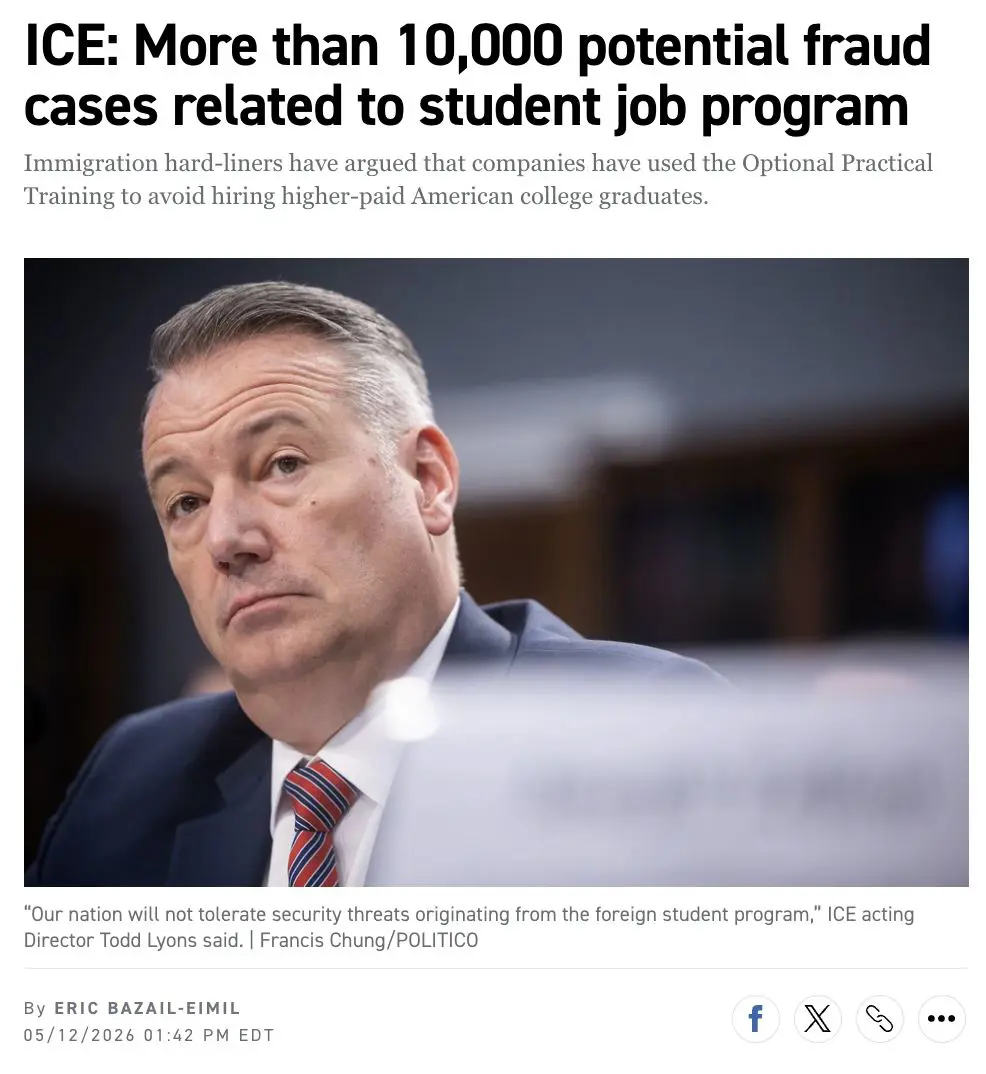
OPT Purge! The Path to Staying in the U.S. Changes
Recently, a piece of news has been circulating widely among international students in the United States. On May 12, local time, U.S. Immigration and Customs Enforcement (ICE) held a press conference to publicly call out issues such as fraudulent employment, shell companies, and employer affiliation within the OPT program. Acting ICE Director Todd M. Lyons stated that law enforcement agencies have identified over 10,000 foreign students associated with highly suspicious OPT employers, and this is only a portion of what has been investigated so far. This sends a very clear signal: the U.S. government is intensifying its scrutiny of international student status, the authenticity of OPT employment, and employer compliance.

How Can Applicants Break Through Under the "Zero Tolerance" Storm of U.S. Visa Violations?
Recently, the Trump administration proposed a policy called "Catch and Revoke." This policy was previously announced by Secretary of State Marco Rubio and implements the principle of "one violation results in visa cancellation," meaning that any foreign national holding a visa in the U.S., even for minor violations, may lose their immigration status.

Document Checklist for U.S. Tourist Visa Application
1. One color photograph (5.1cm x 5.1cm) with a white background taken within the last 6 months (write your name on the back of the photo with a pencil); 2. Applicants must not wear glasses or colored contact lenses in the photo, unless in special cases where the applicant provides medical documentation.
An Overview of Common Questions for the U.S. L-1 Visa Interview
Many overseas individuals believe that while the U.S. L-1 visa has a low threshold, the interview process is difficult. However, according to immigration experts, the L-1 visa has a high approval rate and the interview is not difficult. Understanding common visa interview questions in advance will help you obtain your visa more smoothly and arrive in the United States.
New 2019 Regulations for U.S. Visa Fees
The U.S. Department of Homeland Security has finalized an increase in the fees charged by the Student and Exchange Visitor Program (SEVP) to international students, exchange visitors, and certified institutions. These fees are primarily used for the operation of the SEVP, including online system maintenance, personnel salaries, and program improvements.
Are you aware of this detail in the new U.S. tourist visa policy?
If your passport has less than 6 months of validity, you may be denied entry to the United States and deported. Failure to understand this new U.S. tourist visa policy may result in deportation by U.S. Customs.
US University Graduate Salaries Revealed for the First Time! Private Institutions Perform Impressively
Worldway Group has learned that CNBC recently released its first-ever salary ranking for US university graduates. The rankings were compiled based on data for US undergraduate graduates from both private and public universities, including median salaries for 0-5 years of experience, salaries for 10+ years of experience, average early and mid-career salaries, and net costs during study. Notably, Stanford University and the University of Washington, Seattle...

U.S. Visa Analysis: What is an L-1A Visa? What is an EB-1C Visa?
What is an L-1A visa? What is an EB-1C visa? What is the relationship between the two? We also provide answers to some frequently asked questions to reveal how you can immigrate to the United States using an L-1A visa.
What is the U.S. Q-1 Cultural Exchange Visa? A Detailed Guide to Application Requirements
There are two types of non-immigrant exchange visitor visas in the United States: the J-category educational and cultural programs established by the Department of State, and the Q-category cultural exchange programs established by the U.S. Citizenship and Immigration Services (USCIS). Individuals wishing to participate in a U.S. cultural exchange program may apply for a Q-1 visa, which is designed to provide internship and employment opportunities for sharing the history, culture, and traditions of other countries with the United States.
What is the U.S. O-1 Non-immigrant Visa for Individuals with Extraordinary Ability? What are the application requirements?
The U.S. O-1 visa for individuals with extraordinary ability is intended for foreign nationals who possess extraordinary ability in the sciences, arts, education, business, or athletics, or who have demonstrated a record of extraordinary achievement in the motion picture or television industry. O visas are generally categorized as follows:
What is an L-1 Visa? What are the Requirements for a U.S. L-1 Visa Application?
The L-1A intracompany transferee executive or manager visa allows a U.S. employer to transfer an executive or manager from one of its affiliated foreign offices to one of its offices in the United States. This classification also enables a foreign company that does not yet have a U.S. office to send an executive or manager to the United States to establish one. The employer must file Form I-129 on behalf of the executive or manager employee and pay the filing fee.
Common Reasons for US Family Visit Visa Refusal
There are many reasons for the refusal of a US family visit visa. Consular officers will analyze and judge each applicant's specific situation by considering professional, social, cultural, and other factors. Therefore, the reasons for refusal may vary for each applicant. However, there are five common reasons for refusal, and you should be careful to avoid these pitfalls when applying for a visa.