





Recently, a piece of news has been circulating widely among international students in the United States. On May 12, local time, U.S. Immigration and Customs Enforcement (ICE) held a press conference to publicly call out issues such as fraudulent employment, shell companies, and employer affiliation within the OPT program. Acting ICE Director Todd M. Lyons stated that law enforcement agencies have identified over 10,000 foreign students associated with highly suspicious OPT employers, and this is only a portion of what has been investigated so far.
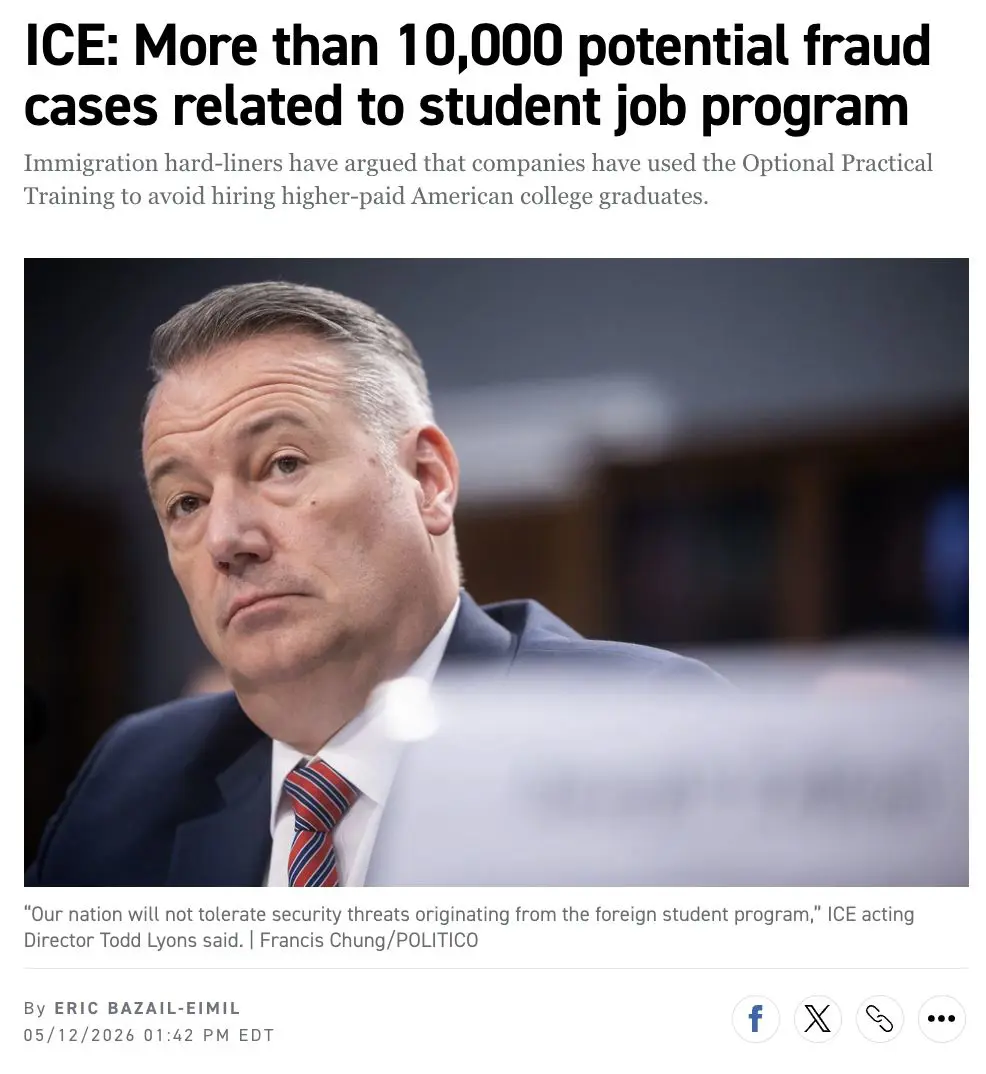
This sends a very clear signal: the U.S. government is intensifying its scrutiny of international student status, the authenticity of OPT employment, and employer compliance.

1. Why is OPT so important?
OPT, which stands for Optional Practical Training, is the primary way for F-1 international students to work legally in the United States after graduation. Simply put, it is a buffer period for international students to transition from "student status" to "work status."
• General majors can usually obtain 12 months of OPT;
• STEM majors, which include science, technology, engineering, and mathematics, can apply for an additional 24-month extension, for a total of up to 36 months.
For many international student families, the significance of OPT goes far beyond "post-graduation internship." It actually serves as the bridge between F-1 student status and the H-1B work visa. Especially for STEM students, a longer OPT period means more opportunities for the H-1B lottery and a longer buffer time to stay in the U.S.
However, precisely because OPT carries the function of "status transition," some non-compliant practices have begun to emerge. Today, the U.S. government's attitude toward this system is undergoing a significant change.
2. Shocking
OPT fraudulent employment exposed
According to disclosures by ICE, Homeland Security Investigations (HSI) has conducted on-site inspections of multiple "high-risk OPT employers," covering states such as Virginia, Texas, Georgia, Illinois, New York, New Jersey, North Carolina, and Florida. The inspections revealed that some OPT employers showed clear anomalies, with issues such as fraudulent employment, shell addresses, and nominal employees coming to the surface.
• Ghost Companies: Hundreds of students are registered as "working" at the same company, but there is almost no trace of real operations on-site.
• Shell Addresses: Vacant offices, locked storefronts, and private residences can all be packaged as a student's "work location."
• Abnormal Headcount: Some companies are very small in actual scale but have records for a large number of OPT students, which clearly does not conform to normal employment logic.
• Fraudulent Employment: Students do not actually work after obtaining their OPT EAD cards but maintain a superficial employment status through employers or intermediaries.
• Document Forgery: Materials such as the I-983 training plan and employment verification may just be paper documents created to maintain status.
• Cross-border Operations: The management and operations of some "companies" are even located entirely overseas.
3. Past OPT records
may also affect subsequent status applications
The truly alarming aspect of this incident is that OPT issues do not necessarily only affect current status. Even if a student has already transitioned to H-1B or is applying for a green card, USCIS may still look back and review past OPT records.
If there were anomalies in the employer, work address, job duties, or salary records at that time, it could be questioned again in subsequent applications, potentially triggering Requests for Evidence (RFE), Notices of Intent to Deny (NOID), and affecting H-1B extensions, status adjustments, or green card approvals. In other words, problems in any previous link could affect future applications.
Past "lucky compliance" may become a major risk point in future status reviews. In fact, it is not just OPT; compliance reviews for H-1B are also tightening simultaneously. Previously, the Texas Attorney General had launched investigations into nearly 30 companies, focusing on issues such as "ghost offices," fake positions, and the authenticity of sponsoring companies. (For details, please see previous reports by WorldWay: Warning for staying in the U.S.! H-1B strict crackdown on affiliation)
4. There are no shortcuts to staying in the U.S.; compliance is the bottom line
The signal released by this OPT review incident is very clear: the regulation of international student status in the U.S. is tightening, and the uncertainty of traditional paths to staying in the U.S. is rising.
With the tightening of OPT policies, fierce competition for H-1B, and the uncertainty of employer support, many families who hope for their children to stay in the U.S. long-term are turning their attention to more proactive status planning methods—EB-5 investment immigration, especially rural projects under the new law.
• No Backlog & Priority Processing: Under the new EB-5 law, rural reserved projects have more quotas, are currently without a backlog, and enjoy priority processing. The earlier you submit, the earlier you enter the processing queue.
• Concurrent Filing (I-526E + I-485): For applicants currently in the United States, they can file the I-485 adjustment of status application at the same time as submitting the I-526E immigration petition.
• EAD and Advance Parole: Quickly obtain a Combo card (EAD + Advance Parole) to enjoy green card benefits in advance, enabling legal work and free travel in and out of the country.
For international student families, the significance of EB-5 is not just applying for a green card, but establishing a relatively proactive and plannable long-term status path in advance.
WorldWay holds high-quality rural EB-5 projects with official I-956F approval—"North Carolina Sugar Mountain Hilton Hotel," helping investors seize policy dividends and realize their U.S. status planning.


For inquiries in mainland China: 400-138-2929, Hong Kong, China customer service center: (852)2802 8798