

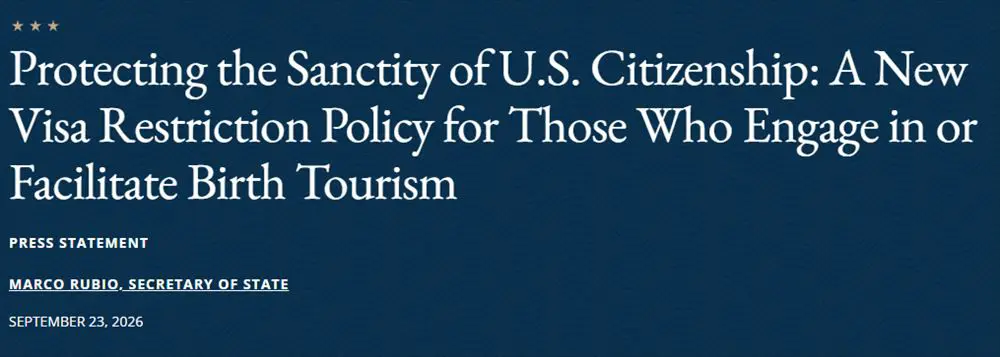
On September 23, 2026, local time, the U.S. Department of State announced a new visa restriction policy, imposing visa restrictions on individuals involved in or assisting with commercial "birth tourism" to the United States.
WorldWay Immigration noted that, unlike the more familiar visa and entry screenings for pregnant women in the past, this time the U.S. government has further expanded its focus to the commercial service chain behind "birth tourism" to the U.S.
I. Who exactly is targeted by the new policy?
U.S. Secretary of State Marco Rubio stated in a statement issued on September 23 that the new policy is implemented pursuant to Section 212(a)(3)(C) of the U.S. Immigration and Nationality Act, targeting individuals who knowingly engage in, have engaged in, or assist in commercial birth tourism activities in the United States.
According to the content released by the U.S. Department of State, the key categories of individuals involved include:
Category 1: Owners, operators, and managerial personnel of commercial U.S. birth tourism service networks.
Category 2: Intermediaries who assist applicants in obtaining U.S. visas through misrepresentation, concealing true travel purposes, or other fraudulent means.
Category 3: Personnel who participate in assisting relevant travel while knowing that the client's primary purpose for traveling to the U.S. is to give birth and secure U.S. citizenship for the child, as well as certain foreign healthcare providers involved in the fraudulent use of the U.S. Medicaid program (Medicaid).
In addition, other personnel who support, assist, or facilitate commercial birth tourism to the U.S. may also be included within the scope of restrictions.
The U.S. Department of State also stated that under specific circumstances, certain family members of individuals subject to visa restrictions may also be affected.
Therefore, what this policy truly targets is commercialized "birth tourism" as defined by the U.S. government, as well as the potential visa fraud, misrepresentation, abuse of public benefits, and related assistance activities involved therein.
The U.S. government stated that these measures aim to uphold the integrity of the U.S. citizenship system and prevent the abuse of immigration system and public benefit resources.
II. Regulatory enforcement on "birth tourism to the U.S." continues to escalate
This is not an isolated policy that suddenly emerged on September 23, 2026.
Looking at a broader timeline, the U.S. government's recent regulatory actions targeting "birth tourism to the U.S." have increased significantly.
On August 6, the White House issued an executive order titled "Ending Birth Tourism," which targets not only the individuals giving birth in the U.S. but also includes those who assist with such actions within the scope of the policy.
On August 12, the U.S. Department of State announced the establishment of a "Special Working Group to Stop Birth Tourism," aimed at investigating and prosecuting foreigners who travel specifically to the U.S. on visas to give birth in an attempt to acquire U.S. citizenship for their children.
On September 3, the U.S. Secretary of Homeland Security stated that the Department of Homeland Security is working with the Department of Justice and the Department of Health and Human Services to study new restrictions, including the possibility of restricting foreign travelers in late-stage pregnancy from entering the United States.
On September 23, the U.S. Department of State went a step further, explicitly extending visa restrictions to operators, managerial personnel, intermediaries, and other assisting personnel of birth tourism agencies. (Click to read WorldWay's previous report: Alarm Sounded on U.S. Residency Status! Birth Tourism Faces a New Round of Strict Scrutiny)
Judging from this series of changes, the regulatory focus of the United States on "birth tourism" is gradually expanding from simply examining individual visas and entry purposes to encompassing visas, entry, and the commercial service chains behind them.
III. What is truly increasing are the policy variables of "birth tourism to the U.S."
In the past, an important reason why many families considered birth tourism to the U.S. was the hope that their child would obtain U.S. citizenship upon birth.
However, from the recent series of policy changes, the variables facing this path are increasing noticeably.
On one hand, the U.S. government is continuously tightening visa and entry management regarding "birth tourism to the U.S."
On the other hand, changes at the policy and judicial levels regarding the scope of application for birthright citizenship itself are still ongoing.
This means that for families planning birth tourism or long-term plans in the U.S., there will be more variables to consider in the future than in the past. Whether visas can be approved, how entry will be screened, whether relevant service agencies face restrictions, and the determination of the child's status after birth may all be affected by policy shifts.
IV. The more policy variables there are, the earlier immigration planning should begin
The recent series of developments surrounding "birth tourism to the U.S." serves as another reminder to families with long-term U.S. needs:
Immigration planning should be built upon genuine, legal, and compliant grounds, as well as the long-term needs of the family. Given that policy variables exist, the earlier immigration planning is prepared, the more options and time are usually reserved.
If a family inherently has long-term plans for future living, education, work, or development in the U.S., rather than waiting for policies to change before seeking solutions, it is better to understand existing legal status pathways in the U.S. earlier and make advance arrangements based on their own conditions.
For families with corresponding financial qualifications and long-term plans for the U.S., EB-5 Investment Immigration is one of the legal immigration pathways that can be explored in advance. Aiming to obtain U.S. permanent resident status, eligible principal applicants can include their spouse and qualified children in the application, making long-term residency planning based on the overall needs of the family. It is worth noting that starting January 1, 2027, the minimum EB-5 investment amount will increase from USD 800,000 to USD 900,000 or higher.

As one of the Top 500 Asian Brands, WorldWay Group has focused on immigration for over 20 years. Starting from Hong Kong in 1998, rooted in Hong Kong for over two decades, it has established professional companies in both Hong Kong and Mainland China. Over the years, WorldWay has continuously monitored U.S. immigration policies and EB-5 project developments, providing status planning and project services for families with long-term plans for the U.S.

For detailed inquiries, Mainland China: 400-138-2929; Hong Kong, China Customer Service Center: (852)2802 8798