





H-1B-related policies are coming one after another.
In early August, news that the U.S. Department of Homeland Security (DHS) proposed to eliminate the "60-day grace period for unemployment" sparked widespread attention. Today, this proposal has completed review at the White House level, moving one step closer to the official publication of the proposed rule.
Meanwhile, another policy directly affecting H-1B families has re-entered the regulatory agenda—DHS plans to consider eliminating eligibility for certain H-4 spouses to apply for EAD work permits.
From the status buffer for H-1B holders following job loss to whether spouses can continue working, policy changes are extending beyond H-1B holders themselves to their entire families.


I. 60-Day Grace Period Proposal
Completes White House Review
On August 6, DHS submitted a proposed rule titled "Removal of Discretionary 60-Day Grace Period" to the White House Office of Information and Regulatory Affairs (OIRA) for review, under RIN 1615-AD22.
On August 27, the review was officially concluded with the result "Consistent with Change." This means the rule has completed the review process at the White House level, paving the way for the subsequent publication of the proposed rule and moving on to public comment and other stages.
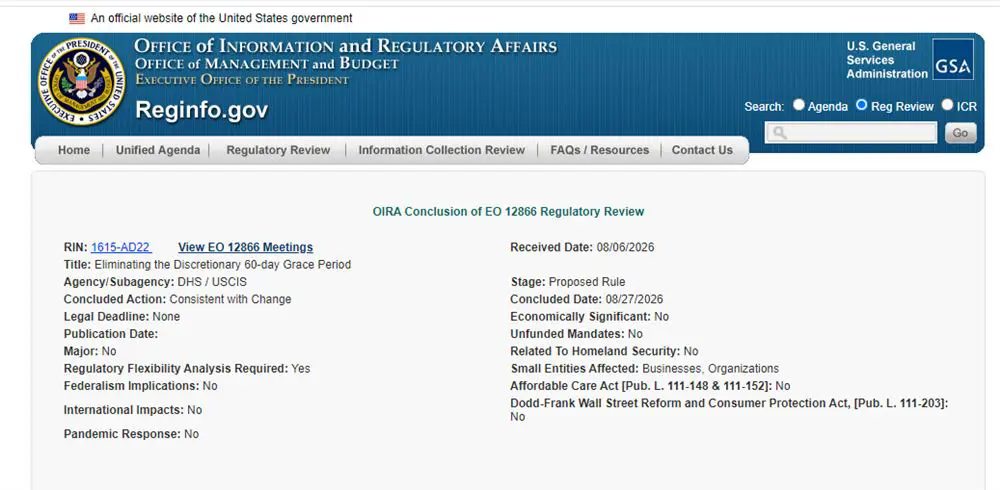
Currently, the full text of the rule has not been made public, and the final scope of adjustments, implementation timeline, and whether transitional arrangements will be provided still await subsequent official documents.
Under current regulations, certain nonimmigrant work statuses—including H-1B, L-1, O-1, E-1, E-2, E-3, H-1B1, and TN—can receive a discretionary grace period of up to 60 days following the termination of employment, allowing time to find a new employer, change status, or prepare for departure.
If this mechanism is tightened or eliminated in the future, the impact on H-1B holders will be very direct: upon losing employment, the buffer period used to find a new employer and manage immigration status may no longer exist, potentially resulting in the loss of lawful status.
As this proposal moves forward, H-1B families face another policy signal worthy of attention.
II. H-4 Spouse Work Permits
Brought Back to the Table
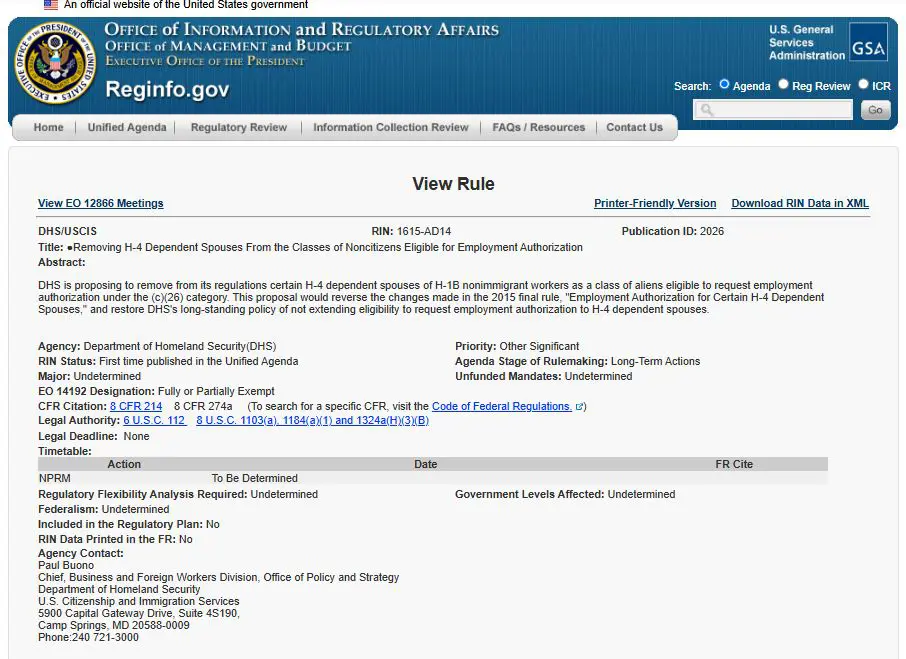
The latest U.S. 2026 Regulatory Agenda shows that DHS has added a new regulatory proposal to its schedule, designated as RIN 1615-AD14.
The core direction is clear: it proposes to eliminate eligibility for certain H-4 spouses to apply for Employment Authorization Documents (EAD), reversing the H-4 spouse work authorization policy introduced in 2015.
In 2015, DHS officially allowed certain H-4 spouses to apply for EAD work permits. This was not available to all H-4 visa holders, but primarily targeted H-1B families who had already entered the employment-based green card process—such as instances where the principal H-1B applicant holds an approved I-140 petition or qualifies for extensions under AC21.
For many families facing long green card retrogression, the practical importance of this policy is significant. While the principal H-1B applicant continues working and waiting for a green card, the spouse can maintain lawful employment with an H-4 EAD, avoiding long-term total reliance on the primary applicant's income while pursuing their own career development.
If this work authorization is indeed revoked in the future, the impact will be on the work eligibility of certain H-4 spouses, rather than on H-4 dependent status itself. In other words, eligible spouses may still lawfully reside in the U.S. under H-4 status, but could lose the ability to work independently.
It is worth noting that this is not the first time the Trump administration has sought to revoke H-4 work permits. During Trump's first term, DHS initiated an almost identical rulemaking process. In 2017, "Removing Eligibility for H-4 Spouses to Receive Employment Authorization" entered the U.S. regulatory agenda for the first time; from 2018 to 2020, the item was repeatedly listed under the proposed rule stage. However, a formal proposed rule text was never published, and it was ultimately withdrawn in August 2021.
Now, the Trump administration's restarting of this initiative effectively places the uncompleted reform direction from its first term back onto the regulatory agenda.
III. H-1B Policy Changes
Extending to More Areas
Looking at the recent series of policies together, H-1B-related adjustments are extending beyond the application stage to employment, status maintenance, and family arrangements.
Recently, the U.S. government has also been advancing several adjustments including H-1B fees, cap-exemption qualifications, employer compliance audits, and regulations on third-party placements. Combined with the 60-day unemployment grace period and H-4 spouse EADs, policy impacts are extending to various aspects of H-1B families.
For H-1B families, the considerations have become much more practical:
If employment is suddenly interrupted, how much time remains to address immigration status? Can the spouse continue working? To what extent do the family's status and income depend on a single job held by the principal H-1B holder?
The succession of policy moves sends a noteworthy signal: for families relying on work visas long-term to remain in the U.S., the variables surrounding status planning are increasing.

IV. Long-Term U.S. Residency
Taking a Step Ahead in Status Planning
If a family's long-term goal is clearly to reside and develop in the U.S., relying solely on a work visa path may expose them to greater uncertainty stemming from employment and policy changes.
For qualifying families, evaluating options aimed at permanent residency status in advance is advisable.
Taking EB-5 as an example, under the new law, the three reserved visa categories—rural, high unemployment, and infrastructure—all remain free of retrogression in the latest Visa Bulletin.Eligible applicants physically present in the U.S. with qualification for adjustment of status can also leverage the concurrent filing mechanism under the new law to submit I-526E and I-485 simultaneously.
After filing the I-485, eligible applicants can further apply for work permits and advance parole, providing greater flexibility for working in the U.S. and international travel.

With successive changes in H-1B policies, what deserves even greater attention is that the work visa system itself is undergoing continuous adjustments.
For families with clear long-term goals for living, working, or educating children in the U.S., evaluating work visa and permanent residency pathways together based on their specific situation can preserve an additional set of options for the future.
Currently, the minimum EB-5 investment amount remains $800,000. Starting January 1, 2027, the investment amount will increase to $900,000–$950,000 or higher. Meanwhile, the September 30, 2026 grandfathering clause deadline is also approaching.
Currently, WorldWay is highlighting the I-956F approved “Deer Valley · Snow Ridge Residences” EB-5 rural project, as well as the “Marriott · Royal Lake Bay Resort” EB-5 project launched in partnership with Peachtree Group for the fifth time, offering more project options for different families. From now until September 30, 2026, applying for EB-5 immigration qualifies for limited-time exclusive offers, further reducing processing costs during the current window.
WorldWay Immigration will also continue to monitor follow-up developments regarding the 60-day unemployment grace period, H-4 spouse EADs, and H-1B reforms, providing timely updates on the latest policy changes.


For detailed inquiries in Mainland China: 400-138-2929; Hong Kong SAR Customer Service Center: (852) 2802 8798