





Every autumn is the peak period for international students entering the United States for school.
For this fall's back-to-school season, in addition to preparing entry documents and procedures in advance, important changes have also arrived for F-1 student status management.
The U.S. Department of Homeland Security (DHS) recently released "First-Time Arrival: Key Information for New Students Traveling to the US" to provide entry guidelines for F and M visa students traveling to the U.S. for the first time. At the same time, rules related to F student status management have also undergone adjustments.
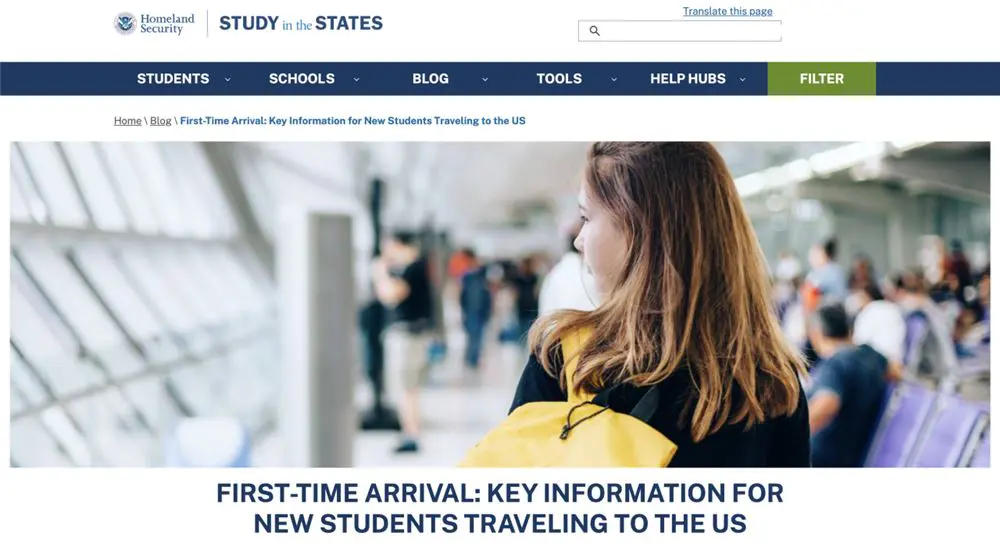

I. Traveling to the U.S. for the First Time
Three Categories of Documents Must Be Carried with You
According to the entry guidelines published by DHS, students traveling to the U.S. for the first time on an F or M visa can enter at the earliest 30 days before the course start date listed on their Form I-20.
Upon arrival in the United States, U.S. Customs and Border Protection (CBP) officers will conduct entry inspections, and students need to prepare:
• Valid Passport
• Valid F or M Student Visa
• Form I-20 Signed by the Student and the School
In addition, it is recommended to carry with you:
• School Admission Letter
• I-901 SEVIS Fee Payment Receipt
• Proof of Financial Support
• Name and Contact Information of Designated School Official (DSO) (Including Emergency/After-Hours Phone Number)
Please note in particular that the above documents must be placed in your carry-on luggage and not checked. Because checked baggage cannot be retrieved prior to completing entry inspection, failure to provide documents promptly in the event of an on-site check may affect your entry.
After successfully entering the country, students should also check their I-94 record in a timely manner to confirm whether their name, class of admission, and period of stay are accurate.
II. Secondary Inspection Does Not Mean Rejection
But Must Be Handled Promptly
If CBP cannot verify student information, or if documents are missing, secondary inspection may be arranged.
During this process, officers usually verify student status through the SEVIS system and may contact the school's DSO to confirm the situation.
If documentation is incomplete, CBP may deny entry or issue a Form I-515A notice.
Form I-515A lists the missing or required supplementary documents during the student status verification process and allows the student to stay temporarily within a specified timeframe. Upon receiving Form I-515A, the student must contact the school DSO promptly and submit the required documents to SEVP within 30 days.
Successfully completing entry is only the first step of studying in the U.S. After entering the United States, students must also continuously maintain their F-1 status to ensure that registration status, SEVIS records, and subsequent study arrangements comply with regulations.
III. F-1 Status Rule Adjustments
International Students Need to Pay Attention in Advance
This year, F student status management rules have also seen important changes.
According to the final rule published by the U.S. Department of Homeland Security, implementation is currently scheduled to begin on September 15, 2026.
Several changes are worthy of attention:
First, adjustment to the D/S system. In the past, as long as F-1 students maintained legal student status, their I-94 typically showed D/S (Duration of Status). Following the rule adjustment, students will be granted a fixed period of stay upon entry, with a specific expiration date displayed on the I-94, generally not exceeding 4 years maximum.
Second, shortening of the grace period after graduation. The departure preparation period after completing studies or related practical training will be adjusted from 60 days to 30 days.
Third, tightening of rules for school transfers and major changes. In the future, students changing schools, majors, and academic degree levels will face more restrictions and can no longer maintain student status long-term by frequently adjusting their study programs.
These changes also remind international students that they need to pay closer attention to status maintenance during their stay in the U.S. From entry and registration to internships and employment, every stage requires advance planning.
IV. Beyond Studying Abroad
Long-Term Status Planning Is Becoming Increasingly Important
For some families, the goal of studying in the U.S. is not merely to complete academic studies, but with the hope that their child can pursue further education, employment, and even long-term development in the U.S. in the future.
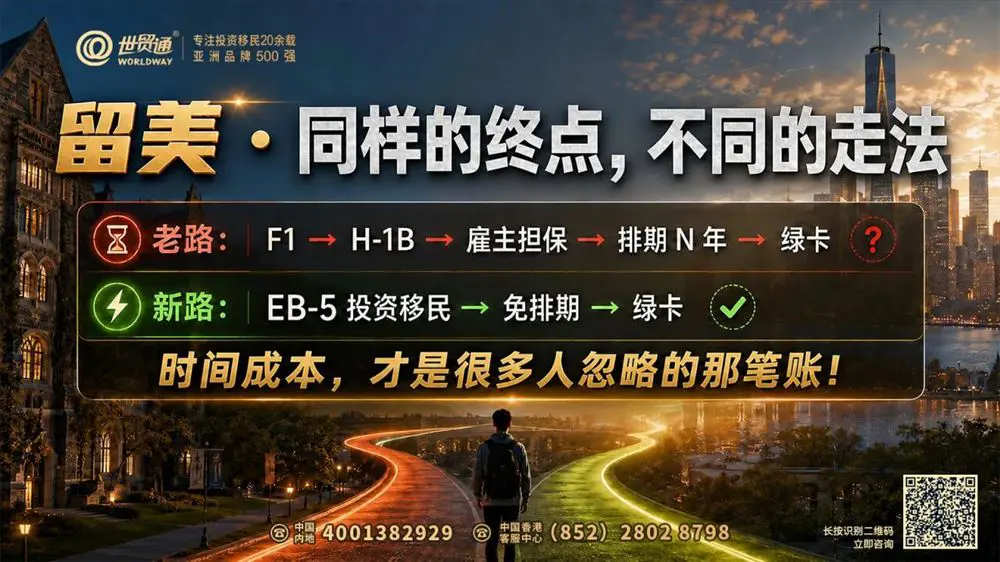
The traditional path usually involves transitioning through F-1, OPT, and subsequent work status conversions, with every step subject to policy, employer, and quota constraints.
If a family has clear goals and hopes for their child to study, work, and live in the U.S. over the long term, immigration status planning can be incorporated into the overall strategy at an earlier stage.
U.S. permanent resident status is not simply an add-on to studying abroad, but provides greater autonomy for future educational choices, career development, and family planning.

V. The EB-5 Window Is Approaching
Currently, the new EB-5 law remains an important pathway for families planning U.S. permanent resident status.
The policy allows applicants without visa retrogression who hold lawful status in the U.S. to concurrently file Form I-526E and Form I-485 to quickly obtain a Combo Card, achieving lawful residence and employment authorization.
At the same time, EB-5 currently faces two important timing milestones:
September 30, 2026: Grandfathering protection deadline. As long as an application is successfully submitted before this date, even if the Regional Center Act expires or major policy changes occur in the future, the applicant's case will still be adjudicated under the old rules.
January 1, 2027: Investment amount adjustment milestone. At that time, the minimum EB-5 investment amount will increase from the current $800,000 to $900,000-$950,000 or even higher.
From fall entry requirements to F-1 status rule changes, to future status planning, more and more families are beginning to realize that studying abroad is not only an educational choice, but also part of long-term development planning.
For families with clear intentions for their children to study, work, and live in the U.S. in the future, planning status in advance is not just about coping with a single policy change, but adding more options for their children's future development.
Currently, WorldWay is highlighting the I-956F approved “Deer Valley · Snowridge Residences” EB-5 Rural Project, as well as the “Marriott · Royal Lake Bay Resort” EB-5 Project launched for the fifth time in partnership with Peachtree Group, meeting the project selection needs of different families. From now until August 31, 2026, processing EB-5 immigration qualifies for limited-time exclusive discounts to advance U.S. status planning at a more favorable cost.


For detailed inquiries in Mainland China: 400-138-2929; Hong Kong, China Customer Service Center: (852)2802 8798