





H-1B's recent changes have been coming virtually wave after wave.
On August 24, 2026, local time, the U.S. Department of Homeland Security (DHS) submitted a proposed rule titled “Reform of the H-1B Nonimmigrant Visa Classification” to the White House Office of Management and Budget (OMB) for review.
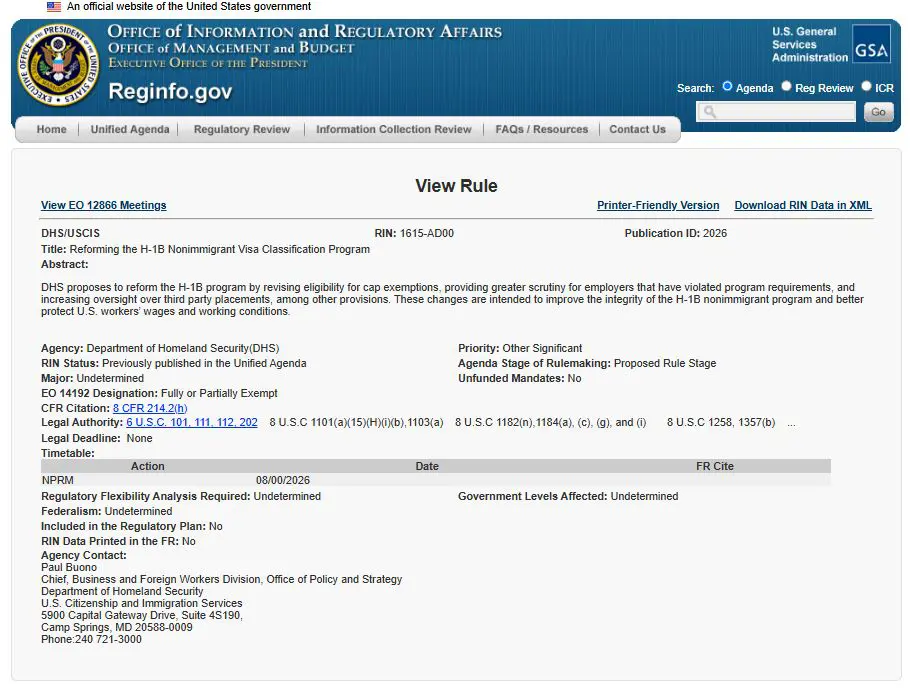
Currently, the rule is still in the proposed rulemaking stage; its full text has not yet been made public, nor has it taken effect. However, based on information disclosed in the Federal Regulatory Agenda, several key focuses of this reform have already surfaced.

I. Key Aspects of This Reform
Focusing Primarily on 3 Areas
1. Re-examining H-1B Cap Exemption Eligibility
Currently, the U.S. has an annual regular H-1B cap of 65,000, along with an additional 20,000 advanced degree exemptions for U.S. master's or higher graduates. Certain universities, affiliated non-profit entities, and research organizations may also qualify for annual cap exemptions.
In this proposal, DHS has suggested re-examining cap exemption eligibility. Whether the future scope of application and qualification criteria will be adjusted remains to be seen until the full proposed rule is published.
2. Strengthening Scrutiny of Non-compliant Employers
In fact, H-1B oversight has long extended beyond the petition materials themselves. The H-1B Modernization Rule that took effect in 2025 officially clarified USCIS's authority to conduct site visits, compliance reviews, and information verifications. Inspection locations may include not only the employer's offices but also third-party worksites where employees actually perform work. If an employer or third party refuses to cooperate, making it impossible for USCIS to verify case information, the relevant H-1B petition may even face denial or revocation.
The latest reform plan further proposes stricter scrutiny of employers with past program non-compliance. This means that an employer's own compliance record may become even more crucial during future H-1B adjudications.
3. Strengthening Oversight of Third-Party Placements
Third-party placements are common in industries such as IT consulting, outsourcing, and technical services: an employee's H-1B is petitioned by Company A, but the employee is actually assigned to work at Company B or a client site.
Existing rules already clarify that if an H-1B employee is placed with a third party and actually fills a position within the third-party organization, USCIS, when determining whether the position qualifies as a “specialty occupation,” will focus on the actual duties and requirements of the third-party position, rather than relying solely on the job requirements set by the petitioning employer.
Now, DHS has explicitly proposed further strengthening oversight of third-party placements. This means such cases may face stricter scrutiny regarding contracts, work locations, actual job duties, and employment relationships in the future.

II. From Cap to Employers
H-1B Is Undergoing a Systemic Overhaul
Looking at the recent series of policies together, one will find that changes to H-1B are actually broader than this single reform.
In January 2025, the H-1B Modernization Rule officially took effect, introducing adjustments to specialty occupation determinations, cap exemptions, third-party placements, and program compliance.
By FY2027, the H-1B cap selection mechanism will also undergo significant changes. The new rule will no longer use the previous equal-weighted selection process; instead, it will assign different weights based on wage levels—higher wage levels receive higher selection weighting—effective starting with the FY2027 registration season.
Entering August 2026, adjustments accelerated once again.
On August 25, DHS published another proposed rule, suggesting an additional fee of $103,265 for all cap-subject H-1B petitions, including the U.S. advanced degree exemption category. Currently, this fee proposal also remains in the proposed rulemaking stage.
Combined with this new round of reform submitted for White House review, from cap selection and petition costs to employer compliance and actual employment practices, H-1B is entering a much broader scope of adjustment.
III. Ongoing H-1B Adjustments
Long-Term Status Deserves Early Consideration
For individuals committed to staying in the United States long-term, what truly needs consideration is not just how the next H-1B policy might change, but whether a long-term status pathway independent of a single employer can be established in advance.
This is precisely where the value of EB-5 lies.
Currently, under the EB-5 Reform and Integrity Act, the three reserved visa categories—rural, high-unemployment area, and infrastructure projects—remain visa-backlog-free, with rural projects also benefiting from priority processing. For applicants already residing in the U.S. under valid nonimmigrant status (such as H-1B, L-1, F-1, etc.), when there is no visa backlog, concurrent filing of Form I-526E and Form I-485 is permitted, allowing them to quickly obtain an Employment Authorization Document (EAD) and Advance Parole (AP).

IV. The $800,000 Window Remains Open
Important Key Dates Are Approaching
Currently, the minimum investment amount for eligible TEA projects remains $800,000. Starting January 1, 2027, the minimum EB-5 investment amount will increase from $800,000 to $900,000–$950,000 or higher.
Meanwhile, the September 30, 2026 deadline for the grandfathering clause is also approaching.
For families who have decided to plan their U.S. residency status through EB-5, now is a critical stage to prepare project selection, funds, and application materials in advance.
As uncertainties around H-1B continue to increase, securing a long-term status plan early allows for greater initiative and control over future career and family arrangements.
Currently, WorldWay is highlighting the I-956F approved “Deer Valley · Snow Ridge Residences” EB-5 rural project, as well as the “Marriott · Imperial Lake Bay Resort” EB-5 project launched in partnership with Peachtree Group for the fifth time, offering diverse project choices for different families. From now until August 31, 2026, applying for EB-5 immigration qualifies for limited-time exclusive discounts, enabling you to advance your U.S. residency planning at a more optimized cost.


For inquiries in Mainland China: 400-138-2929; Hong Kong Customer Service Center: (852)2802 8798