





On local time August 24, 2026, the U.S. Student and Exchange Visitor Program (SEVP) issued the latest CPT guidance notice, further clarifying the applicable standards for F-1 international students applying for CPT (Curricular Practical Training).
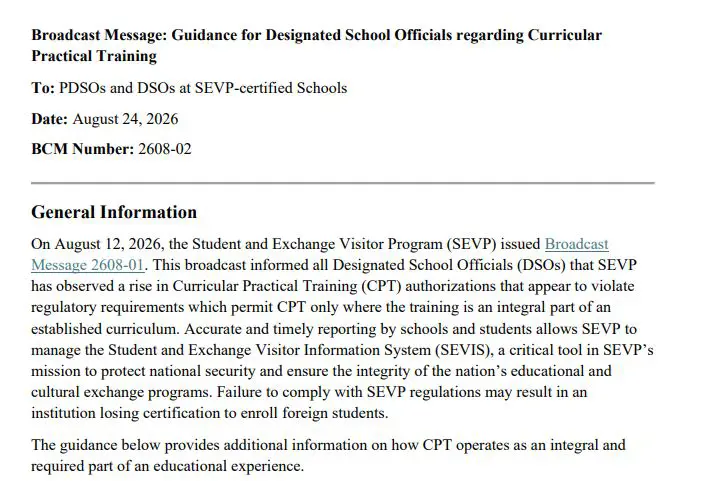
This is already the second notice issued by SEVP regarding CPT this month.
On August 12, SEVP reminded universities to strengthen CPT compliance reviews and warned institutions as well as all Designated School Officials (DSOs) across the United States not to use CPT to “create job opportunities” for students. (For details, see WorldWay's previous report: Sudden Change in CPT! Essential Red Lines for U.S. International Student Status)
The new notice on August 24 further explains what truly qualifies as practical training that is an “integral part” of the curriculum.

I. What Exactly Was Tightened Regarding CPT This Time?
The core message from SEVP this time is actually very simple:
CPT must be an integral part of an established curriculum and practical training that students must undertake to complete the program.
In the past, some schools allowed students to find an internship first and then enroll in an internship course to apply for CPT through that course. Going forward, this practice will face stricter scrutiny.
Because if a student can complete the curriculum normally and graduate without participating in the internship, it becomes difficult to prove that the practical training is an “essential” part of the curriculum.
In addition, if a program indeed includes practical training as a mandatory requirement, in principle, both international students and domestic U.S. students should participate, rather than setting it up solely for F-1 students requiring CPT.
When students apply for CPT, it still requires formal authorization from a DSO, and the internship content must be directly related to their major field of study.
As for Day-1 CPT, if the program itself cannot prove that practical training is mandatory for students starting from their very first semester, it will face greater scrutiny in the future.
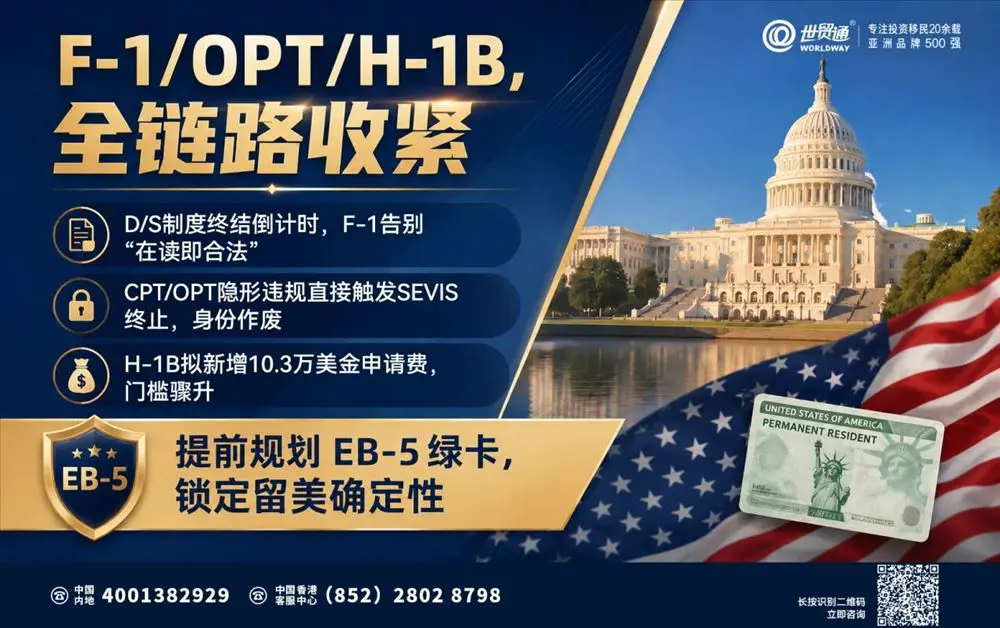
II. Pressure on the First Link:
Why Does CPT Directly Impact Employment in the U.S.?
For many international students hoping to work in the U.S. after graduation, immigration status and employment are often interconnected links:
① Internship via CPT during school → ② Receiving a return offer → ③ Formal employment via OPT after graduation → ④ Applying for H-1B
This chain is closely linked, and CPT happens to be at the very beginning—a crucial link.
When seeking employment in the U.S., an internship is often not just about adding work experience to a resume, but serves as an important gateway to full-time employment. Many students leverage upper-level or summer internships to gain local experience, connect with employers, and secure return offers upon graduation.
If CPT is restricted, off-campus internship opportunities for international students during their studies will decrease. Without this step, the difficulty of obtaining a return offer and smoothly transitioning into the workforce after graduation will increase accordingly.
The legal industry is a prime example. For international law students, summer law firm internships are a vital avenue for accumulating local U.S. experience and securing full-time job offers. If they cannot participate in such internships, entering the job market directly after graduation will put them at a greater competitive disadvantage compared to domestic students.
III. Why Are Internships
So Important for Employment in the U.S.?
Internships are an important gateway to full-time employment: U.S. employers—especially law firms, investment banks, consulting firms, and tech companies—commonly screen full-time candidates in advance through summer internships. For international students, internships are not only about gaining experience but are also directly tied to whether they can successfully enter full-time recruitment.
Harder to find a job without local experience: Lacking U.S. internship experience makes entering the full-time job market after graduation significantly more challenging. Given the current fierce job market competition, this impact is particularly pronounced for international students.
Work authorization is a practical barrier: F-1 students participating in off-campus internships must meet the relevant work authorization requirements. Once CPT becomes unavailable, off-campus internship opportunities for students will be significantly restricted, making it much harder to build local U.S. work experience in advance.
Therefore, the impact of CPT tightening is not simply “losing one internship experience,” but rather raising the barrier for international students transitioning from campus to the workforce.
When the first link becomes more difficult, subsequent steps—such as return offers, OPT employment, and even the transition to H-1B—will face increased uncertainty.

IV. Beyond the Chain:
Where Is the Path Forward as CPT Becomes Increasingly Difficult?
Tightening CPT does not mean there is no solution to staying and working in the U.S.
However, it serves as another reminder to families preparing for U.S. study: if the child's future goal extends beyond just “studying in the U.S.” to include post-graduation internships, employment, or long-term development, immigration status cannot be left unaddressed until after graduation.
Because in the traditional U.S. study-to-employment pathway, almost every step is tied to immigration status.
Internships rely on CPT, post-graduation work relies on OPT, and further down the line lies the H-1B.
If any link undergoes changes, subsequent plans may be affected.
WorldWay Immigration believes that for families with clear long-term goals for the U.S. and suitable financial conditions, exploring long-term residency pathways such as EB-5 in advance can provide more options for future study, career, and life planning.
Under the EB-5 Reform and Integrity Act, when there is no visa queue, applicants maintaining lawful status in the U.S. can concurrently file Form I-526E and Form I-485, commonly known as “concurrent filing”. At the same time, they can apply for an EAD work permit, allowing them to work in the U.S. upon approval without relying on CPT or OPT as the work authorization basis.
V. Two Key EB-5 Time Nodes
Worth Watching
First is the September 30, 2026 “grandfather clause” protection deadline. Qualifying regional center investor applications filed prior to this date will continue to be processed by USCIS even if the authorization for the regional center program expires in the future.
Second is January 1, 2027. Currently, the minimum EB-5 investment amount is $800,000. Starting January 1, 2027, the minimum EB-5 investment amount will rise to $900,000–$950,000 or even higher.
For families who already have long-term plans to move to the U.S. and pursue EB-5, the current lack of visa backlog, concurrent filing options, and these two key timelines are all worth evaluating in advance based on their individual circumstances.
Currently, WorldWay focuses on promoting the I-956F approved “Deer Valley · Ridge Residences” EB-5 rural project, as well as the “Marriott · Royal Lake Bay Resort” EB-5 project launched in partnership with Peachtree Group for the fifth time, helping families with U.S. immigration planning needs seize the current policy window.


For detailed inquiries, Mainland China: 400-138-2929; Hong Kong SAR, China Customer Service Center: (852)2802 8798