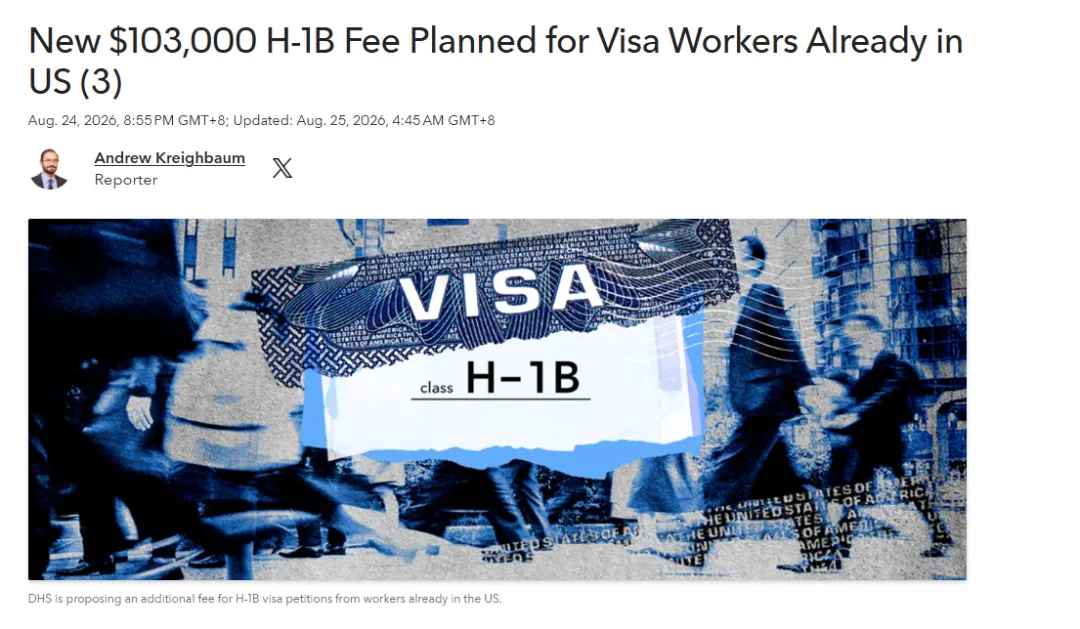
The application cost for H-1B visas may be set to rise significantly once again.
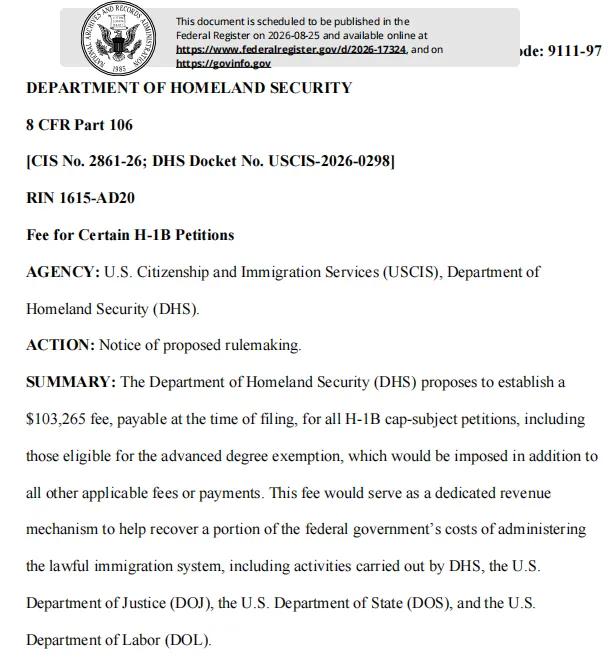
The U.S. Department of Homeland Security (DHS) has recently proposed a new rule planning to charge an additional fee of $103,265 for certain new H-1B applications.
Note that this does not mean increasing the original application fee to $100,000, but rather adding an additional fee of over $100,000 on top of all existing H-1B fees.
01
Which H-1B Applications
Might Face the Extra $103,000?
This fee is not targeted at all H-1B visas.
According to the proposal currently announced by DHS, it mainly targets new applications that are subject to the annual H-1B cap.
The U.S. typically allocates 85,000 H-1B cap numbers each year, of which:
65,000 are under the regular cap, and an additional 20,000 are reserved for eligible applicants holding a U.S. master's degree or higher.
In other words, the pathway familiar to many international students in the U.S.:
F-1 Study → OPT Employment → H-1B Cap Application
falls right into the scope that requires key attention.
What international students should pay attention to is that this new fee is not limited to H-1B workers recruited from abroad. Under the current proposed rule, any application subject to the annual H-1B cap for the first time could fall within the scope of this fee.
That is to say, if an F-1 international student works under OPT after graduation and subsequently applies for an H-1B for the first time, under the current proposal, they could also face this additional fee of $103,265.
However, standard extensions or employer changes after having already secured an H-1B cap number, as well as cap-exempt H-1B applications, are currently not the primary targets of this fee.
02
Why $103,265?
This number was not chosen at random.
According to the proposed rule released by DHS, this amount is tied to the volume of funds the government expects to raise through the fee. DHS estimates that the fee could generate approximately $8.777 billion in revenue annually. Based on the 85,000 annual H-1B cap numbers: $8.777 billion ÷ 85,000 ≈ $103,265. Therefore, $103,265 is actually the fee level calculated based on the estimated annual cost and the number of affected H-1B applications.
These funds will be used for U.S. immigration petition processing, fraud investigations, national security vetting, and immigration system operations.
Precisely due to the high amount and broad coverage of costs, whether this proposal will be smoothly implemented remains subject to considerable debate.
Because it is the employer that actually needs to bear this cost.
For large tech companies, $100,000 may simply represent an added labor cost; but for startups and small-to-medium enterprises, it could directly dictate a decision: should they still petition for an H-1B visa for this foreign employee?
03
Last Year's $100,000 Fee Was Halted;
This Time a Different Approach Is Taken
In fact, the Trump administration introduced a $100,000 H-1B fee last year.
However, in June of this year, a U.S. federal court ruled the fee unlawful, and the Trump administration is currently appealing the decision.
This time around, DHS took a different path by formally initiating administrative rulemaking rather than relying solely on a presidential proclamation.
Currently, this provision is merely a proposed rule and has not officially taken effect. Although the new rule may also face legal challenges, one cannot assume it will definitely not be implemented simply because last year's fee was blocked by the court.
Moving forward, the rule still needs to undergo public comment and final review; the specific fee amount, scope of applicability, and implementation timeline may all still be adjusted.
04
Uncertainty Surrounding H-1B
Continues to Grow
For international students in the U.S., what truly deserves attention is not just this $100,000 fee.
In the past, the pathway for many to stay in the U.S. was relatively clear:
F-1 → OPT → H-1B → Green Card.
Now, however, variables are constantly increasing—from the H-1B cap and application rules to employer costs. Even after graduating smoothly and securing a job, one still faces uncertainties like winning the H-1B lottery and whether the employer is willing to provide ongoing sponsorship.

For families clear about their intent to reside in the U.S. long-term, rather than betting their entire future on the H-1B visa, it is better to incorporate long-term status planning at an earlier stage.
Compared to temporary statuses that rely on schools, OPT, and employers, EB-5 investment immigration directly targets U.S. permanent residency, avoiding the H-1B lottery competition and removing dependence on a specific employer.
Currently, under the EB-5 Reform and Integrity Act, set-aside visa categories for rural areas, high-unemployment areas, and infrastructure projects remain visa-backlog-free. Rural projects also enjoy priority processing. For applicants already maintaining lawful status in the U.S. (such as H-1B, L-1, F-1, etc.), concurrent filing of Form I-526E and Form I-485 is allowed when there is no visa backlog, enabling them to quickly obtain an Employment Authorization Document (EAD) and Advance Parole (AP).

Meanwhile, the minimum investment threshold for current EB-5 projects remains at $800,000. It is worth noting that starting January 1, 2027, the minimum EB-5 investment amount will rise from $800,000 to $900,000–$950,000 or even higher. For families who have determined to plan their U.S. status through EB-5, the current $800,000 window is well worth seizing.
Currently, WorldWay is highlighting the I-956F approved "Deer Valley · Snowridge Residences" EB-5 rural project, as well as the "Marriott · Imperial Lake Bay Resort" EB-5 project launched in partnership with Peachtree Group for the fifth time, offering diverse project choices for different families. From now until August 31, 2026, clients applying for EB-5 immigration can enjoy limited-time exclusive offers to advance their U.S. status planning at a more optimized cost.
It is difficult to predict how H-1B policy will change, but with immigration planning, you can take control of your own initiative as much as possible.