



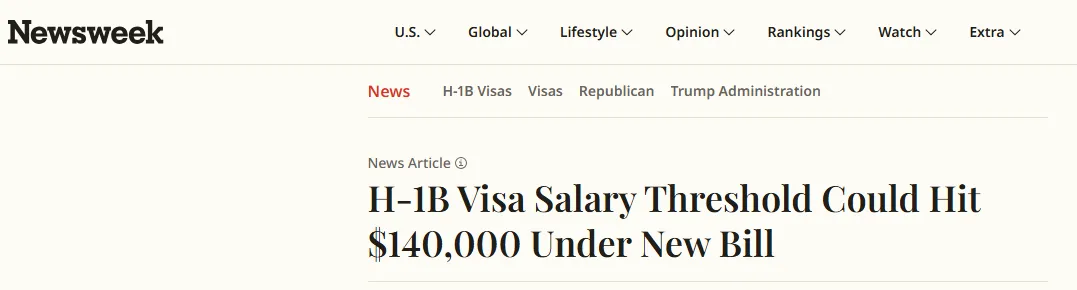
Recently, U.S. lawmakers introduced legislation aiming to raise the wage exemption threshold applicable to certain H-1B dependent employers from an annual salary of $60,000 to approximately $140,000. Meanwhile, tech company Cloudera reached a settlement with the U.S. government over recruitment compliance issues related to employer-sponsored Green Cards, resulting in a two-year ban from participating in the PERM labor certification program.
One is an H-1B rule adjustment still under legislative discussion, while the other represents an announced PERM enforcement action. These two developments reflect from different angles that the U.S. government is tightening its supervision over the employment of foreign workers and employer-sponsored immigration processes.
For individuals currently working in the U.S., planning to stay after graduation, or hoping to apply for a Green Card through employer sponsorship, these changes deserve close attention. Next, WorldWay Immigration will walk you through the details.

On September 30, 2026, U.S. Senator Jon Husted of Ohio introduced the Protect American Workers H-1B Modernization Act (S.5638). On October 13, Representative Glenn Grothman of Wisconsin introduced companion legislation, planning to adjust relevant provisions under the current H-1B system.
The focus of this proposal is to modify the wage exemption standards applicable to certain H-1B dependent employers.
Core Change: It proposes to replace the fixed threshold of $60,000 per year with a dynamic standard tied to the National Average Wage Index, which is currently estimated to be approximately $140,000.
So, what is an H-1B dependent employer?
Simply put, it refers to employers with a high proportion of H-1B employees that reaches statutory thresholds. For example, a business with 51 or more employees generally falls into this category if more than 15% of its workforce holds H-1B status.
Under current regulations, when hiring certain H-1B workers, such employers are subject to additional obligations to protect U.S. workers, including complying with specific recruitment requirements, as well as adherence to particular layoff restrictions and workplace rules.
However, exemptions may apply to certain employees who meet specific high-salary criteria or hold a master's or higher degree in a relevant field. The current $60,000 salary standard has remained unadjusted since its establishment in 1998, making it a primary target of this proposed amendment.
If the proposal is ultimately passed and takes effect, conditions for certain employers to qualify for relevant exemptions will change. In particular, businesses that rely on H-1B employees while offering relatively lower salaries may need to re-evaluate their recruitment and compliance arrangements. WorldWay will continue to monitor subsequent developments.
While the H-1B wage threshold adjustment remains a proposal, the Cloudera incident is an officially announced enforcement action.

On October 16, 2026, the U.S. Department of Justice and the Department of Labor announced that tech company Cloudera reached a settlement with the U.S. government regarding allegations of labor recruitment discrimination. According to information released by the Department of Justice, the company was accused of failing to provide qualified U.S. workers with fair application and competition opportunities during the recruitment process for employment-based immigration on behalf of foreign employees, involving seven positions.
The settlement includes several key measures:
Core Settlement Measures
PERM is a crucial step in many employer-sponsored employment-based immigration applications in the U.S. Under normal circumstances, an employer must complete mandatory recruitment procedures and demonstrate that no qualified, willing, and able U.S. workers are available for the position before proceeding with a PERM-based immigration application.
Once an employer is barred from participating in the PERM program, its ability to sponsor foreign employees for related Green Cards will be directly impacted.
This serves as a reminder to applicants: an employer's recruitment compliance status not only affects the enterprise itself but may also impact employees' long-term immigration plans.
Combining recent policy trends, it is evident that U.S. work visa and employment-based immigration applications involve multiple distinct review stages.
▎1. H-1B Application: Salary and Employer Compliance Requirements Warrant Attention
If the H-1B wage exemption proposal ultimately comes into effect, some employers relying on H-1B workers may face stricter recruitment obligations. For recent graduates, international students entering the workforce, and individuals planning to apply for H-1B visas through small and medium-sized enterprises or outsourcing firms, it will be necessary to pay closer attention to whether employers comply with relevant regulations in the future.
▎2. PERM Green Card: Employer's Ability to Sustain Applications Is Equally Important
For individuals relying on employer sponsorship for employment-based immigration, the PERM recruitment process is a key step requiring focus. If a company is suspended or prohibited from participating in relevant programs due to compliance issues, application progress may be affected.
▎3. Long-Term U.S. Residence: Avoid Relying Entirely on a Single Pathway for Status Planning
From H-1B work visas to PERM employer-sponsored Green Cards, applicants not only need to meet their own qualification criteria but may also be impacted by employer recruitment arrangements, compliance status, and policy adjustments.
For families seeking to work, live, and arrange their children's education in the U.S. long-term, understanding the application requirements, timelines, and potential risks of different status pathways in advance will help in formulating more reasonable long-term plans.

Faced with policy shifts in work visas and employer sponsorship, families intending to reside in the U.S. long-term can explore other legal status planning options tailored to their circumstances.
EB-5 Investment Immigration is one pathway to U.S. permanent residency that is not dependent on job sponsorship from a specific employer.
For eligible investors, if visa numbers are available for the requested visa category and requirements for adjusting status within the U.S. are met, they can concurrently file the I-526E Investor Petition and I-485 Adjustment of Status Application. They may also apply for an Employment Authorization Document (EAD) and Advance Parole (AP) according to regulations.
It is worth noting that starting January 1, 2027, pursuant to the automatic inflation adjustment mechanism under the EB-5 Reform and Integrity Act (RIA), the minimum investment threshold for EB-5 Targeted Employment Areas (TEA) will be raised; based on current CPI data, the present $800,000 threshold is expected to increase to at least $900,000. The final amount is subject to official publication in the Federal Register by USCIS.
As a Top 500 Asian Brand dedicated to immigration services for over 20 years, WorldWay Group originated in Hong Kong in 1998 and operates professional entities in both Hong Kong and Mainland China. To assist investors in seizing the golden window for planning before the EB-5 investment threshold adjustment, WorldWay is launching a limited-time promotional campaign: From now until December 31, 2026, clients applying for U.S. EB-5 immigration projects through WorldWay will enjoy exclusive special offers. For details, please contact your dedicated WorldWay consultant or customer service representative.


•EB-5 Immigration Application Fees to Increase Starting November 30, 2026!