





On September 19, the White House officially announced a major new H-1B visa policy:
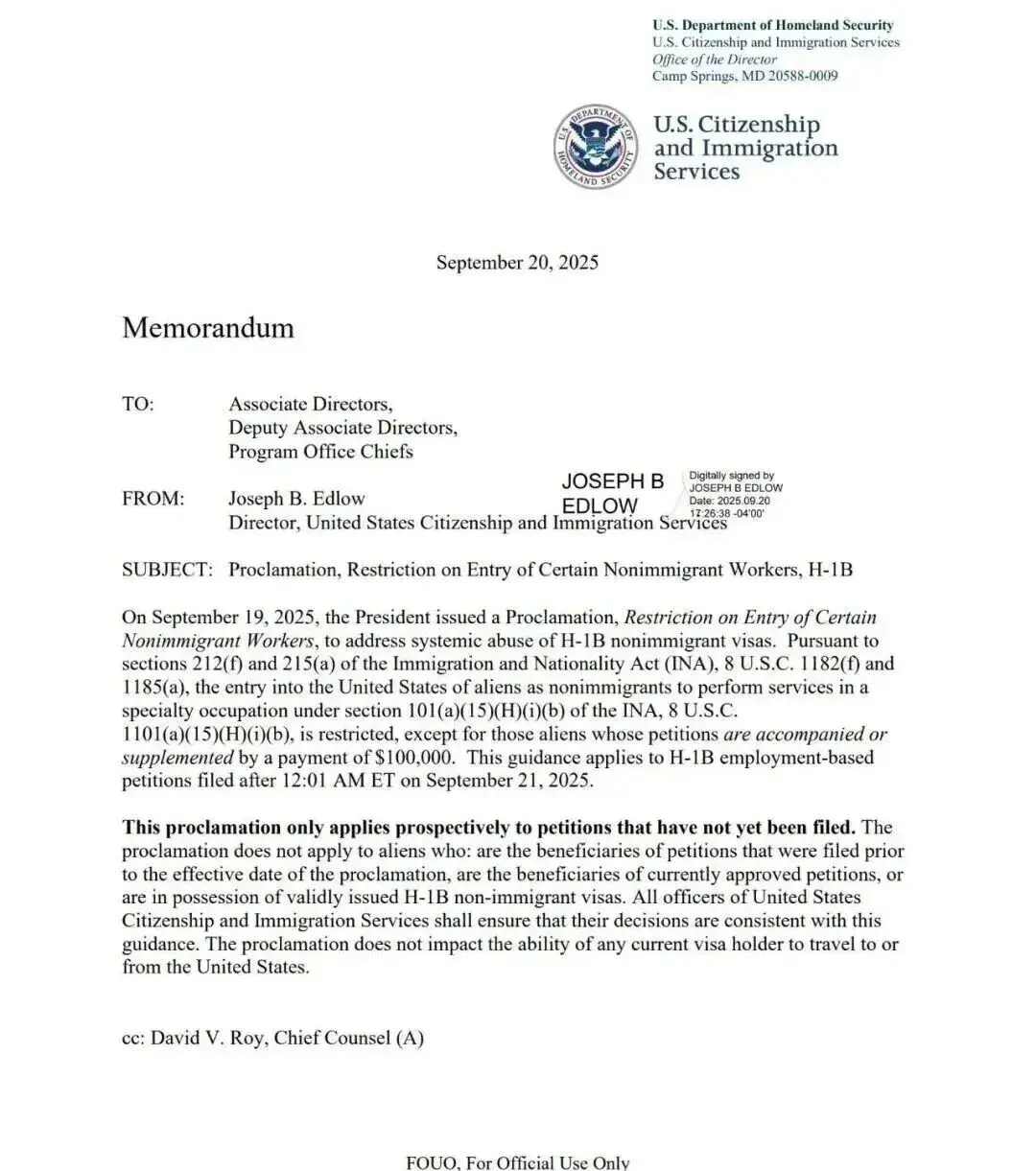
Effective 12:01 AM Eastern Time on September 21, 2025, employers of individuals outside the U.S. seeking to enter with H-1B status must pay an additional fee of $100,000; failure to pay will result in denial of the visa or entry. This policy is initially valid for 12 months.
After the news was announced, the global tech community, international students, and cross-border travelers fell into immediate panic. "Grabbing tickets," "changing routes," and "gambling on ports of entry" became popular topics. Tech giants such as Microsoft, Amazon, and JPMorgan Chase issued urgent directives requiring H-1B employees to return to the U.S. before September 21. In just 24 hours, countless human dramas unfolded at airports around the world.
However, on September 20 (Eastern Time), White House Press Secretary Karoline Leavitt provided clarification on social media:
• $100,000 one-time payment: This is not an annual fee, but a one-time, lump-sum payment.
• Applicants already selected for Fiscal Year 2025 are unaffected: The fee applies starting from the 2026 application cycle.
• Individuals outside the U.S. holding an H-1B visa can enter normally: Those who already hold an H-1B visa and are currently outside the U.S. do not need to pay the $100,000 to return to the U.S. as usual.
Additionally, there is uncertainty regarding whether current holders will be affected: The announcement and clarification frequently use the term "H-1B petition." Traditionally, a petition may include various scenarios such as initial applications, extensions, transfers, and amendments. It is currently unclear whether the announcement will impact these types of applications. Worldway will continue to monitor the situation.
1
The new threshold is now a reality
2026 applicants are the first to bear the brunt
Although this wave of panic is subsiding, for those who have not yet obtained an H-1B visa, or who will graduate after 2026 or plan to participate in the H-1B lottery in 2026, the "$100,000 threshold" is now an unavoidable reality. Students need to weigh whether they are worth the high cost for their employers. For the vast majority of ordinary international students, this will become an almost insurmountable obstacle.

2
Salary ranking effectively disqualifies ordinary positions
More importantly, the Trump administration not only set a fee threshold but also plans to promote a "salary-based ranking system" to replace the traditional lottery. This means that future H-1B distribution will no longer depend on luck, but on who has the higher salary. High-paying tech, finance, and medical positions will be prioritized for approval, while low-to-mid-range positions will have almost no chance. This change undoubtedly adds an "iron gate" for the vast number of ordinary international students.
3
F/J and OPT programs tightening, traditional paths being closed
Meanwhile, F/J visa and OPT policies are also tightening. In the past, international students could legally remain in the U.S. as long as they maintained their studies; after graduation, they could obtain one to three years of work experience through OPT and then attempt to transition to an H-1B visa. However, this path is now being systematically dismantled: the "automatic continuity" of legal residence may be revoked, and OPT programs face the risk of being reduced or even eliminated.
With these combined, the traditional "Study → OPT → H-1B → Green Card" path is almost completely blocked. For freshmen through seniors who just arrived in the U.S., for graduates currently in the OPT stage, and for the vast group of international students planning to apply for an H-1B in the coming years, future uncertainty regarding status is increasing rapidly.
4
U.S. immigration policy is moving toward total 'elitism'
The attitude of companies is equally clear. For most small and medium-sized enterprises, the $100,000 cost is far beyond what they can bear, and the salary-ranking system leaves ordinary positions with almost no chance for an H-1B. Therefore, the future of H-1Bs will belong almost exclusively to the tiny minority of high-paying elite positions. In other words, U.S. immigration policy is becoming fully "elitist," leaving little to no possibility for low- to mid-level talent to remain.
5
EB-5: A definitive choice amidst status anxiety
Under the multiple pressures of high H-1B costs, salary ranking, and tightened OPT, Chinese families must think calmly: Do you want your children to endure years of status anxiety? Do you want to entrust their future to policy uncertainty and employer generosity?
In contrast, EB-5 investment immigration offers a unique advantage. It is a legal, compliant, and clear path. Under the new EB-5 law, applicants currently in the U.S., including international students, can concurrently file the I-526E immigrant petition and the I-485 application for adjustment of status, receiving a Combo card in about three months. Applicants can legally reside, study, and work in the U.S. while waiting for their green card, truly freeing themselves from dependence on the H-1B lottery and employer sponsorship.
Planning for a green card in advance is not just "investment immigration"; it is building a "status moat" for your child's life. This allows students to study and work with peace of mind, without being long-term troubled by status issues.
Important Reminder! According to the new Child Status Protection Act (CSPA) age calculation regulations released by USCIS in August 2025, the B Table (Dates for Filing) cannot lock age; only the A Table (Final Action Dates) can. To help parents quickly calculate whether their children are aging out, Worldway has specially launched a "CSPA Age Self-Test Table." Worldway's professional immigration consultants/customer service representatives will provide a precise assessment based on the specific details of your case (child's birth date, priority date, visa category, etc.) to calculate the child's CSPA age under the new rules and determine the risk of aging out. Please scan the code for details↓↓↓

6
Today's choices determine tomorrow's opportunities
In the future, U.S. immigration policy will only become more restrictive. For investors, now is the most critical window. Seize the benefits of no-backlog & concurrent filing & priority processing, get on board early, and lock in your priority date as soon as possible.
Submitting your application today secures a more stable future for your child; delaying by one day increases risk and uncertainty. Please remember: Status is not something you wait for; it is achieved through early planning and decisive action.
Nineteen years of glorious history, thank you for walking with us
Worldway 19th Anniversary Celebration of U.S. Investment Immigration is officially open
September 1 to September 30, 2025
Apply for U.S. immigration programs
Enjoy exclusive value discounts
Seize the opportunity, act now, and apply promptly!


For inquiries in Mainland China: 400-138-2929, Hong Kong customer service center: (852)2802 8798
Notes: 1. Within the scope permitted by law, the right of final interpretation of this promotional event belongs to Worldway Group. 2. Investment carries risks; the above information is for reference only.