





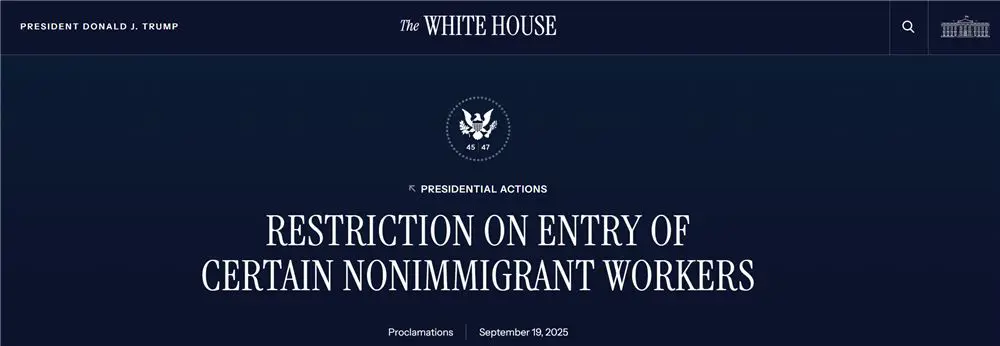
On September 19, 2025, local time, the White House announced significant news: Trump signed a proclamation imposing an additional application fee of up to $100,000 for H-1B work visas!
Starting from September 21, 2025, for a period of 12 months, foreign nationals applying for H-1B professional visas will be required to pay an additional fee of $100,000, and those who do not pay will face restrictions on their entry applications.
This move aims to limit the use of H-1B visas and protect American workers, viewed by the government as part of the response to "national security threats." This policy adjustment has instantly shaken the tech industry and the foreign talent community, and for international students who originally relied on H-1B visas, it is undoubtedly a bolt from the blue, with the cost of studying in the U.S. skyrocketing and uncertainty rising sharply.

01. The H-1B Dilemma: High Fees, Strict Regulations, and Intensified Competition
According to information disclosed by the White House, this adjustment to the H-1B visa not only introduces a substantial application fee but also further restricts visa issuance by modifying the "wage standards." Under current regulations, the direct costs associated with H-1B visas only include the registration fee and the I-129 form fee, while the additional $100,000 fee effectively increases the application cost by over a hundred times.
For tech companies and job seekers relying on H-1B visas, this is undoubtedly a double blow. Data shows that in 2025, tech giants like Amazon, Microsoft, and Meta received approvals for thousands to tens of thousands of H-1B visas; in 2024, India (71%) and China (11.7%) were the main beneficiary countries of H-1B visa approvals. With the tightening of policies, recruitment costs for companies have surged, and under the dual pressure of "lottery + high fees," traditional immigration pathways are becoming increasingly difficult.
It is important to note: The $100,000 fee is only payable when submitting a complete application (I-129 form) after being selected in the lottery; employers who do not win the lottery only need to pay a $10 registration fee and are not required to pay the $100,000 fee, thus there is no refund issue. If selected and the fee is paid but the application is denied, according to USCIS regular policies, the $100,000 is likely non-refundable, pending specific implementation details.

02. The Path for H-1B Holders: EB-5 Investment Immigration as the Optimal Solution
As the H-1B visa landscape changes, an increasing number of international students and H-1B holders are turning their attention to EB-5 investment immigration. As one of the few pathways in the U.S. immigration system that allows for "direct green card acquisition," EB-5 provides H-1B holders with an alternative to bypass the restrictions of employment-based visas.
Compared to the "employer dependency + lottery uncertainty + salary restrictions" of H-1B, the core advantages of EB-5 lie in "autonomy" and "stability." Applicants do not need to rely on employer sponsorship; by investing in qualifying projects, they can secure U.S. permanent residency for themselves and their families without being constrained by occupational fields or salary levels.
03. Why Can EB-5 Become a "Fast Track"?
Currently, EB-5 regional center projects are enjoying the benefits of a no-waiting period policy, with clear investment thresholds and relatively efficient processes.
Under the new EB-5 law, EB-5 applicants in the U.S., including international students, can submit their I-526E investment immigration applications simultaneously with their I-485 adjustment of status applications, provided that the EB-5 project category has no waiting period, allowing them to receive a Combo card in about three months. Applicants can legally reside in the U.S. while waiting for their green card approval results, allowing them to study and work.
For H-1B holders, choosing EB-5 means:
• Breaking free from employer dependency: No longer worrying about visa invalidation due to job changes or company layoffs, with full control over the green card application process;
• Family benefits: Once the principal applicant is approved, the spouse and unmarried children under 21 can also obtain green cards, enjoying U.S. education, healthcare, and other social benefits;
• Greater freedom in career development: After obtaining a green card, one can work in any region and industry across the U.S., without being restricted by H-1B occupational categories.
Seize the window of opportunity; early planning for EB-5 immigration yields early benefits
Behind the tightening of H-1B policies is the U.S. immigration system's tilt towards "high-value immigrants." Currently, it is the golden window period for planning EB-5 immigration. Rather than passively waiting in the "lottery battle" and "soaring costs" of H-1B, it is better to proactively arrange EB-5, paving a more certain path for immigration to the U.S. for oneself and one’s family. Act now, consult with a professional EB-5 immigration advisor at WorldWay Immigration, assess your eligibility, and seize the no-waiting period benefits!
Nineteen years of glorious journey, grateful to walk hand in hand with you
WorldWay Immigration's 19th Anniversary Celebration Commences
September 1 to September 30, 2025
Processing U.S. immigration projects
Enjoy exclusive value offers
Seize the opportunity, act immediately, and expedite processing!


For inquiries in mainland China: 400-138-2929, Hong Kong customer service center: (852)2802 8798
Note: 1. The interpretation rights of this promotional activity are reserved by WorldWay Immigration Group within the legal limits. 2. Investment involves risks; the above information is for reference only.