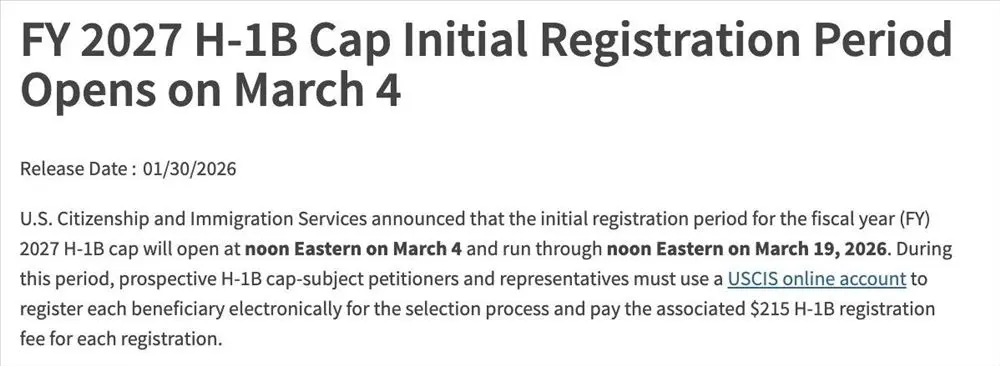
Recently, the U.S. Department of Homeland Security (DHS) officially released the Final Rule for H-1B visas. This rule will take effect on January 17, 2025, and will apply to the electronic lottery in March 2025.

The H-1B visa is a non-immigrant work visa established by the United States for hiring foreign professionals. It is applicable to professional positions requiring at least a bachelor's degree, such as in technology, engineering, law, and other fields. The visa is typically valid for 3 years and can be extended for up to 6 years. It is sponsored by an employer and is subject to an annual quota (approximately 85,000). H-1B holders can legally work and reside in the U.S. and apply for a green card, but they are subject to the lottery process and employer sponsorship.
This reform aims to simplify the H-1B visa application process, expand support for non-profit and government research organizations, and improve the transparency and integrity of the program. In short, applying for and renewing an H-1B visa will become more convenient. So, what exactly has been adjusted and optimized in this change? Let's find out!
The new rule provides a clear application path for entrepreneurs. H-1B applicants can establish a qualifying U.S. company and apply for an H-1B for themselves. The law clarifies that shareholders can hold more than 50% of the shares. Although the initial validity period for an entrepreneurial H-1B is only 18 months, and the first renewal can also be for a maximum of 18 months, this reform focuses more on the essence of the law—placing the emphasis on a bona fide job offer, which can be considered the biggest highlight of this new rule.
In addition, the new rule incorporates the USCIS Fraud Detection and National Security (FDNS) workplace inspection program into the regulations and explicitly states that if an employer or employee refuses to cooperate with a workplace inspection, it may lead to the denial or revocation of the H-1B application, further strengthening the oversight of H-1B visas and helping to ensure the legal use of the visa.
It is not difficult to see that the introduction of the new H-1B regulations brings more opportunities for international students and professionals, and 2025 will be a year full of opportunities and challenges! However, even so, under the current immigration policy framework, the path to obtaining a green card solely through an H-1B visa remains long and full of uncertainty. If the applicant's process goes smoothly, the entire journey from application to final green card approval takes approximately 7-8 years! If you factor in the H-1B holding period, and the employer waits until the 6th year to start the application process, plus the uncertainty of visa backlogs (which may be even longer for Chinese applicants), it is estimated that it will take over 14 years to go from H-1B to a green card! This is not only a test of patience but also a dual challenge of willpower and financial resources. (For more information, click to view: Data Reveal: How Long Does It Take for International Students in the U.S. to Go from H-1B to a Green Card? )
Currently, the two best-selling premium EB-5 projects on the market, for which Worldway is the exclusive agent in the Greater China region—the "Bryce Canyon Marriott Hotel" located in one of the top ten national parks in the U.S., and the "Grayson Hotel Hawaii" created by capital giants—are high-quality EB-5 rural projects that have been screened and strictly vetted by the Worldway Group. They are your best choice for quickly immigrating to the United States. Both of these premium EB-5 projects comply with the rural TEA project requirements under the new act. They not only enjoy reserved EB-5 visa quotas but also receive priority processing from the immigration bureau. They combine many advantages such as no backlog, priority approval, and first-priority mortgage guarantee for EB-5 funds. The whole family can quickly obtain a U.S. green card without a backlog. Quotas are scarce, so act fast.