





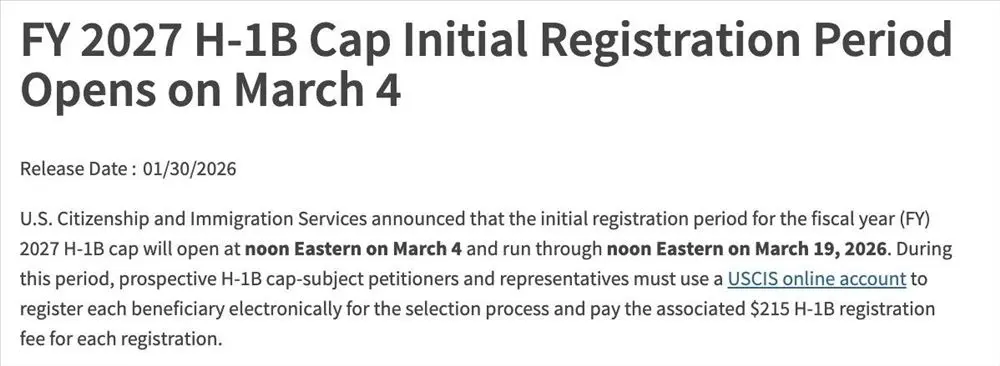
The U.S. Citizenship and Immigration Services (USCIS) has officially announced: The online electronic registration window for FY 2026 H-1B lottery-based visas will open at 12:00 PM EST on March 4 and close at 12:00 PM EST on March 19.
While the H-1B registration process for 2026 may appear unchanged on the surface, the shift in the policy environment, cost structures, and success logic signals that this H-1B cycle has completely moved beyond the era of "relying on luck."


Process Continued
But underlying rules are quietly raising the threshold
1. Registration fee remains unchanged, but the "cost of entry" is rising
As in previous years, a $215 registration fee is required for each H-1B electronic registration. However, registration is only the beginning and not the true core cost.
2. Higher compliance thresholds for employers
Employers must complete the creation and verification of a USCIS Organizational Account in advance; otherwise, they cannot submit any registrations for beneficiaries. For small- to medium-sized employers and startups, their internal compliance capacity has become an implicit threshold.
3. "One person, one draw" continues to be enforced; multiple registrations are no longer meaningful
While multiple employers can register for the same beneficiary, the lottery process remains beneficiary-centric. Regardless of how many times a beneficiary is registered, they participate in the lottery only once. Former strategies of "finding multiple employers and piling up registrations" have been institutionally blocked.
The True Watershed
Wage-weighted lottery officially in effect
Starting in FY 2026, the H-1B lottery is no longer purely random. USCIS will conduct a weighted lottery based on the Department of Labor's OEWS wage system:
• Level 1 (Entry level): 1 lottery chance
• Level 2 (Initial professional level): 2 lottery chances
• Level 3 (Experienced level): 3 lottery chances
• Level 4 (Advanced/expert level): 4 lottery chances
The conclusion is clear: the lottery mechanism is significantly tilted toward high-wage, core positions, while the chances of selection for entry-level and low-wage positions have dropped significantly.
More importantly: the wage level must be highly consistent with job responsibilities and the work location. Any attempt to "falsely report wage levels to increase selection rates" may lead directly to the registration being deemed invalid and could even impact the employer's future compliance record.
Selection ≠ Right to File:
The risks of $100,000 emerge for the first time
This is a potentially overlooked yet impactful change for the 2026 H-1B cycle. In the following scenarios, even if selected, you may be required to pay up to $100,000 in additional costs before the formal filing:
• The beneficiary is outside the U.S. and lacks valid H-1B status
• The beneficiary is in the U.S., but the Change of Status (COS) is denied, or a Consular Processing/Port of Entry notification is required
• The beneficiary leaves the country without authorization after being selected, disqualifying their Change of Status eligibility
This means H-1B is no longer a "selection guarantees peace of mind" pathway, but a visa system heavily dependent on status continuity, procedural compliance, and critical timeframes.
Reality is emerging:
H-1B is not a long-term status solution
In the 2026 policy environment, the essence of H-1B is clearer: it is an employer-dominated work visa; it is highly dependent on job roles, wages, and company stability; and it cannot provide long-term, controllable status certainty for families...
Risks are particularly amplified for the following groups:
• Those with families and children's education plans
• Those whose career paths are not yet fully stabilized
• High-net-worth families hoping to reduce singular dependency on an employer
EB-5 new law "Concurrent Filing":
Becoming a predictable option for status planning
Since the implementation of the 2022 EB-5 reform rules, the "Concurrent Filing" mechanism is truly changing the status pathways for families in the U.S.: you can file I-526E + I-485 while residing in the U.S.; concurrently apply for an Employment Authorization Document (EAD) and Advance Parole (AP), and receive a Combo card in about 3 months, quickly achieving legal residency and employment eligibility. Furthermore, rural EB-5 projects under the new law currently have no visa backlogs and enjoy priority processing rights.
From "Gambling on lottery odds"
To "Building status certainty"
H-1B has clearly signaled a message: through its institutional design, the United States is returning the power of status selection to applicants with "clearer conditions and more proactive planning."
Status planning is never a single-point gamble; it is a systematic engineering of time, policy, and family goals.
Friendly reminder: The current EB-5 policy includes a clear "grandfathering" clause: applications filed before September 30, 2026, can lock in current policies and will not be affected by future legislative changes. Now is the precious time to plan your U.S. status.
WorldWay holds two high-quality EB-5 rural projects, helping investors stably, efficiently, and without backlog achieve U.S. status planning, and quickly embark on a new life in the U.S. Global quotas are limited and seats are scarce—first come, first served!




Additionally, the Trump Golden Card immigration program is officially open for applications. WorldWay has taken the lead in launching Golden Card acceptance services, assisting applicants in efficiently advancing their processing and seizing critical time windows.
For details, contact Mainland China: 400-138-2929, Hong Kong Customer Center: (852) 2802 8798