Generally speaking, international students in the U.S. go through the following stages when applying for a Green Card via the H-1B visa:
● H-1B visa lottery
● Employer applies for a PERM Labor Certification
● Filing the I-140 immigrant petition
● Waiting for visa retrogression, and filing the I-485 application while in the U.S. once the priority date is current
● I-485 approval and receipt of the Green Card
So, how long does it actually take to go from H-1B to a Green Card? Let's reveal the answer using data released by the American think tank, the Cato Institute!
01. Participating in the H-1B visa lottery
Because the number of H-1B applicants far exceeds the quota each year, a lottery system has been in place since 2020. From the data released by U.S. Citizenship and Immigration Services (USCIS), we can clearly see the intense demand for H-1B filings, with the latest selection rate being only around 20%.
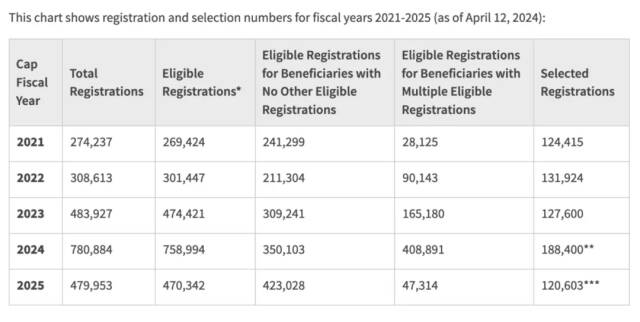
If selected, USCIS will process the application. Once approved, you will receive an H-1B visa, which is generally valid for three years and can be renewed once. In other words, if you do not successfully obtain a Green Card within six years, all your previous efforts may be in vain.
02. Applying for PERM Labor Certification
In addition to the application time, the employer is also an important factor influencing international students' ability to obtain a Green Card via the H-1B route; the status adjustment depends entirely on the employer. There are two scenarios here: a fortunate student starts working at the company after getting an H-1B, and the company immediately starts helping them apply for a Green Card; or a less fortunate student works at the company, and the company only starts the application shortly before the 6-year H-1B visa expires.
For employers, applying for a Green Card for an employee involves certain costs, such as the Labor Certification (PERM), where the employer must prove that there are no qualified U.S. workers available to fill the position. Counting the preliminary processes of confirming salary and advertising the job, it takes approximately over 2 years for the labor certification to be issued!
It should be noted that if there is a wave of large-scale layoffs, PERM applications may be paused. Previously, due to the impact of layoffs, several large U.S. companies, such as Amazon, Google, and Deloitte, announced the suspension of PERM applications.
03. Filing the I-140 petition
Once the PERM is certified, the applicant can submit the I-140 petition to USCIS. Only from this moment can one be considered to have officially entered the stage of applying for U.S. employment-based immigration. The regular processing time for an I-140 is about 7 months (Q1 of FY2024). If choosing the EB-2/EB-3 route, the I-140 stage can be expedited for a decision within 15 calendar days (at an additional cost of $2,805 for premium processing).
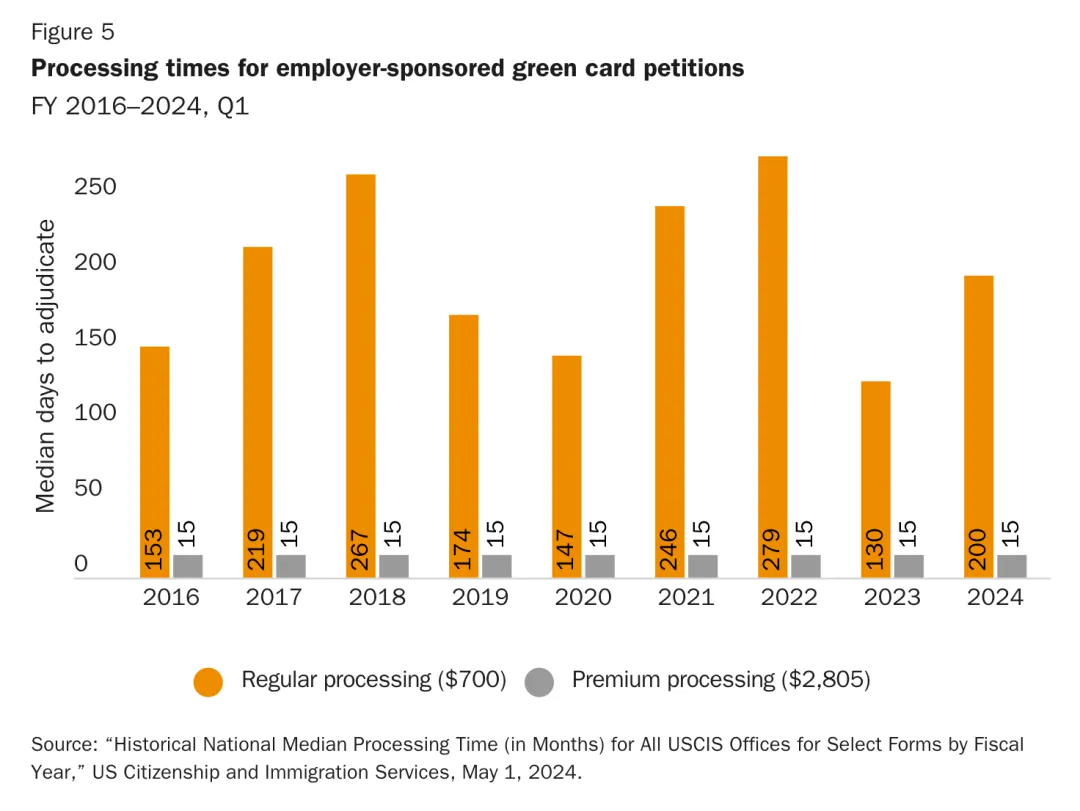
Once the I-140 is approved, your Priority Date (PD) is locked, which is very important for the subsequent filing of the I-485. As long as the I-140 is approved, even if you change jobs or are laid off, the PD for the Green Card is preserved, even if you have to go through the process again with a new employer. For Chinese applicants who are already subject to visa retrogression, the earlier it is approved, the better.
04. Waiting for visa retrogression and filing the I-485
Both EB-2 and EB-3 categories are subject to visa retrogression, meaning that even if the I-140 petition is successfully approved, you must wait for your priority date to become current before filing the I-485 within the U.S. Referring to the December 2024 Visa Bulletin Chart B, the EB-2 priority date is October 1, 2020, and the EB-3 priority date is November 15, 2020. The wait for these two categories is estimated to be around 4-5 years.
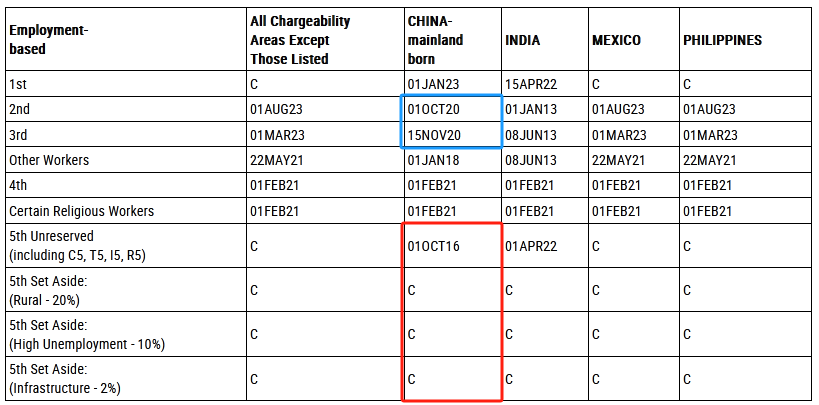
Additionally, note that the interpretation of the priority date varies by application category:
For Green Card categories that do not require a PERM labor certification (such as EB-1A & EB-2 NIW), it is usually the date USCIS receives the I-140 petition, as stated on the receipt notice issued by USCIS; for categories requiring PERM (EB-2, EB-3), it is usually the date the employer submits the PERM application.
05. I-485 approval and receiving the Green Card
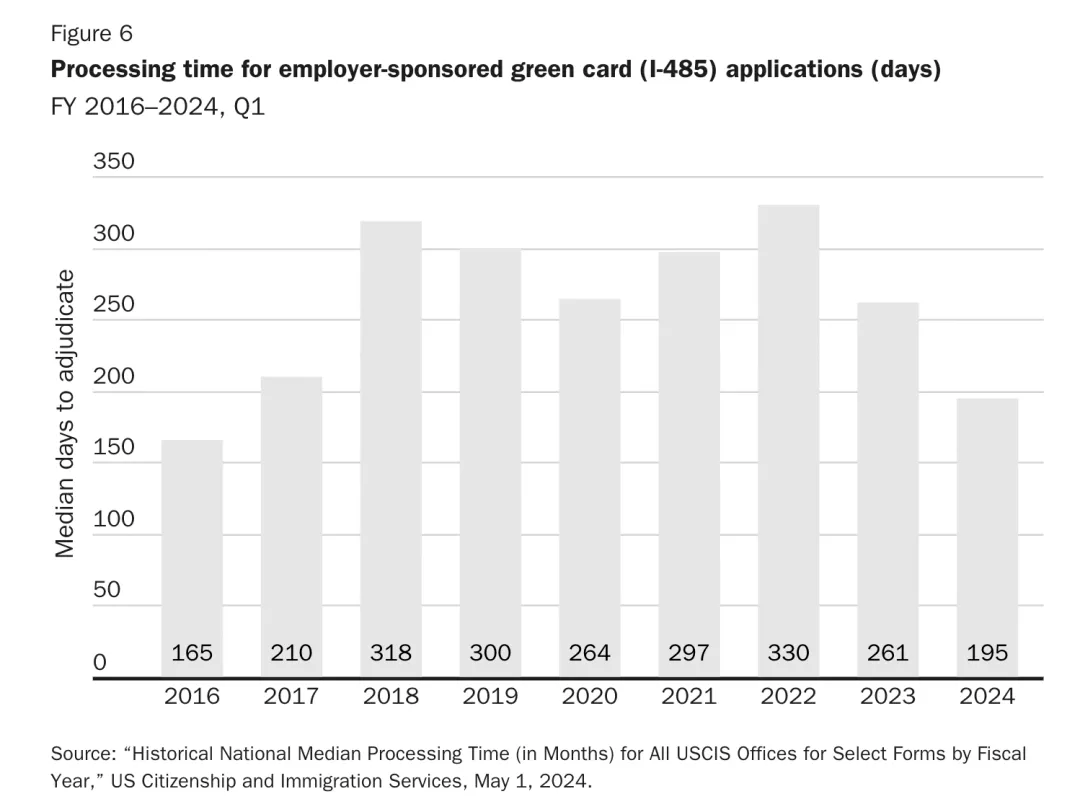
As we can see from the data above, the I-485 processing cycle also fluctuates: 6.4 months in Q1 of FY2024, 8.6 months in FY2023, and 5.4 months in FY2016. According to the EB-2 I-485 processing times on the USCIS website, times vary by region. Taking a median of 1.5 years as an example, and excluding the time spent waiting for the employer to initiate the application, starting from the initiation of the EB-2/3 Green Card application, the time from H-1B to Green Card is approximately:
PERM application (approx. 2 years)
Filing I-140 + waiting for retrogression (approx. 4-5 years)
I-485 approval cycle (approx. 1.5 years)
Total duration is approximately 7-8 years
In conclusion, under the current immigration policy framework, if an applicant is smooth, faces no job changes or layoffs, and does not have to restart the Green Card process, the entire journey from the start of the application to final approval takes about 7-8 years! If you factor in the H-1B holding period, and the employer only starts the application in the 6th year, plus the uncertainty of visa retrogression (which may be even longer for Chinese applicants), it is estimated that going from H-1B to a Green Card could take over 14 years! Therefore, relying solely on an H-1B for a Green Card is a war of attrition with too many variables, and the economic investment over these years is also a significant expense! It is evident that this path is not only a test of patience but also a double test of willpower and financial resources.
It is clear that whether for graduates participating in the H-1B lottery or individuals already holding an H-1B and looking to obtain a U.S. Green Card through the EB-2 or EB-3 route, this path is full of challenges and extremely difficult. So, what other ways are there for F-1 visa holders to obtain a U.S. Green Card? Are there more convenient options?
For investors who intend to immigrate to the U.S., if they want their children to stay in the U.S., and if the budget allows, the EB-5 investment immigration route is preferable. By choosing an EB-5 reserved visa project, investing $800,000, and filing I-526E and I-485 applications, one can obtain a COMBO card in about 3 months. This does not affect entry or exit during the Green Card waiting period, allows for legal residence, study, and work in the U.S., requires no employer sponsorship, and provides the freedom of quasi-Green Card status in advance.
Currently, the two top-selling boutique EB-5 projects on the market—the "Bryce Canyon Marriott Hotel" located in one of the top ten U.S. national parks, for which WorldWay acts as the exclusive agent in Greater China, and the "Hawaii Grand Reserve Resort" created by capital giants—are both high-quality EB-5 rural projects selected and strictly vetted by the WorldWay Group. They are your best choice for rapid U.S. immigration. These two major boutique EB-5 projects both qualify as rural TEA projects under the new act. They not only enjoy reserved EB-5 visa quotas but also receive priority processing from USCIS, combining multiple advantages such as no visa retrogression, priority approval, and first-lien collateral security for EB-5 funds. The entire family can quickly obtain a U.S. Green Card without waiting. Quotas are scarce, so act fast!