



Introduction:
Dr. Joseph J. Pambora, a senior Fulbright scholar in economics, currently serves as the chairman of several organizations, including the California Energy Investment Center.
Dr. Pambora has received numerous professional awards, including the highest academic honors in the United States. He has also held several key positions in U.S. government agencies and has founded multiple publicly traded companies.
On March 18, at the "2017 U.S. Investment Summit" hosted by the Worldway Wealth Club and organized by the Worldway Immigration Group, Dr. Joseph J. Pambora analyzed current U.S. investment trends and provided an outlook using data and case studies. The following is an exclusive summary of the speech prepared by Worldway.

I would like to thank the organizing committee of the "2017 U.S. Investment Summit" and Worldway for inviting me to such a grand summit. This is actually my 20th visit to China; my first visit was back in the 1970s.
Today, I will share with you the major trends and developments in U.S. investment. First, let me introduce myself. I am a senior Fulbright scholar in economics. While people usually think of scholars as being focused on research, I actually have two skill sets: one in my left hand and one in my right. One is research, and the other is practice.
I am also a descendant of immigrants and grew up in a very poor area of New Jersey, so I have a certain resonance with Mr. Hall. Because I grew up in the United States, I have a certain understanding of the U.S. economy, which I will share with you below.
Major Trends in U.S. Investment
I am the chairman of the California Energy Investment Center. I have had many collaborations with the Worldway Group in the past, and we have raised 5 billion in investment funds, which also includes investments from Worldway clients. Our primary investments are in Hawaii, Nevada, the West Coast of California, and other regions.
As an economist, my main task is to analyze projects, value them, and determine if they are worth investing in. First, I will pose a question for you to consider: Is the United States really a place worth investing in?
Currently, there are some conditions in the U.S. investment market, but these are historical anomalies; such situations have only occurred 13 times in U.S. history. I have analyzed, compared, and tracked many U.S. economic indices, including employment indices and various variable indices, to reach this conclusion. In addition, I track global stock markets, investments, foreign exchange rates, and other relevant indices. We track the Federal Reserve and various government departments, as well as the movements of President Trump.
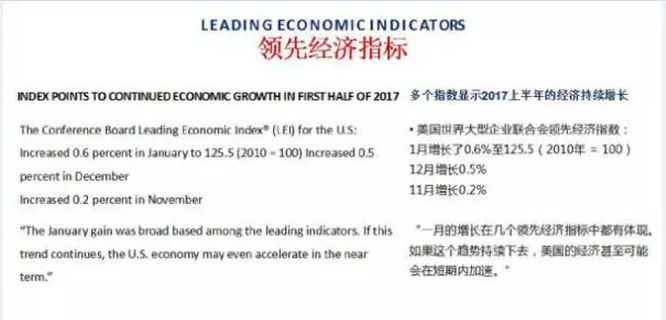
Below, I will show you some leading U.S. economic indicators. These indicators mainly come from the Conference Board's Leading Economic Index, which is a composite index derived from data provided by 75 heads of large enterprises. From this data, you can see that the U.S. economy is performing quite well.
Please take a good look at the chart below, as it represents the current political climate in the United States.
I am not sure if you are familiar with the monster Godzilla, which causes destruction in cities. At first, it is a demon, but in the end, it becomes a hero that defeats other demons. This is the current situation in the United States. In fact, different Americans represent different forms, but we can be certain that the group Trump represents does not include the Democratic Party, the Republican Party, Washington, or Wall Street. Actually, I have some understanding of him because my father and his father knew each other; they used to run a beer business together. He has his own direction to follow.
Below, I will share some U.S. investment policies, which are my personal views for your reference. These mainly stem from policies recently announced in Washington, involving three aspects. Some of these policies are consistent, while others are contradictory.
First, Trump hopes for investment projects with little or no government intervention, unless he has a personal interest in them. There is a very popular saying in the U.S. now called "2 for 1," meaning that for every new policy you create, you must remove at least two old ones. Ironically, Trump appointed a cabinet member whose primary goal is to eliminate all government administrative departments, which means he himself might lose his job. This sounds strange because the government has many connections to the economy and exerts some influence on it, but for you as investors, it is actually more favorable, as personal investments will be less affected by the government.
Trump's Pro-Business Moves: Deregulation, Trade Protectionism, and Infrastructure Spending
Next, I will talk about the situation regarding trade protectionism. Among Trump's policies, he first hopes for deregulation and de-governmentalization. However, in terms of trade, he is very insistent on trade protectionism; he hopes to increase tariffs and also wants to increase control over companies that hire overseas employees. You might ask, what is Trump's ultimate goal? Recently, Trump and the Chinese leader will meet in Miami, which will involve trade discussions. However, he is not using tariffs or fines as his ultimate goal; he must have other trade considerations, which is to prompt some countries to take spontaneous actions.
Next, let's talk about Trump's infrastructure spending, which is also an important policy. This policy is somewhat different from those of previous U.S. presidents. He places the main decision-making power in the national development bank, which is a bank that mainly finances railway infrastructure projects. He hopes these banks will primarily invest in local communities, including public spending, medical facilities, and energy.
Trump's Populism: Job Creation, Immigration Control, and Tax Strategy
The second part is populism. The definition of populism is taking the interests of the masses as the primary goal; it is actually against the elite class and the wealthy. Moreover, this wave of populism is not only prevalent in the United States but is now also spreading in Europe. In fact, it ultimately comes down to whether ordinary people have jobs. If they have stable jobs, they will definitely be more stable regarding their families, communities, and the country. Regarding some issues with the U.S. employment situation, we actually see that the U.S. population is slowly aging, and only 62% of the working-age population is employed, which is also an issue of aging.
His other policy, immigration control, is actually mainly aimed at Muslim countries or immigrants who want to enter the United States illegally. Although we often see articles in U.S. magazines about immigration control, his ultimate goal is just to create jobs for the American people, not to restrict immigration itself. Therefore, sometimes when we see some of Trump's remarks, whether about the North American Free Trade Agreement or the Trans-Atlantic trade agreements, what is ultimately discussed is job creation.
The next part is tax strategy, which is very important for investing in the United States. However, taxation is very complex, so I will just give you a few key points. If the Trump administration is truly determined to cut taxes, it could lead to a decline in federal government revenue of 5 to 7 trillion over the next few years. We can also see that after Trump was elected president, the U.S. stock market soared. This is actually because after his tax cuts, more investment entered the market, which also caused the stock market to grow by 20%–30%. This is also due to the effectiveness of a series of policies, whether fiscal policy, monetary policy, or financial means; these policies have all manifested their effects.
Next, I will touch upon some technical issues because my own company is based in Silicon Valley, which is a hub for high-tech. Actually, I personally do not like Trump. The reason is: there is a policy to cancel H1B visas. This type of visa mainly allows high-tech personnel and engineers to work in the United States. Companies like Apple or Google use these visas to bring foreign workers into the United States. If this type of visa is canceled, it will have some impact on Silicon Valley. In fact, it is very ironic that the United States needs to hire many high-tech personnel from abroad, but there is also a lot of investment in high-tech majors in U.S. universities, which creates a very ironic situation. Another ironic point is: Trump strongly advocates for the development of new technology and hopes to develop more robots to replace labor. On one hand, he is developing robots to do work, and on the other, he wants to create jobs; these are contradictory. None of these are his biggest problem; a larger problem is in handling healthcare, especially since it requires hiring many people to work in this area.
Three Major Trends in the World Today
One: The U.S. population is aging severely. For the first time, the population over 50 is greater than the population under 5, and negative growth has even appeared in other countries. Population aging has an impact on many aspects, such as real estate and retail sales. Just like everyone sitting here, no one wants to have a worse life when they get old, so now you need to invest more money in retirement. I also hope to have a good life when I get old.
Two: Communication technology. This refers to the communication devices in your hands. It not only allows you to contact family and friends but also to socialize. Therefore, most people, as long as they have a communication device, will constantly look down at it and interact with the device. Any company or industry will need such communication technology when developing in the future.
Three: The synthesis of humans and machines. This topic is not new; in fact, people have been discussing it for hundreds of years, but now it has reached a new chapter. There are already some projects collaborating with high-tech companies that can map the intentions of a household and understand the various directions of the family.
Investment Opportunities Are in Your Hands
With the continuous development of technology, in the future, we will no longer be satisfied with the use of mobile devices like mobile phones. More equipment similar to robots will be developed, and the cost will also decrease in the future. I believe that everyone here is younger than me, and you will definitely see the development and application of such high technology appearing in every aspect of life, taking care of your daily life in your home. At that time, life will undergo earth-shaking changes, and investment opportunities will be in your hands.
Thank you for listening! If you have any questions, you can also find Worldway or find me, and we can communicate together.
Event Preview

The "2017 Overseas Investment Summit," co-hosted by the Worldway Wealth Club and the China Real Estate Chamber of Commerce, and organized by the Worldway Immigration Group, Worldway Beijing Company, and Worldway Shanghai Company, will be held in Beijing and Shanghai on June 17 and 18, respectively. We cordially invite you to attend!

【Warm Reminder】This forum not only brings together top-tier heavyweight guests such as Mr. Feng Lun, founder of Vantone Group, Chairman of Feng & E Capital, and Chairman of the Worldway Wealth Club and Investment Committee, Mr. Hall, a member of the famous American Billionaires Club, and numerous domestic and foreign economists, world-renowned real estate experts, and investment experts to discuss new paths for overseas investment, but also features foreign dignitaries such as heads of investment agencies from EU countries and commercial counselors from EU countries to share with you the status quo and latest trends of overseas investment. As forum seats are limited, please reserve your spot for admission.