



Introduction:
Zhong Dajun, a renowned economic observer and a senior scholar in the field of economics. He graduated from Fudan University in Shanghai and has worked at Xinhua News Agency and the Development Research Center of the State Council as a senior reporter and researcher. He is currently the director of Beijing Dajun Think Tank Economic Consulting Company.
On March 18, at the "2017 U.S. Investment Summit Forum" hosted by the SWorld Capital Club and organized by the SWorld Immigration Group, Mr. Zhong Dajun analyzed the economic integration between China and the United States. Below is the content of his speech, exclusively compiled by SWorld.

Ladies and gentlemen, good afternoon. My speech topic is deepening the economic integration between China and the United States.
I would like to address a mental concern shared by many. Chinese people feel that Chinese money is being invested in the United States. What will this mean for our Chinese economy? What benefits will arise from Chinese capital being invested abroad? What will the investment returns look like? These are matters of great concern to Chinese investors. From a macro perspective, how should we view the phenomenon where investment between the two countries has completely reversed? This shift from previous American investment in China to Chinese investment in the United States—how did this happen? What are the underlying causes? Today, let's explore these questions.
First, this state in China is the result of years of economic imbalance between China and the United States. Why do I say imbalance? For the first twenty years or so, China was primarily a country attracting foreign capital, with very little outward investment. However, after thirty years of reform and opening-up, the situation had finally begun to change. The phenomenon where exports exceeded imports and attracted more investments than were being made abroad has seen some transformations. Particularly, in recent years between China and the United States, there has been a very large trade deficit. This imbalance is evident not only in terms of investment but also in trade. China exports a large amount to the U.S., while U.S. exports to China are significantly lower than imports. The U.S. trade deficit is about 500 billion U.S. dollars, with approximately 350 billion of that deficit arising from China annually. What does this phenomenon indicate? The trade imbalance between China and the United States has been building up over many years and is a result of the vast amount of American investment entering China and relocating production to China, with the produced goods returning to the U.S. Additionally, many enterprises from Hong Kong and Taiwan have also relocated to mainland China, leading to a significant increase in China's exports. This massive surplus formed by China reflects the outcome of this trade imbalance.
Now, as we develop towards the present, an opportunity for adjustment has arrived. When a country’s economy reaches a certain stage, it no longer maintains the phase of attracting significant amounts of capital as before. China’s economy, having reached a particular stage, is now slowing down and requires adjustment. Likewise, the United States, experiencing significant trade deficits, also needs to adjust. However, the U.S. should not initiate a trade war, as previously suggested by Trump, with increased tariffs on Chinese goods and other restrictions. Such actions benefit neither of the two countries. After experiencing a phase of attracting foreign investment, as capital becomes abundant in China, it can now be exported. Just as American businesses relocated to China, Chinese companies can now move to the United States to achieve balance. Hence, capital inherently seeks value—wherever value exists, capital will flow. Of course, the value of capital is influenced by several factors such as exchange rates, investment returns, and the economic environment.
Looking back at history, examining the impact that investment from the United States and other countries into China has had on their own economies, we find notable examples. For instance, when China joined the WTO in 2001, it integrated into the larger WorldWay cycle, leading to a reduction of 2 million American manufacturing jobs within just one year. The number of employees in the U.S. manufacturing sector was 17 million in 2000, but by 2016, it had decreased to 12 million. Thus, it can be said that during the past fifteen or sixteen years since China entered the WTO, the number of manufacturing jobs has decreased by 5 million, resulting in significant impacts on the U.S. economy. Now, as the United States seeks to attract investment and revitalize its manufacturing industry, the question arises—should a real adjustment take place? Consider today, with many American entrepreneurs, reflecting on their attitudes.
In recent years, China's national wealth has been increasing, marking its development into a capital-exporting country. It’s noteworthy that Japan also reached a stage of capital outflow by the end of the 1980s, coinciding with a strong appreciation of the yen and significant overseas investments. At that time, Japanese investments surged towards the United Kingdom and the United States, leading to astonishment regarding Japanese purchasing power. Today, we see China reaching a similar phase. As the renminbi appreciates, purchasing power relatively increases, and surplus capital emerges, China is also seeking international markets to secure investment returns—this is the reason for the capital outflow. The overall macroeconomic landscape has prompted this phenomenon. Moreover, capital outflow from China has recently surprised many, as it is known that in less than two years, specifically from 2015 to 2016, China's foreign exchange reserves decreased by 1 trillion U.S. dollars, and the capital outflow increased significantly. This means that overseas investments rose dramatically from just a few billion, peaking around 10 billion, to 100 billion or 200 billion in a short time. Particularly in 2016, such an explosive increase was observed. Of course, this phenomenon is related to several factors: one being the relatively slowing pace of China's economy, another being market saturation in various domestic industries, and the overall turning of the renminbi's appreciation thereby increasing the demand for better investment returns which caused a large-scale movement of funds.
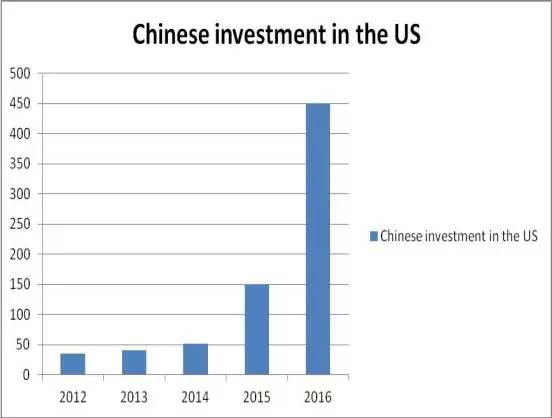
(The above image illustrates the investment from China to the United States. In 2012, Chinese investment into the U.S. was approximately 3 to 4 billion U.S. dollars, which escalated to 15 billion U.S. dollars in 2015 and reached 45 billion U.S. dollars in 2016—a drastic increase from earlier minimal investment levels. What might 2017 look like? Let’s make some predictions.
Accompanying this wave of external investments, the primary mode of Chinese investment overseas has been mergers and acquisitions, comprising 80%-90%. However, alongside acquisitions, productive investments are also gradually increasing. Notable Chinese companies such as Fuyao Glass, Haier, and various real estate firms have progressively invested in the United States. The scope of Chinese investments in the U.S. is broad, involving industries such as manufacturing, technology, energy, apparel, agriculture, catering, food processing, tourism, finance, insurance, transportation, engineering contracting, real estate, and security services, among others. Wherever investment value exists, Chinese funds are present. Preferred investment destinations for Chinese investors include New York City, North Carolina, Virginia, Texas, Illinois, and California.
Now, it is essential for entrepreneurs from both China and the United States to work together to create an investment environment that presents a mutually beneficial opportunity. From a macro viewpoint, this is a necessary manifestation and result of China's economic expansion.
This wave of investment from China presents a rare opportunity for the United States, as there is a saying in China: "You reap what you sow." After investing in China for three to four decades, foreign investors must expect returns. As China develops strength, it needs to reach out, and the United States requires Chinese investment; the two countries complement each other, fostering integration and mutual benefits.
Moreover, it’s not just about the quantity of investment but also the structure of investments involved. Our direct investments in the U.S. are quite limited; however, our outbound bond investments are significant. This indicates the immense imbalance between China and the U.S. Approximations suggest that in 2016, the estimated assets of American companies in China exceeded 500 billion U.S. dollars, over six times the existing U.S. investments in China, and the actual numbers may be even greater. China's overseas net assets stand at about 2 trillion U.S. dollars, but the returns are almost at a negative value. Chinese overseas investments often find themselves in a state of loss. Presently, China is anxious, sitting on vast assets, yet seeing its overseas net assets shrink daily, yielding low returns. As such, it needs to adjust its overseas asset structure by increasing direct investments.
Investment immigration is also a significant form of capital outflow. Investments between China and the U.S. exhibit distinct formats. The U.S. invests in China based on capital investment in funding, technology, and equipment. Conversely, China's investment in the U.S. primarily revolves around capital and talent, often intertwining capital investment with immigration investment. Why does this phenomenon occur? Due to differences in national circumstances; the U.S. possesses vast land and space which require such resources along with human resources, while Chinese human resources hold significant value, sometimes exceeding that of the U.S. dollars. Thus, this presents a complementary investment scenario where China offers talent and capital, and the U.S. provides space and technology.
Currently, regarding the direction of the renminbi, it appears to be fluctuating, while the U.S. dollar is strengthening. However, I believe the renminbi remains stable. The value of a country's currency is assessed based on its purchasing power. The actual purchasing power of the renminbi still holds space for appreciation. The recent depreciation of the renminbi results from capital fleeing rather than from trade or other reasons; once this escape concludes, volatility will cease. I believe the renminbi's decline will stabilize around 7. For any country that has reached a capital-exporting phase, the strength of its currency is essential. If it were facing a weakening currency, it would lack the capability to venture outward.
Economic exchanges between China and the United States need to be strengthened. Thus, investment immigration not only improves Sino-U.S. relations but also carries a historical mission of Chinese cultural exportation. It is essential to extend the merits of China outward, which underscores the significant meaning of capital output; Sino-U.S. investments will mutually benefit each other. I firmly believe that the current wave of Chinese immigration is not a bad thing, nor do I consider the capital outflow from China to be detrimental. How else would China expand without relying on capital? Chinese culture must also be exported, and China's influence must be articulated through strength—the strength represented by capital.
Event Announcement

The "2017 Overseas Investment Summit Forum," jointly hosted by the SWorld Capital Club and the All-China Real Estate Association, and organized by the SWorld Immigration Group, SWorld Beijing Company, and SWorld Shanghai Company, will be held on June 17 and 18 in Beijing and Shanghai, respectively. We sincerely invite you to attend!

【Warm Reminder】 This forum will not only gather high-profile guests, including the founder of Wantong Group, Mr. Feng Lun, Chairman of F&E Capital, Chairman of the SWorld Capital Club, and members from the American Billionaire Club, as well as numerous economists from home and abroad, globally renowned real estate experts, investment specialists, and others, who will discuss new pathways for overseas investments, but will also feature officials like Investment Bureau Heads from EU countries and business attachés from EU countries to share the current status and latest trends of overseas investments. Due to limited seating at the forum, please ensure your attendance via reservation.