— U.S. Immigration Policy • WorldWay Insights —
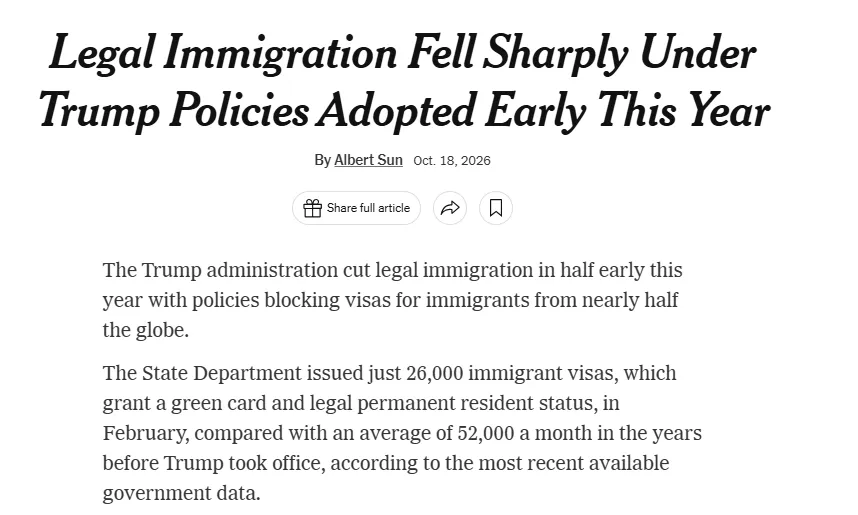
Recently, U.S. visa issuance trends have drawn widespread attention. According to data released by the U.S. Department of State, in February 2026, global U.S. immigrant visa issuances dropped to approximately 26,000, compared to a monthly average of about 52,000 prior to Trump's previous term, representing a drop of roughly half from previous monthly levels.
WorldWay Immigration notes that the shift in visa issuance volume coincides in timing with multiple restrictive measures implemented between late 2025 and early 2026. These measures span across several visa categories, leaving applicants from multiple countries facing varying degrees of visa and entry restrictions.
Student and Work Visas Also Impacted
In 2025, overall U.S. visa issuance experienced a decline of approximately 10%. As several visa restriction policies were gradually implemented, the U.S. further expanded travel restrictions on select nations, affecting citizens from 39 countries; immigrant visa suspension policies impacted applicants across 52 countries; additionally, the Diversity Visa (DV) program, which offers about 55,000 quotas annually, was temporarily paused before seeing subsequent policy and judicial developments.
Under the compounding effect of these restrictions, applicants from 91 countries and regions are virtually unable to immigrate to the United States through standard channels, while visa quotas for applicants from another 61 countries and regions have been reduced.
Africa and the Middle East have been particularly hard hit, with immigrant visa issuances for certain Muslim-majority nations dropping by more than 90%.
The repercussions extend beyond immigrant visas, as issuances of student, work, and tourism/business visas have also experienced declines.
Student Visas
F-1
↓30%
YoY Change
Work Visas
Includes H-1B
↓30%
YoY Change
Visitor Visas
B-1/B-2
↓25%
YoY Change
Data shows that in February 2026, U.S. student visa (F-1) and work visa (such as H-1B) issuances dropped by approximately 30% year-over-year, while tourism and business visa (B-1/B-2) issuances fell by about 25%.
Travel restrictions directly impact citizens from designated countries applying for relevant visas, while heightened vetting standards and other policy shifts may also affect applicants not listed under travel bans. For example, applicants from China and India have similarly seen declines in student and work visa issuances.
For international students and foreign workers heading to the U.S., securing a visa is only the initial step. Subsequent considerations such as maintaining lawful status, OPT/STEM OPT work authorizations, H-1B applications, and transitioning to employment-based permanent residency are all crucial components of long-term planning in the U.S.

How to Plan for Long-Term Status?
The impacts of visa policy shifts vary across different groups. For families seeking to study, work, or live in the U.S. over the long term, beyond focusing on current visa applications, it is essential to consider how to transition status in subsequent stages.
▍1. Students: Transitioning Status from Enrollment to Post-Graduation
In addition to school admissions and student visas, families planning for U.S. study must evaluate the student's maintenance of status during their stay, as well as post-graduation employment and long-term career arrangements.
For example, F-1 students planning to gain work experience after graduation via OPT or STEM OPT must meet corresponding eligibility and application criteria. Those hoping to remain in the U.S. through an H-1B work visa also need to account for visa category eligibility, cap allocations, and employer requirements.
For families looking to support their children's long-term education and career growth in the U.S., educational planning and immigration planning should be coordinated well in advance.
▍2. Foreign Workers: How to Connect Work Visas to Green Cards?
For individuals already working in the U.S. or planning to gain employment there, work visa extensions, employer sponsorship, PERM labor certification, and subsequent Green Card applications each come with distinct requirements and procedures.
Holding an H-1B work visa does not directly guarantee a Green Card. Pursuing permanent residency through standard employer-sponsored pathways typically requires navigating multiple stages, including PERM labor certification, Form I-140 immigrant petitions, and visa queue waiting periods, a process that can take several years.
At the same time, policy changes regarding H-1B application and extension requirements, as well as stricter scrutinies on employer-sponsored Green Cards, introduce further practical considerations for foreign workers. Should a work visa application or extension encounter hurdles, or if an employer cannot proceed with Green Card sponsorship, an individual's employment and long-term residency in the U.S. could be affected.
For individuals who prefer not to rely indefinitely on employer sponsorship, exploring alternative immigration pathways is recommended to prepare a sound long-term status strategy for themselves and their families.
▍3. Long-Term Residency: Understanding Different Pathways Early
Unlike standard employer-sponsored categories, the EB-5 Immigrant Investor Program does not require applicants to first obtain an H-1B work visa, nor does it require going through the employer PERM labor certification process. Applicants obtain U.S. permanent resident status by meeting established requirements regarding investment, source of funds, and job creation.
Under the EB-5 program, eligible applicants in the U.S. can take advantage of "concurrent filing": when no visa backlog exists, applicants can concurrently file the Form I-526E immigrant petition and Form I-485 adjustment of status application. They can also simultaneously apply for travel authorization (Form I-131) and employment authorization (Form I-765)—commonly referred to as a "combo card"—enabling legal work, free international travel, and early access to living and working conveniences similar to a Green Card.
Early Planning Is Recommended
It is worth noting that effective January 1, 2027, under the automatic inflation adjustment mechanism of the EB-5 Reform and Integrity Act (RIA), the minimum investment threshold for EB-5 Targeted Employment Areas (TEAs) will be adjusted upward. Based on current CPI calculations, the existing $800,000 threshold is expected to rise to at least $900,000, with the final amount subject to official publication in the Federal Register by USCIS.
For families considering U.S. EB-5 investment immigration, adjustments to the investment threshold involve actual capital allocation. It is advisable to understand these policy developments early and plan your timeline appropriately based on individual circumstances.
As a Top 500 Asian Brand with over two decades of focus on immigration services,WorldWay Group started in Hong Kong in 1998 and operates professional entities across Hong Kong and Mainland China. To assist investors in capitalizing on the golden planning window before the EB-5 investment threshold adjustment, WorldWay has launched a limited-time promotional campaign: From now until December 31, 2026, clients initiating U.S. EB-5 immigration projects can enjoy WorldWay exclusive promotional offers. For details, please contact your dedicated WorldWay advisor or customer service representative.
Immigration Services: A Beginning with No End
WorldWay Immigration will continuously monitor policy trends
to provide clients with professional project insights and immigration planning services.