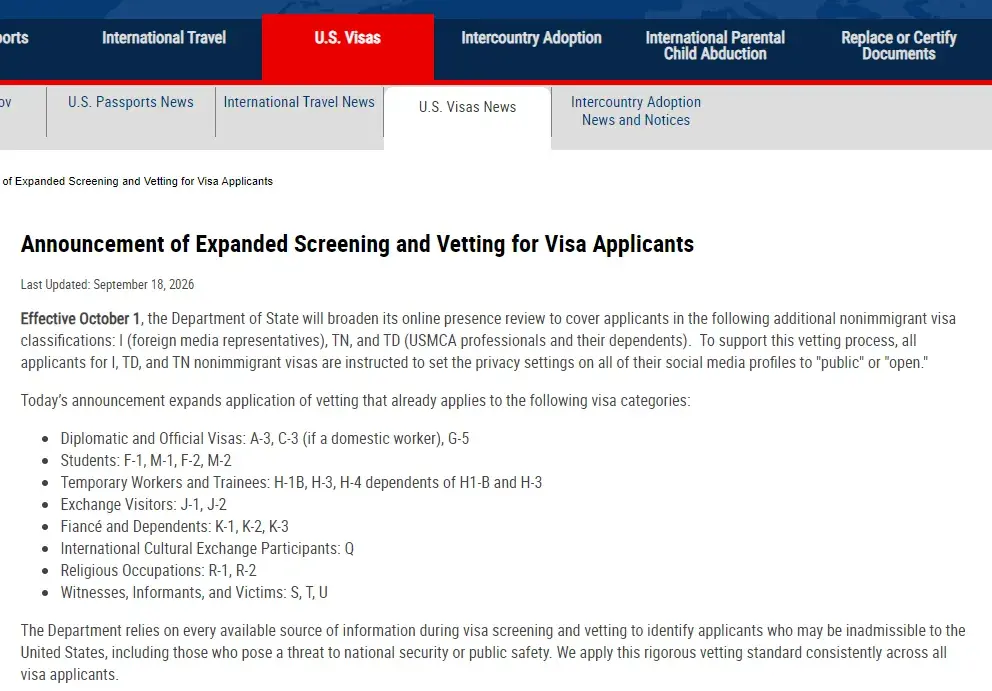
An increasingly noticeable shift is taking place in US visa vetting: applicants' online information is becoming an increasingly critical component of background checks.
Recently, the US Department of State announced that effective October 1, 2026, it will further expand the scope of online information screening for nonimmigrant visa applicants.
For individuals preparing to study, work, participate in exchanges, or engage in media-related work in the United States, it is essential not only to assemble traditional application materials but also to pay closer attention to their public online presence. WorldWay Immigration reminds those with US travel plans to verify relevant requirements in advance to prevent discrepancies from affecting their application.
01
Which visa applicants are affected?
Starting October 1, 2026, the US Department of State will include I, TN, and TD visa applicants under stricter “Online Presence Review” rules. Specifically:
I visas primarily apply to foreign media personnel traveling to the US to engage in newsgathering, reporting, broadcasting, film production, and related activities.
TN visas primarily apply to Canadian and Mexican professionals under the US-Mexico-Canada Agreement (USMCA), who must meet specific professional, educational, or professional credential requirements, as well as US employment arrangements.
TD visas primarily apply to spouses and qualifying unmarried minor children of TN visa holders.
The addition of I, TN, and TD categories is part of the ongoing US effort to expand the scope of online information screening.
Previously, multiple nonimmigrant visa categories were already subject to online presence reviews, including F-1, M-1, and their dependents; H-1B, H-3, and related H-4 dependents; J-1 and J-2; as well as K, Q, R, and select A-3, C-3, G-5, S, T, and U categories.
Evidently, US scrutiny regarding visa applicants' online information continues to broaden in scope.

02
Social media accounts must be public: what will primarily be reviewed?
A key aspect of this policy update is the explicit requirement by the US Department of State that I, TN, and TD visa applicants set their social media accounts to public status.
It is important to note that this is not entirely the same as disclosing social media handles on visa application forms in the past.
As early as 2019, the US required most visa applicants to declare social media information used within a specified timeframe. Now, designated visa categories subject to online presence reviews must go a step further by ensuring relevant accounts are set to public.
However, this does not imply that “posting certain types of content will automatically result in a visa refusal.”
Currently, the US Department of State has not published a so-called “social media content blacklist.” Review priorities remain focused on evaluating applicant eligibility, verifying genuine intent to enter the US, and identifying potential concerns related to national security, public safety, or inadmissibility.
For standard applicants, the key focus should be:
Whether significant contradictions exist between public online information and visa application materials.
For instance, if employer details, job titles, or dates of employment on the visa application form conflict noticeably with public online profiles, or if a student visa applicant's public activity indicates long-term plans that clearly conflict with “studying in the US,” such discrepancies may trigger further scrutiny.
03
Recommended steps to take prior to application
Prospective US visa applicants can perform several simple checks in advance.
First, review and organize previously used social media accounts.
Check whether any accounts have been inactive for extended periods, contain outdated information, or conflict noticeably with current circumstances. When completing application forms, declare information truthfully in line with the questions and guidelines provided.
Second, verify personal background consistency.
Focus on verifying work history, educational background, job titles, employment dates, and purpose of travel to ensure there are no major discrepancies between public online profiles and visa application documents.
Third, avoid intentionally “curating” accounts solely for visa approval.
It is inadvisable to abruptly delete substantial content or conceal genuine active accounts solely to pass vetting, and applicants must strictly refrain from fabricating credentials or altering key facts.
Fourth, confirm your visa category in advance.
Currently, online information vetting requirements do not apply uniformly across all US visa categories. Applicants are advised to confirm whether their specific visa category falls under these review mandates, referring to the latest official regulations at the time of application.
For visa applications, what remains paramount is: truthful information, accurate documentation, and consistent personal history.
Recent developments indicate that the United States continues to tighten policies regarding visa vetting, background checks, and status management.
For individuals planning travel to the United States, in addition to preparing immediate visa applications, it is beneficial to consider long-term immigration arrangements early. Whether applying for a single visa or planning long-term US residence status, understanding regulations early and preparing according to individual circumstances helps avoid unexpected complications.
Those with long-term residency needs in the United States may also monitor immigration pathways such as the EB-5 Investment Immigration Program. Under the Reform and Integrity Act, EB-5 set-aside visa categories currently maintain a window with no visa backlog. Eligible applicants residing lawfully in the United States can utilize concurrent filing to simultaneously submit immigration petitions and adjustment of status applications when visa numbers are available.
Furthermore, effective January 1, 2027, pursuant to the automatic inflation adjustment mechanism under the EB-5 Reform and Integrity Act (RIA), the minimum investment threshold for EB-5 Targeted Employment Areas (TEA) will increase; based on current CPI data estimates, the current $800,000 threshold is projected to rise to at least $900,000, with the final amount subject to formal publication by USCIS in the Federal Register. Families planning for EB-5 are advised to evaluate qualifications early, conduct project due diligence, and prepare filings promptly to capitalize on the current policy window.

Ranked among Asia's Top 500 Brands with over 20 years of dedication to immigration services, WorldWay Group launched from Hong Kong in 1998 and has been rooted in Hong Kong for over two decades, operating professional entities across both Hong Kong and Mainland China. Over the years, WorldWay has continuously monitored US immigration policies and EB-5 project developments, providing comprehensive residency planning and project services to families with long-term US plans.