How to choose a U.S. university has always been a key concern for families planning for study abroad.
University reputation, academic strength in specific majors, employment performance…… every family focuses on different priorities, and university rankings have become an important window for many families to understand school strength and dynamic changes.
With the release of the 2027 U.S. News Best Colleges Rankings, many prestigious universities have seen shifts in their positions and evaluation criteria this year. Which changes are worth paying attention to? And how should families interpret this list? Below, please explore with WorldWay Group.
I. Overview of the 2027 Top 15 U.S. National Universities
The top fifteen universities in this year's U.S. News U.S. National University Rankings are:
No. 1: Massachusetts Institute of Technology
No. 2: Princeton University
No. 3: Harvard University
No. 4: Yale University
Tied for No. 5: California Institute of Technology, Stanford University
No. 7: University of Pennsylvania
No. 8: Duke University
Tied for No. 9: Johns Hopkins University, Northwestern University, University of Chicago
Tied for No. 12: Columbia University, Dartmouth College
Tied for No. 14: Carnegie Mellon University, Cornell University
Among them, what has drawn significant attention is that Massachusetts Institute of Technology rose to No. 1 in the nation for the first time, ending Princeton University's 15-year streak at the top of the list.
California Institute of Technology rose to No. 5, tying with Stanford; Carnegie Mellon University rose to No. 14.
Regarding public universities, University of California, Berkeley and University of California, Los Angeles tied for No. 20, continuing to lead among public institutions.
Regarding liberal arts colleges, Williams College remained No. 1, Amherst College was No. 2, and Bowdoin College, Claremont McKenna College, Pomona College, and Swarthmore College tied for No. 3.
Overall, the landscape of top-tier universities remains stable, but some STEM-strong institutions performed even more prominently this year.
II. Ranking Methodology Adjustments: "Post-Graduation Outcomes" Gain Greater Attention
A notable adjustment in this year's ranking is the addition of the metric "Graduate Earnings by Major".
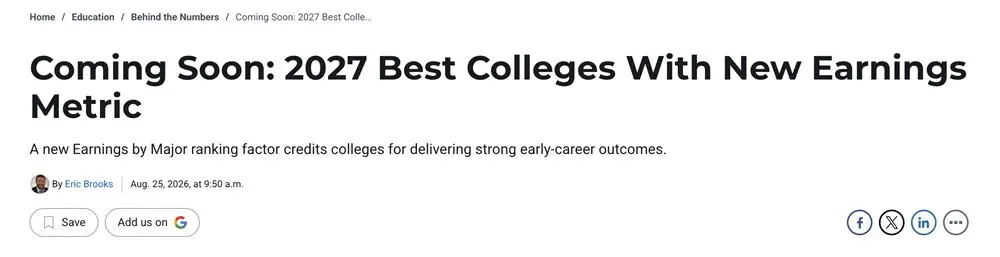
The graduate debt metric previously used was eliminated and replaced by "Salary Breakdowns by Major".
Relevant data mainly comes from the U.S. Department of Education's College Scorecard, examining the income performance of qualifying undergraduate graduates four years after graduation.
Unlike simply comparing overall university average salaries, this metric emphasizes comparisons within the same major. For example, computer science is compared with computer science, and economics with economics, minimizing the impact caused by differing major structures across institutions. This change also demonstrates that U.S. News is paying closer attention to student career outcomes after graduation.
Another major change this year is the adjustment in university classification methods.
Impacted by this change, approximately 20% of evaluated institutions were reclassified into different ranking categories, and some institutions with distinct specialized majors entered new comparison systems.
III. How Should Study-Abroad Families View the Rankings?
First, do not focus excessively on short-term rank fluctuations over one or two years.
University rankings fluctuate every year, especially given that some evaluation metrics and university classification methods were adjusted this year. Compared to a shift of a few spots up or down, a university's long-term academic strength, faculty resources, and overall development are far more worthy of attention.
Second, when choosing a school, look at the major as well.
The addition of the "Graduate Earnings by Major" metric this year further demonstrates that within the same university, curriculum resources, internship opportunities, and career development can vary significantly across different majors.
Therefore, beyond overall rankings, it is essential to focus on understanding major-specific strength, curriculum design, and graduate destinations.
Third, look ahead to the period after university graduation.
Selecting a university is not just about deciding where to study for the next four years; it is also tied to future internships, employment, and career directions.
For international students, the industrial environment and internship opportunities in the city where the university is located, as well as whether they intend to remain in the U.S. after graduation, are all factors worth considering in advance.
IV. From Overseas Study to Future Development, Immigration Status Is Also a Key Variable
As planning extends beyond "which university to attend," another practical question gradually emerges: if a child wishes to stay in the U.S. for career development after graduation, how should their residency status be arranged?
After F-1 international students graduate, if they wish to work in the U.S., they typically need to obtain temporary work authorization through pathways such as OPT, followed by potential transitions to other work statuses.
Therefore, for families who have clearly decided that they want their children to study, intern, and develop long-term in the U.S. in the future, educational planning often cannot stop at the university application stage alone.
Schools, majors, internships, employment, and legal status can in fact be considered together along a longer timeline.
For families seeking to further plan for long-term U.S. residency status, they can also explore suitable status pathways in advance by taking into account the child's age, future career direction, and overall family arrangements.
Among these options, the EB-5 Investment Immigration program represents one of the current pathways to U.S. permanent resident status. Eligible investors may include their spouse and unmarried children who meet the age requirements in the application.
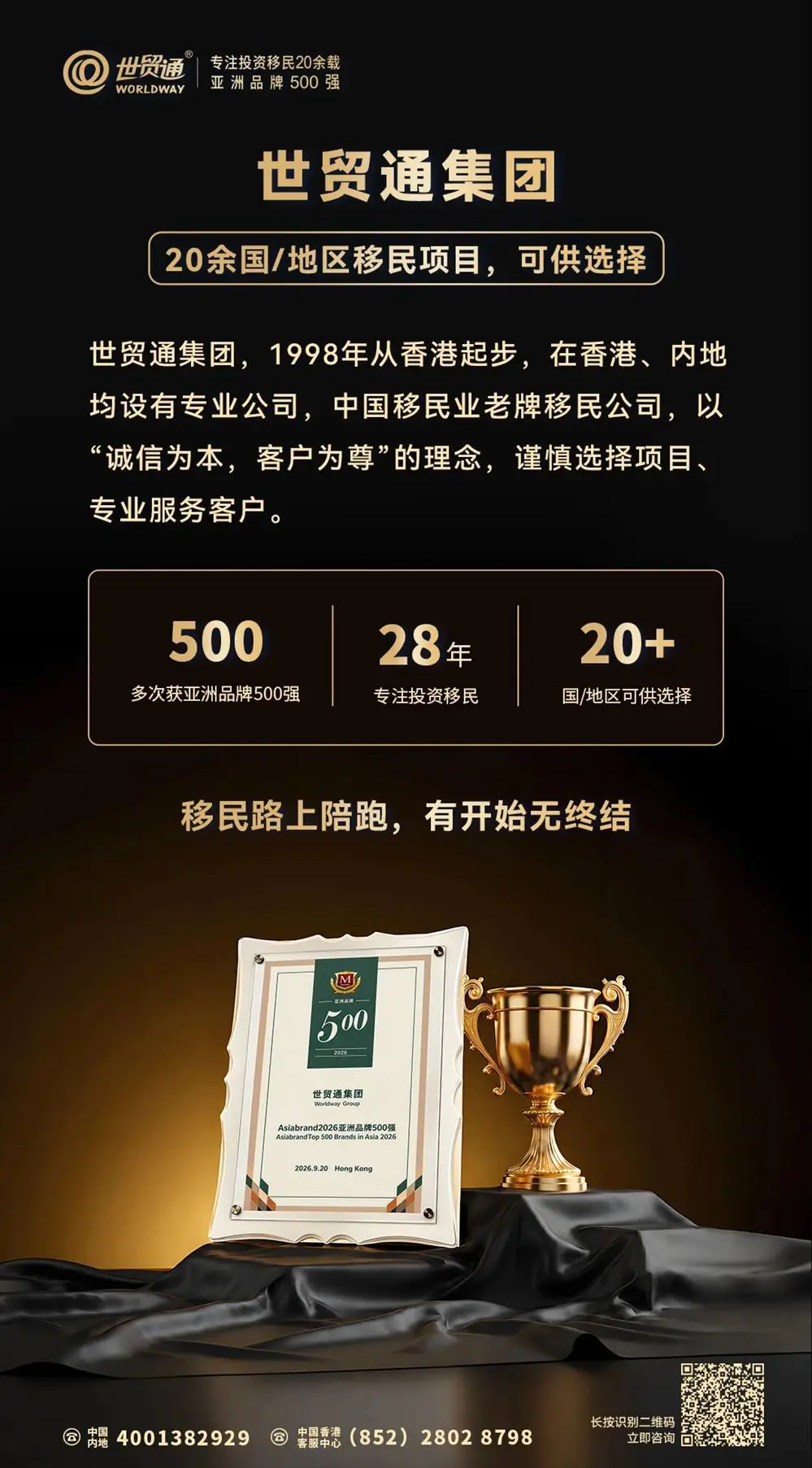
As a Top 500 Asian Brand with over 20 years of dedication to immigration services, WorldWay Group originated in Hong Kong in 1998 and currently maintains professional companies in both Hong Kong and Mainland China. Over the years, WorldWay has continuously cultivated expertise in U.S. immigration, providing long-term support for families planning for the U.S. across immigration status planning, project screening, application solutions, document preparation, and follow-up overseas services. For further information regarding EB-5 applications and related residency solutions, please contact WorldWay for consultation.
For detailed inquiries in Mainland China: 400-138-2929, Hong Kong Customer Service Center: (852)2802 8798