





U.S. PERM reform has taken another step forward.
Previously, the U.S. Department of Labor (DOL) placed the most substantial reform to the PERM permanent labor certification process in over two decades onto its regulatory agenda. (Click to read WorldWay's previous report: Sudden Shift for H-1B Pathway in the U.S.! Major Changes Proposed for PERM Rules)
Now, this reform has achieved new substantive progress.
WorldWay Immigration notes that on September 14, 2026, data from Reginfo.gov—the U.S. government regulatory information website—indicated that the Proposed Rule for PERM reform submitted by DOL (RIN: 1205-AC29) has officially entered the White House OIRA review phase.
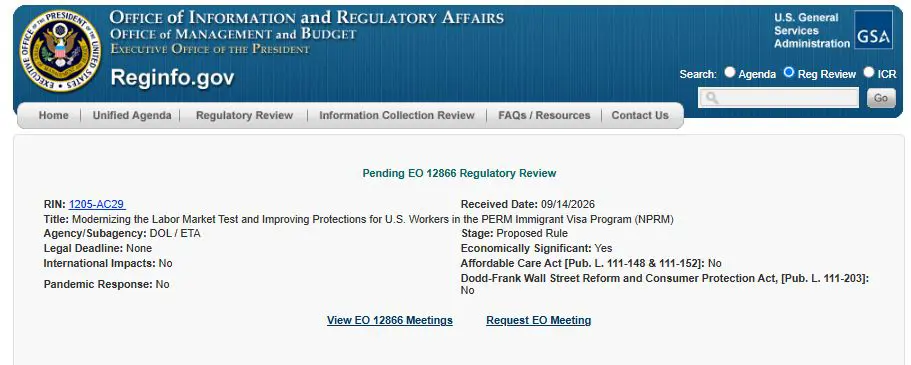

1. Accelerating PERM Reform After Over 20 Years
PERM is the U.S. Permanent Labor Certification process, serving as a critical prerequisite for many seeking U.S. Green Cards through employer sponsorship. Simply put, employers must demonstrate that they have conducted recruitment in the U.S. labor market without finding a qualified, willing, and able U.S. worker for the position.
Notably, the current PERM regulatory framework has not undergone a comprehensive overhaul since 2004. Over 20 years later, DOL's renewed push for systematic reform will focus heavily on recruitment standards, U.S. worker protections, and employer compliance.
2. Key Focus Areas of the PERM Reform
As the full proposed rule has not yet been made public, what can currently be confirmed is primarily the direction of the reform. Compared to past practices, DOL plans to adjust the PERM system in the following key areas:
First, updating recruitment standards. DOL plans to raise and modernize the minimum requirements for recruiting U.S. workers, aligning PERM recruitment methods with today's actual labor market and corporate hiring environments.
Second, strengthening protections for laid-off U.S. workers. While current rules impose certain restrictions regarding recent layoffs, the reform will further bolster these safeguards. Employers attempting to process PERM applications for foreign workers while simultaneously conducting layoffs may face stricter recruitment and audit requirements in the future.
Third, enhancing recruitment and hiring compliance. DOL has explicitly stated that it will strengthen non-discriminatory recruitment and hiring standards. How employers screen candidates and why qualified U.S. workers were not hired will likely face greater scrutiny.
Fourth, increasing record retention requirements. Employers may be required to maintain more comprehensive documentation of recruitment, candidate screening, and supporting evidence to demonstrate that the entire PERM recruitment process was genuine and fully compliant.
In short, the core of this reform shifts PERM from simply "completing required recruitment steps" toward placing greater emphasis on genuine recruitment, U.S. worker protection, and employer compliance obligations.

3. Increasing Variables in Employer-Dependent Immigration Pathways
As evident from this PERM reform, employers themselves are becoming an increasingly pivotal variable for securing long-term U.S. status through employment.
Whether a company is willing to offer long-term sponsorship, whether it undergoes layoffs, whether the position can be maintained, whether recruitment meets statutory standards, and whether the firm is willing to absorb rising compliance costs can all directly impact an application.
Furthermore, this pressure does not stem solely from PERM reform.
The U.S. Department of Labor previously proposed a separate rule on prevailing wages, intending to raise the four-tier wage thresholds used for PERM and H-1B programs. Under the proposal, the Level 1 wage threshold would increase from the current ~17th percentile to the 34th percentile.
If these policies are finalized, certain businesses could face higher wage obligations, stricter recruitment mandates, and heavier compliance duties simultaneously.
For applicants, the critical consideration is no longer just securing employer sponsorship today, but whether the employer can maintain the position, bear the associated costs, and cooperate through all subsequent immigration stages over the coming years.
4. Greater Flexibility with Employer-Independent Immigration Planning
For those with long-term plans to move to the U.S., it is advisable to evaluate early an alternative pathway that requires neither an employer nor a PERM labor certification—the EB-5 Investment Immigration Program.
Unlike traditional employer sponsorship, EB-5 relies on qualifying investments and corresponding job creation, without requiring the applicant to depend on a specific employer for a permanent job offer.
Consequently, an applicant's status planning remains independent of a specific job or employer, freeing them from the risk of job changes, company restructuring, or shifts in corporate hiring policies.
Ranked among Asia's Top 500 Brands with over two decades of dedicated expertise in immigration, WorldWay Group launched from Hong Kong in 1998 and operates professional offices across both Hong Kong and Mainland China. Over the years, WorldWay has continuously provided status planning, project selection, and application services for families planning their move to the U.S.

Currently, WorldWay is featuring the I-956F approved "Deer Valley · Snow Park Residences" EB-5 rural project, as well as the "Marriott · Imperial Lake Bay Resort" EB-5 project—our fifth collaboration with Peachtree Group—offering diverse options tailored to different family needs. From now until September 30, 2026, clients applying for EB-5 immigration can enjoy limited-time exclusive offers from WorldWay. Interested families are encouraged to assess their options early based on their circumstances.
Please note that EB-5 is approaching its next investment amount adjustment threshold. Effective January 1, 2027, the minimum EB-5 investment amount will increase from the current $800,000 to $900,000 or higher.
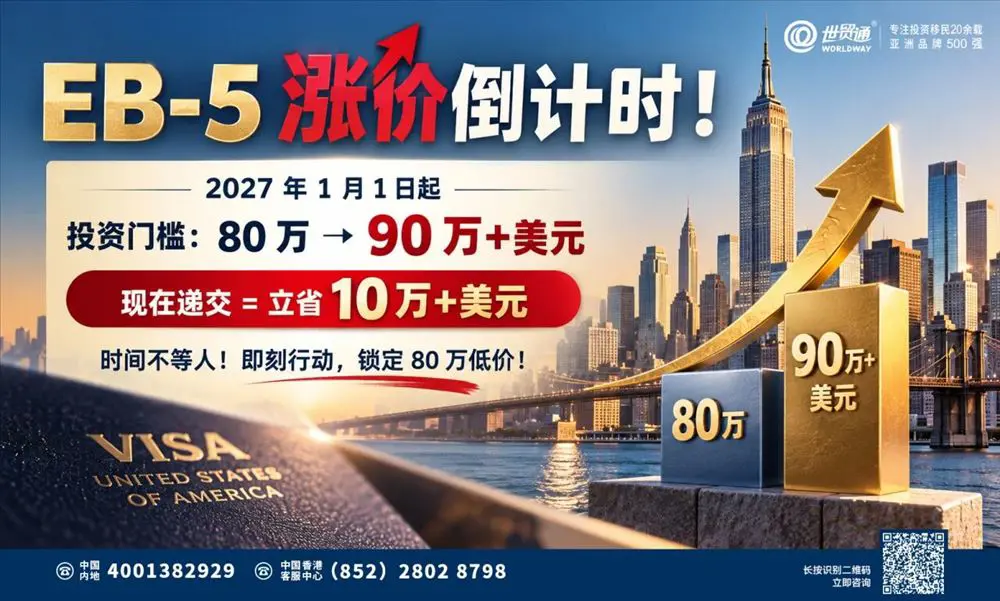
For families planning an EB-5 application, now is the time to accelerate preparation. While the current $800,000 threshold remains in effect, complete project evaluations, source of funds documentation, and application filings promptly to lock in current costs and avoid higher investment requirements in the future.


Inquiries (Mainland China): 400-138-2929; Hong Kong Customer Service Center: (852)2802 8798