





New progress on US OPT fee rules.
WorldWay Immigration notes that the US Department of Homeland Security (DHS) proposed rule on OPT fees completed OIRA review on September 11, and the official text may be published soon. This means that the high-profile $100,000 OPT fee proposal has taken another step forward.
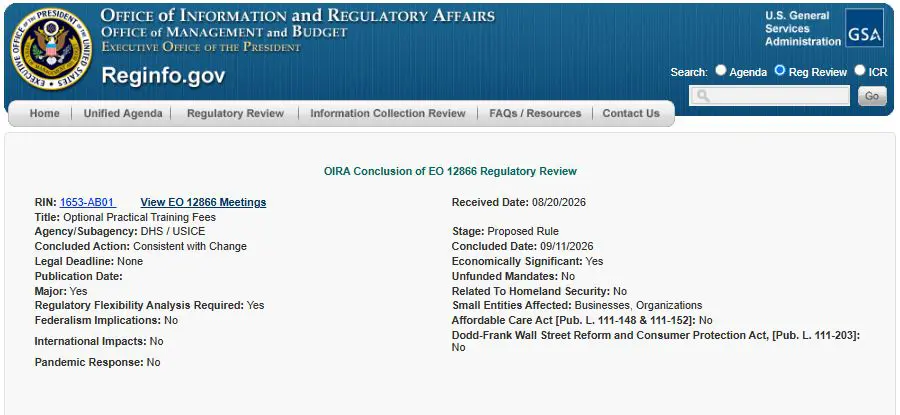

1. Key Review Completed for OPT Fee Rule
This proposed rule, titled “Optional Practical Training Fees,” was submitted by US Immigration and Customs Enforcement (ICE), a component of the US Department of Homeland Security (DHS), on August 20 to the Office of Information and Regulatory Affairs (OIRA) within the White House Office of Management and Budget (OMB) for review.
On September 11, OIRA completed its review, with the result listed as “Consistent with Change.” This indicates that the rule has cleared a crucial review stage prior to official publication.
Next, DHS is expected to still need to:
· Publish the full text of the proposed rule in the Federal Register;
· Open a public comment period;
· Modify the rule based on feedback;
· Formally issue the final rule and its effective date.
While the rule is progressing, it has not officially taken effect. Official announcements have not yet been made regarding the specific fee amount, who will be charged, whether both standard OPT and STEM OPT will be affected, whether exemptions will exist, or when implementation will begin. WorldWay Immigration will continue to monitor relevant developments and will summarize the specific changes promptly once the official rule is published.
2. Rising OPT Costs Will Strain Both Students and Employers
The reason OPT receives such high attention is that it directly impacts international students' employment transition after graduation.
Under current rules: standard OPT lasts up to 12 months; eligible STEM graduates can apply for an additional 24-month extension, reaching up to 36 months in total.
For many international students, OPT serves not only as a crucial pathway to enter the US workforce after graduation, but also as an important transitional stage leading to H-1B status.
If high fees are actually implemented in the future, the impact will likely manifest in two primary areas.
First, increased costs for students. Most recent international graduates are at the beginning stages of their careers. If they are required to bear these high costs themselves, the threshold for utilizing OPT will rise significantly.
Second, potentially higher recruitment costs for businesses. If the final rule requires employers to cover part or all of the fees, some small and medium-sized enterprises may re-evaluate the costs of hiring international students and even reduce available positions.
In other words, if high fees take effect, what actually gets raised may not just be the application cost for OPT, but also the barrier for international graduates entering the US job market.

3. Beyond OPT, H-1B Fees Are Also Seeing Continuous Adjustments
Alongside the high fee proposal for OPT, H-1B policies have also recently seen consecutive fee changes.
On August 24, DHS published a new proposed fee rule for H-1B, suggesting an additional fee of $103,265 for certain H-1B cap-subject petitions. (Click to read WorldWay's previous report: Major Overhaul for H-1B Again! New Proposal Sent to White House for Review)
This fee also currently remains in the proposed stage and has not taken official effect.
However, another H-1B fee adjustment has already been implemented starting September 9. Certain large employers with 50 or more employees where more than half hold H-1B or L-1 status must pay a $4,000 special fee when processing relevant H-1B extensions; the corresponding fee for L-1 is $4,500. (Click to read WorldWay's previous report: Attention US-based Students! H-1B/L-1 Renewal Fees to Increase Soon)
One is OPT, and the other is H-1B.
Although the two policies are distinct, for students planning to follow the “Study abroad — OPT — H-1B — Long-term US residency” path, the reality is becoming increasingly clear:
Whether you can remain in the US after graduation depends not only on securing a job, but also on immigration status policies, application costs, and employer willingness.
4. With Policy Shifts, International Students Must Prepare Earlier
Currently, the new OPT fee has not yet taken effect. What truly needs to be done is to plan several matters in advance.
First, prepare eligible OPT applications as usual.
Current rules remain unchanged, so students who originally planned to apply for OPT can proceed normally according to their current timelines.
Second, pay close attention to the official text.
The OPT fee rules are currently still in the proposed stage. The final fee amount, scope of application, and effective date have not been determined. Details will become clearer once the official text is published. WorldWay Immigration will continue to monitor policy developments.
Third, consider job hunting and immigration status simultaneously.
Securing a job offer is crucial, but international students must also plan ahead regarding OPT duration, whether employers are willing to sponsor H-1B, and how to transition immigration status smoothly afterward.
For families who have already established a long-term goal of remaining in the US, long-term immigration status can be incorporated into overall planning much earlier, alongside immediate employment arrangements.

5. For Long-Term US Residency, Immigration Status Needs Earlier Planning
In the past, many families focused their US study-abroad planning primarily on schools, majors, and job prospects. However, as OPT and H-1B policies undergo continuous adjustments, it is increasingly difficult to separate legal status from education and career planning.
For families who clearly intend for their children to study, work, and live in the US for the long term, long-term immigration status can be planned in advance.
Currently, EB-5 is one of the key options families focus on when planning long-term US legal status. At this stage, the minimum EB-5 investment amount remains $800,000, and the set-aside visa categories under the Reform and Integrity Act remain unreserved with no visa backlog. Eligible applicants who are currently maintaining lawful status within the US can concurrently file the I-526E immigrant petition and the I-485 adjustment of status application when no visa backlog exists.
At the same time, EB-5 is approaching two key milestones worthy of attention: September 30, 2026, marks a critical deadline for the EB-5 RIA “grandfathering clause”; and starting January 1, 2027, the minimum EB-5 investment amount will increase.
For families structuring their US plans around their children's education and future development, the earlier education, employment, and legal status are planned holistically, the more options they will have when facing policy changes in the future.
Ranked among Asia's Top 500 Brands and with over 20 years of dedication to immigration services, WorldWay Group started in Hong Kong in 1998 and operates professional companies in both Hong Kong and Mainland China. WorldWay has long monitored changes in US immigration policy, providing status and project services for families planning to move to the US.

Currently, WorldWay is prominently featuring the I-956F approved 「Deer Valley · Snow Country Residence」 EB-5 rural project, as well as the 「Marriott · Grand Lake Bay Resort」 EB-5 project launched in partnership with Peachtree Group for the fifth time, offering diverse project choices for different families. From now until September 30, 2026, applicants applying for EB-5 immigration can enjoy WorldWay's limited-time exclusive discounts. Interested families are advised to evaluate their circumstances early to seize the current application window.



For inquiries, Mainland China: 400-138-2929, Hong Kong, China Customer Service Center: (852)2802 8798