





Just on the eve of the scheduled effective date for the new U.S. “Public Charge” rule, a major legal challenge suddenly emerged.
On September 14 local time, New York Attorney General Letitia James, joined by 21 other states and Washington, D.C., filed a lawsuit in the U.S. District Court for the Southern District of New York, seeking to block the implementation of the Trump administration's new “Public Charge” rule.
At the same time, municipal and local governments including New York City, Chicago, San Francisco, and Seattle filed another lawsuit challenging the same rule.
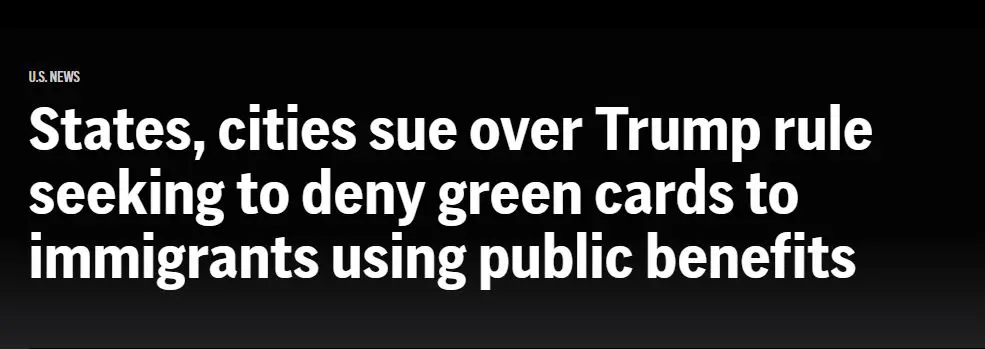
WorldWay Immigration notes that this widely controversial new rule was originally scheduled to take effect officially on September 18, 2026.
For immigrant families currently applying for U.S. Green Cards, planning to adjust status, and especially those living in the U.S. and receiving certain public benefits, this policy change warrants close attention.

I. The New “Public Charge” Rule
What Has Actually Changed?
In July of this year, the U.S. Department of Homeland Security (DHS) officially published the new “Public Charge” final rule in the Federal Register, rescinding the relevant 2022 provisions and clarifying that the new rule will take effect on September 18, 2026.
In the past, under the previous regulations, U.S. Citizenship and Immigration Services (USCIS) evaluated public benefits within a relatively limited scope when making “Public Charge” determinations, focusing mainly on cash assistance for income maintenance and government-funded long-term institutional care.
Under the new rule, however, immigration officers will have broader discretion during “Public Charge” adjudications, and the scope of review will no longer be limited to the few explicitly listed benefit programs as before.
Subsequently in August, USCIS further issued the latest policy guidelines to re-clarify the standards for evaluating “Public Charge,” thereby further expanding the scope of review. (Click to read WorldWay's previous report: Green Card Alert! New U.S. Public Charge Rule to Take Effect Soon)
II. Why Are So Many States and Cities
Filing Lawsuits?
The core of this legal dispute lies in how far DHS can expand the scope of evaluation and how much discretionary authority immigration officers should hold.
Plaintiffs, including New York State, contend that the new rule lacks sufficiently clear evaluation standards and may result in the lawful use of public benefits such as food, healthcare, and housing adversely affecting future immigration applications.
The plaintiffs further assert that the new rule expands the scope of “Public Charge” application beyond the statutory authority of DHS and violates the Administrative Procedure Act (APA). These arguments are currently pending before the federal court.
Local governments including New York City, Chicago, San Francisco, and Seattle expressed concern that the new rule might lead some immigrant families who are otherwise legally eligible to voluntarily forgo essential public benefits like healthcare and food out of fear of compromising their future Green Card or visa applications.
DHS maintains a different stance. DHS argues that the 2022 rule excessively restricted the information immigration officers could consider, and that restoring a broader case-by-case evaluation allows officers to consider all relevant facts to determine whether an applicant is likely to become a public charge in the future.
As of September 17, the relevant litigation remains ongoing. According to the currently published final rule, September 18, 2026, remains the scheduled effective date. WorldWay Immigration will continue to monitor court developments and policy updates.

III. Frequent Policy Adjustments
U.S. Status Planning Requires Advance Preparation
From the introduction of the new “Public Charge” rule to the ongoing lawsuit brought by 22 states, Washington, D.C., and multiple cities, it is evident that U.S. immigration policy continues to undergo ongoing adjustments.
For families planning to live and work in the U.S. long-term, or hoping for their children to study and pursue future career development in the U.S., it is essential to consider long-term immigration pathways early rather than merely reacting to individual policy shifts.
EB-5 Investment Immigration represents a long-term status pathway within the U.S. employment-based immigration system.
Its core requirement is for applicants to make a qualifying investment in the United States and meet statutory conditions such as job creation. Spouses and unmarried children under the age of 21 of qualifying investors may also apply jointly for U.S. permanent resident status.
Currently, the EB-5 program is at a crucial window of opportunity. September 30, 2026, marks an important upcoming date under the grandfathering provisions of the new EB-5 law. Furthermore, starting January 1, 2027, the minimum EB-5 investment amount will undergo another scheduled adjustment, and the current $800,000 minimum threshold will increase further.
In other words, for families considering U.S. status planning via EB-5, two critical timelines are fast approaching; preparation of source of funds, project selection, and application materials should be initiated as early as possible.
As a top 500 Asian Brand with over 20 years of expertise in immigration, WorldWay Group originated in Hong Kong in 1998 and operates professional companies in both Hong Kong and Mainland China. WorldWay has long closely monitored U.S. immigration policy changes, providing comprehensive status and project services for families planning to move to the U.S.

Currently, WorldWay is highlighting the I-956F approved “Deer Valley · Snow Country Residence” EB-5 rural project, as well as the “Marriott · Royal Lake Bay Resort” EB-5 project launched in partnership with Peachtree Group for the fifth time, offering diverse choices for different families. From now until September 30, 2026, applicants processing EB-5 immigration can enjoy limited-time exclusive offers from WorldWay. Interested families are encouraged to assess their options early based on their specific circumstances to leverage the current filing window.
For families with a clear long-term goal of moving to the U.S., frequent policy changes make it even more essential to grasp the manageable filing timeline today, leaving more options open for the future.


For details, please contact Mainland China: 400-138-2929; Hong Kong Customer Service Center: (852)2802 8798