





Recently, a set of data regarding F-1 student visas has drawn attention.
WorldWay Immigration has learned that a recent report released by Shorelight based on U.S. Department of State data shows that the global refusal rate for F-1 student visas reached 35% in 2025, higher than 31% in 2024, hitting a near ten-year high. Back in 2015, this proportion was only 23%.
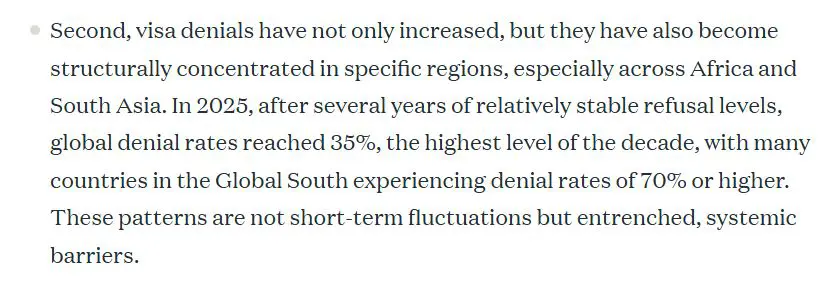
Meanwhile, U.S. Department of State visa data also shows that the number of F-1 visas issued in 2025 dropped by 33.4% year-on-year.
One is the rising refusal rate, and the other is the significant decrease in actual issuances.
For families planning to send their children to study in the U.S., the signal behind this is becoming increasingly clear:
The uncertainty of studying in the U.S. is extending from “whether one can get admitted” to “whether one can successfully enter the country, complete studies smoothly, and remain after graduation.”
I. F-1 Visa Application Difficulty Is Rising
An F-1 visa is essentially a nonimmigrant visa.
Applicants not only need to obtain university admission and prepare Form I-20 and proof of funds, but also need to prove to the consular officer that they meet the F-1 application requirements, including a genuine academic intent and a plan for traveling to the U.S. that complies with nonimmigrant status requirements.
Particularly under the INA 214(b) framework, if applicants fail to adequately demonstrate that they qualify for the corresponding nonimmigrant visa, they may be refused. Once refused, it cannot be resolved simply by “reapplying.”
The U.S. Department of State explicitly notes that after a 214(b) refusal, one may reapply, but upon reapplying, one should be able to provide new relevant information or demonstrate significant changes in circumstances since the previous application. If nothing has changed and one simply refills forms, repays fees, and attends another interview, it will likely merely repeat the previous outcome.
Schools can assist with Form I-20 processing, deferrals, and related matters, but the assistance they can provide regarding specific refusal reasons and complex visa issues has its limits.
In addition, the scope of student visa screening is expanding.
Currently, the U.S. Department of State requires F, M, and J student and exchange visitor visa applicants to undergo online information and social media screening, requiring applicants to adjust their social media accounts to “public” or “open” for review.
In other words, when applying for a U.S. student visa today, screening is becoming more comprehensive—from application materials and interview responses to personal online footprints—further increasing the difficulty and uncertainty of F-1 visa applications.
II. Starting September 15
F-1 Stay Rules in the U.S. Will Also Change
If the rising F-1 refusal rate affects “whether one can enter the U.S.,” another upcoming policy change impacts how long students can remain after entering.
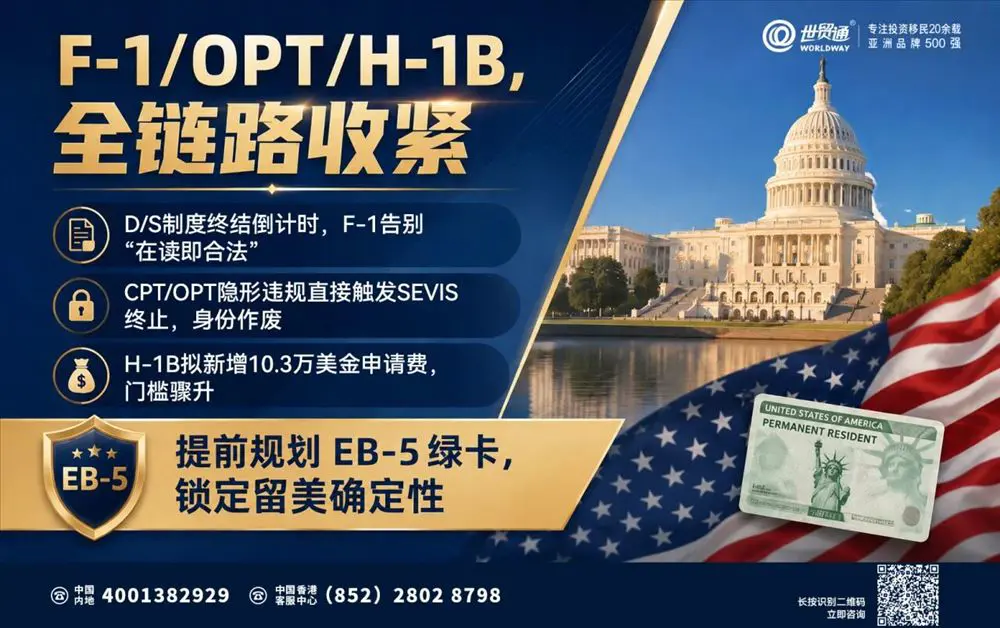
The U.S. Department of Homeland Security has issued a final rule stating that starting September 15, 2026, the long-standing “Duration of Status (D/S)” system for F-1 students and J-1 exchange visitors will transition to a fixed period of admission system. (For details, click to read WorldWay's previous report: Major New Regulation Implemented! U.S. Ends Duration of Status (D/S) System)
In the past, “D/S” annotated on Form I-94 upon entry for F-1 international students meant “as long as you are studying, you can legally remain indefinitely.”
After the new rule takes effect, newly admitted or re-entering F-1 students will receive a specific I-94 “Admit Until Date,” usually tied to the program end date on Form I-20, in principle not exceeding 4 years. Meanwhile, under the new system, the grace period for F-1 students to prepare for departure after program completion will also be shortened from the current 60 days to 30 days.
This means that the previously flexible “duration of status” is becoming a more concrete matter of “time management.”
III. From F-1 to H-1B
Status Pressure Persists Throughout the Entire Journey of Studying in the U.S.
In fact, for many Chinese families, F-1 is only the first stop on the journey of U.S. immigration status.
After entering a U.S. university, children often still need to navigate:
F-1 Enrolled Student → CPT/OPT Internship & Employment → H-1B or Other Work Status → Employment-Based Green Card.
F-1 requires maintaining student status continuously, OPT has time limits and employment requirements, and if students wish to continue working in the U.S. after graduation, many must enter the work visa system.
Therefore, the question truly worth considering for families today is no longer just: “Can my child attend a university in the U.S.?”
Rather, it is: “With what immigration status will my child navigate studying, interning, and working in the U.S. over the next 5 to 10 years?”
This is also why an increasing number of families with long-term U.S. plans are beginning to plan overseas study and immigration status together.
IV. With a Green Card, the Logic of Studying and Working Changes Completely
The biggest difference between an F-1 visa and a Green Card is not merely two different documents, but two distinct underlying status logics.
F-1 is a temporary nonimmigrant status for the purpose of studying, requiring compliance with specific regulations regarding study, employment, and stay.
Conversely, after obtaining U.S. permanent resident status, studying, living, and working in the U.S. no longer depend on F-1 student status.
There is no need to repeatedly apply for F-1 visas or face nonimmigrant intent reviews under 214(b); when entering the internship and employment stage, work authorization no longer relies primarily on OPT; after graduation, staying in the U.S. no longer hinges entirely on temporary work statuses such as H-1B.
For children who wish to develop long-term in the U.S., a Green Card truly expands options for education, employment, and long-term career growth.
V. Why Are Families Planning Overseas Studies Starting EB-5 Planning Early?
For families that are clear about wanting their children to build a long-term future in the U.S., EB-5 provides an employment-based immigration pathway leading directly to U.S. permanent resident status.
Currently, several advantages under the EB-5 Reform and Integrity Act are drawing greater attention from families planning overseas studies:
• No Visa Backlog Dividend: Reserved visa categories remain in a golden “no backlog” window.
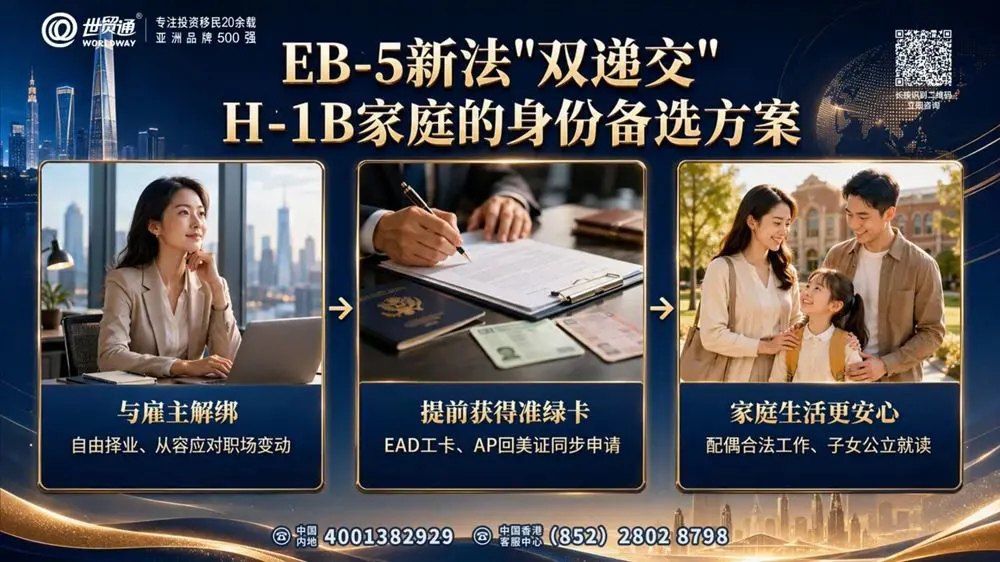
• Concurrent Filing Advantage: International students in the U.S. with lawful entry status can concurrently file Form I-526E and Form I-485 to quickly obtain lawful status, completely freeing themselves from the constraints of F-1 status.
• One Person Invests, the Entire Family Obtains Green Cards: Aligning children's education planning with family status planning.
It should be noted that on January 1, 2027, the minimum investment amount will increase from $800,000 to $900,000–$950,000 or even higher. The “grandfather clause” in the new EB-5 law will reach a critical deadline on September 30, 2026.
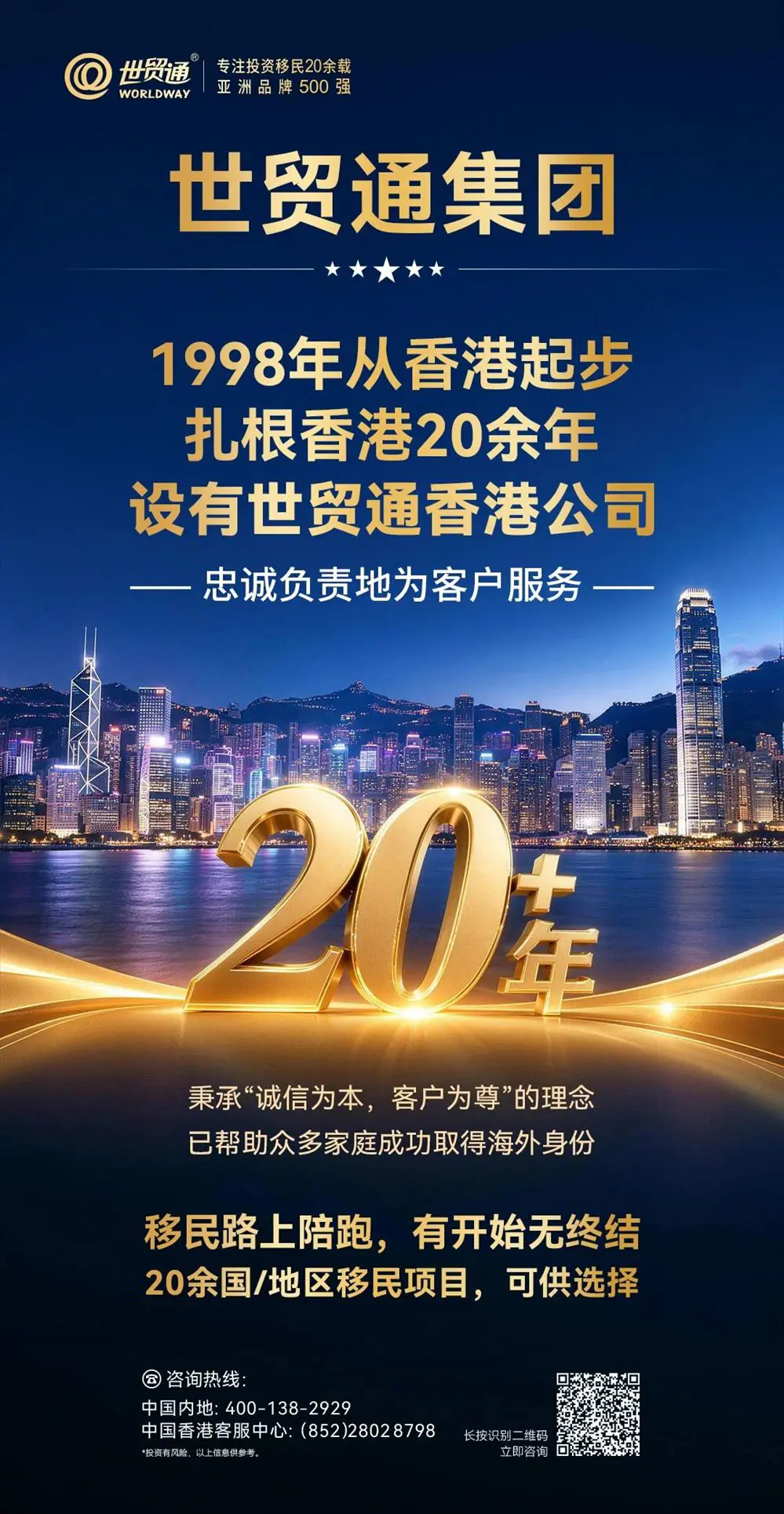
As a Top 500 Asian Brand with over 20 years of focus on immigration, WorldWay Group originated in Hong Kong in 1998 and has been rooted in Hong Kong for over two decades, establishing professional entities in both Hong Kong and Mainland China. Over the years, WorldWay has continuously monitored changes in U.S. immigration policies, providing professional services for families needing U.S. study, employment, and long-term status planning.
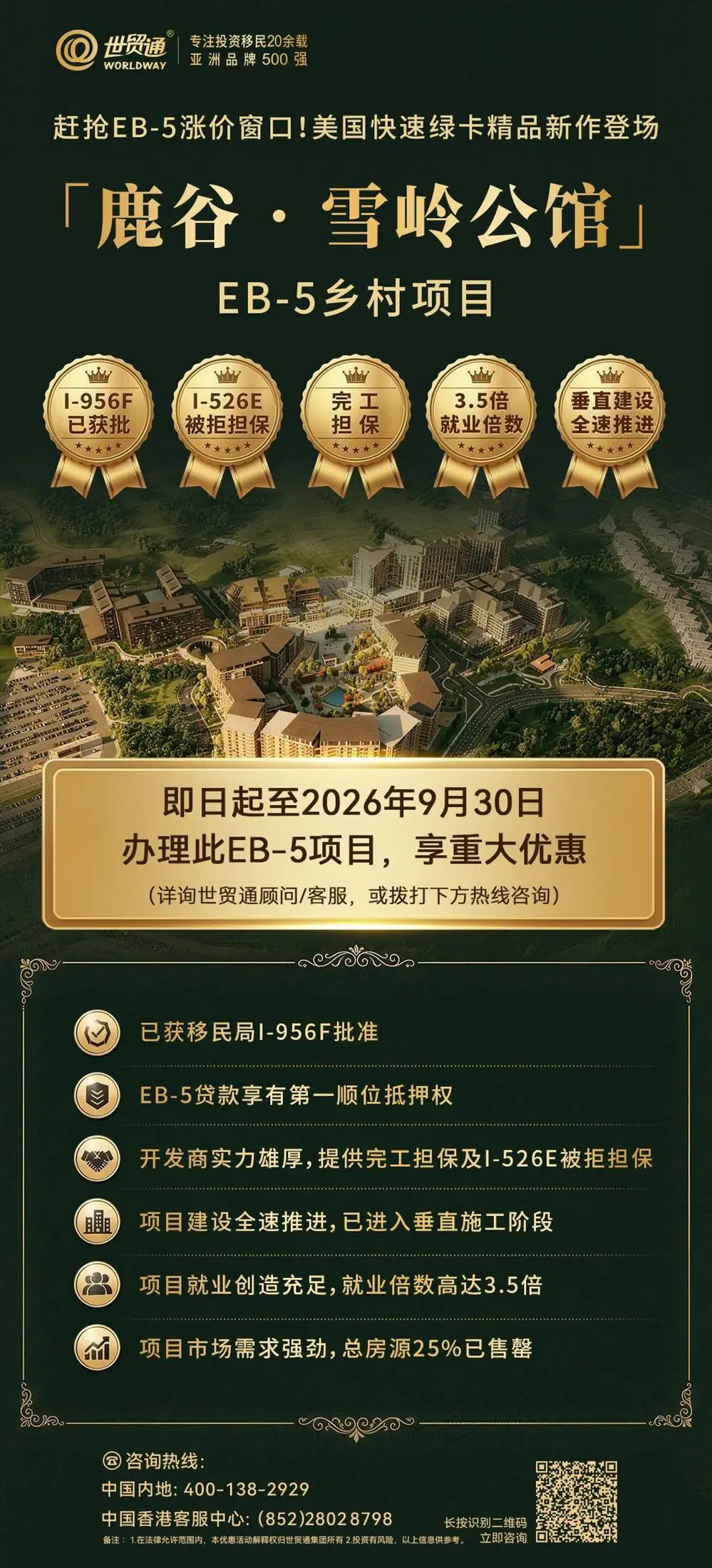
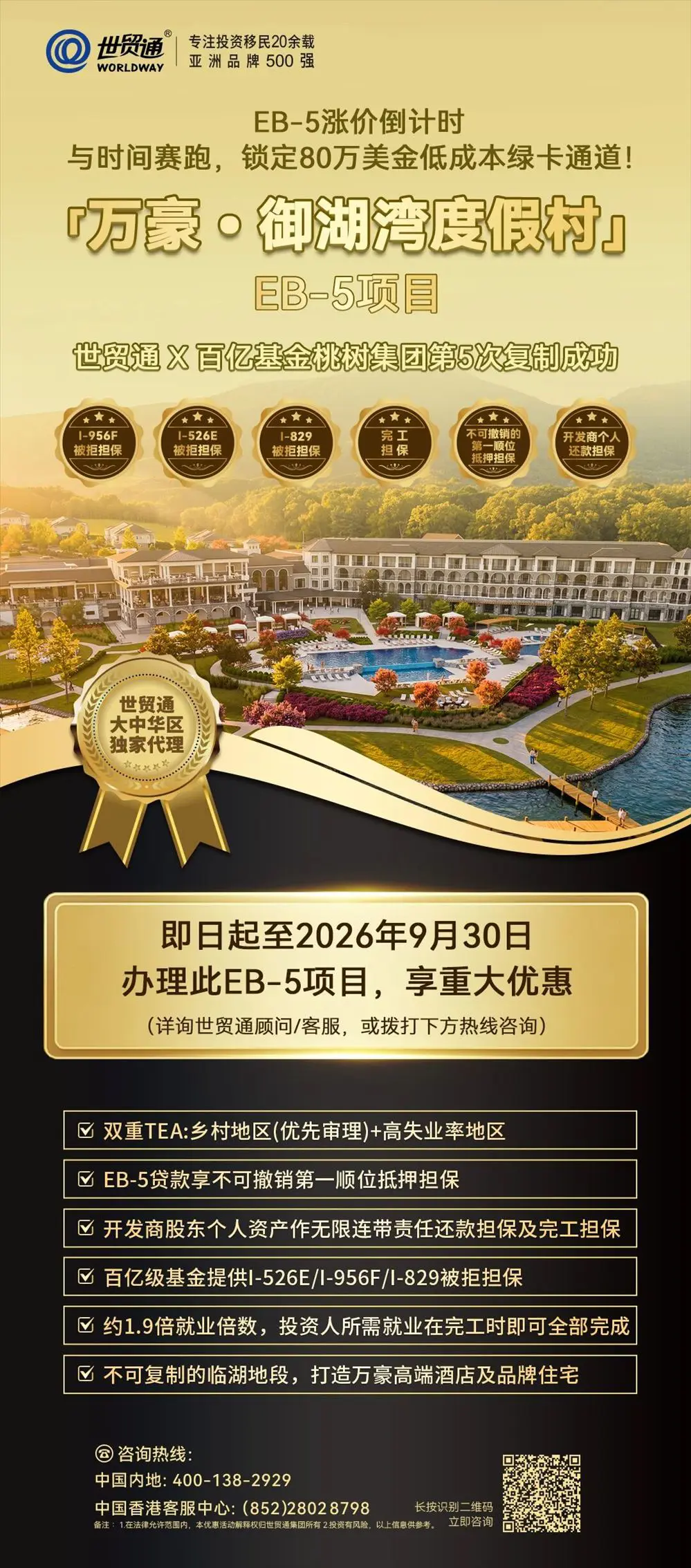
Currently, WorldWay focuses on promoting the I-956F approved rural EB-5 project “Deer Valley · Snowridge Residences” and the “Marriott · Royal Lake Bay Resort” EB-5 project launched in partnership with Peachtree Group for the fifth time, offering diverse project choices for families with different planning needs. From now until September 30, 2026, clients applying for EB-5 immigration can enjoy limited-time exclusive offers, further reducing application costs during the current window period.
Inquiries in Mainland China: 400-138-2929, Hong Kong Customer Service Center: (852)2802 8798