





International travel, overseas education for children, cross-border business operations, living abroad…… the living radius of an increasing number of families is no longer confined to a single country.
At the same time, visa, entry, and residency policies across different countries are constantly evolving.
According to the 2026 Henley Passport Index, the average passport globally currently grants visa-free or visa-on-arrival access to approximately 108 destinations, while the top-ranked passport provides access to 192 destinations. Over the past 20 years, overall global travel convenience has improved significantly.
For individuals who need to travel across borders multiple times a year for business, leisure, or family visits, a second passport can reduce visa application, appointment, and waiting times, while providing an additional set of residency options for their children's education, career development, and future life. This is also a genuine need observed by WorldWay through its long-standing service to numerous families.

1. Why Have Some Global Investors
Paid Attention to a Second Status Early On?
As early as 2017, internationally renowned investor Jim Rogers (Jim Rogers) remarked when discussing a second status that in the next 20 years, having only one passport could leave you at a significant disadvantage.
This view was later widely summarized as:
“In the next 10, 15, or 20 years, having only one passport is very dangerous. You must have a Plan B, and having a second passport gives you an extra option.”
Li Ka-shing also expressed a similar view in an interview:
“It is not surprising that some people have two or three passports. My company's business involves 57 countries; whichever country's passport is convenient, I use that one.”
One focuses on having a Plan B when facing uncertainty, while the other emphasizes mobility efficiency in global business.
Through its service to numerous cross-border families, WorldWay has found that both perspectives ultimately point to the same principle:
As family, career, and daily life become increasingly globalized, status itself has become a resource that requires advance planning.
2. Providing Children with an Additional Path
for Future Education and Development
For families planning their children's education, one of the most practical values of a second status is offering children more choices in their academic progression. WorldWay has served many families whose primary focus is their children's education, deeply understanding the power of choice that this planning brings.
Children can receive local education in the destination country or choose from different educational systems such as international schools and private schools based on family plans, providing more options for transitioning to overseas universities in the future.
If the family later prefers the children to study in mainland China, they can also apply to top mainland universities as international students without written examinations.
In other words, a second status does not restrict a child to a single educational track, but rather gives the family greater flexibility to balance “studying abroad” and “pursuing higher education back home.”
3. Tax and Asset Allocation:
Greater Room for Planning
For business owners and high-net-worth families, the value of a second status is also reflected in tax planning and global asset allocation.
Some Citizenship by Investment countries implement relatively simple or tax-friendly regimes, with low tax burdens or no levies on personal income tax, capital gains tax, inheritance tax, gift tax, or wealth tax. Families with overseas income, cross-border businesses, or global assets can make more reasonable arrangements by integrating actual residence, tax residency status, and asset distribution.
At the same time, when a family's enterprises, real estate, financial assets, and living arrangements are distributed across different countries, a second status can be combined with overseas residency, business operations, and family wealth structuring, creating broader opportunities for global asset allocation.
4. Relocation Is Not Mandatory:
Preparing a Plan B in Advance
Obtaining a second status does not mean having to relocate overseas immediately.
In fact, what many families value most when acquiring a second status is precisely having a “backup.”
The international environment changes, visa policies are adjusted, and children's future development paths, business footprints, and family life arrangements may become entirely different from what they are today.
The significance of a Plan B is not that it must be used right now, but that when the time truly comes, you are already prepared.
This is why, for families with global lifestyle needs, status planning often needs to begin well ahead of actual deployment.
5. Which Families Stand to Benefit Most
from Considering a Second Status?
√ Frequent global travelers who undertake frequent business trips, vacations, or family visits and wish to reduce visa hassles and travel restrictions;
√ Families planning overseas education for their children who want to open more pathways for higher education, employment, and long-term career growth;
√ Business owners with cross-border operations whose ventures span multiple countries and regions and who wish to align their personal status with their global business footprint;
√ Families with increasingly internationalized lifestyles whose members, education, business, and daily lives are distributed across different countries;
√ Families seeking to prepare a Plan B in advance who have no immediate relocation plans but want to preserve an alternative status option for the future.
Simply put, the broader a family's living radius, the more evident their need for status flexibility becomes.
6. 9 Countries: WorldWay Continues to Expand Its Layout
in Global Citizenship by Investment Programs
Addressing the diverse status needs of different families, the Citizenship by Investment programs currently prioritized by WorldWay span multiple regions, covering a total of 9 countries:
• Europe: Turkey
• Pacific: Nauru, Vanuatu
• Caribbean: St. Kitts and Nevis, St. Lucia, Grenada, Antigua and Barbuda, Dominica
• Africa: São Tomé and Príncipe
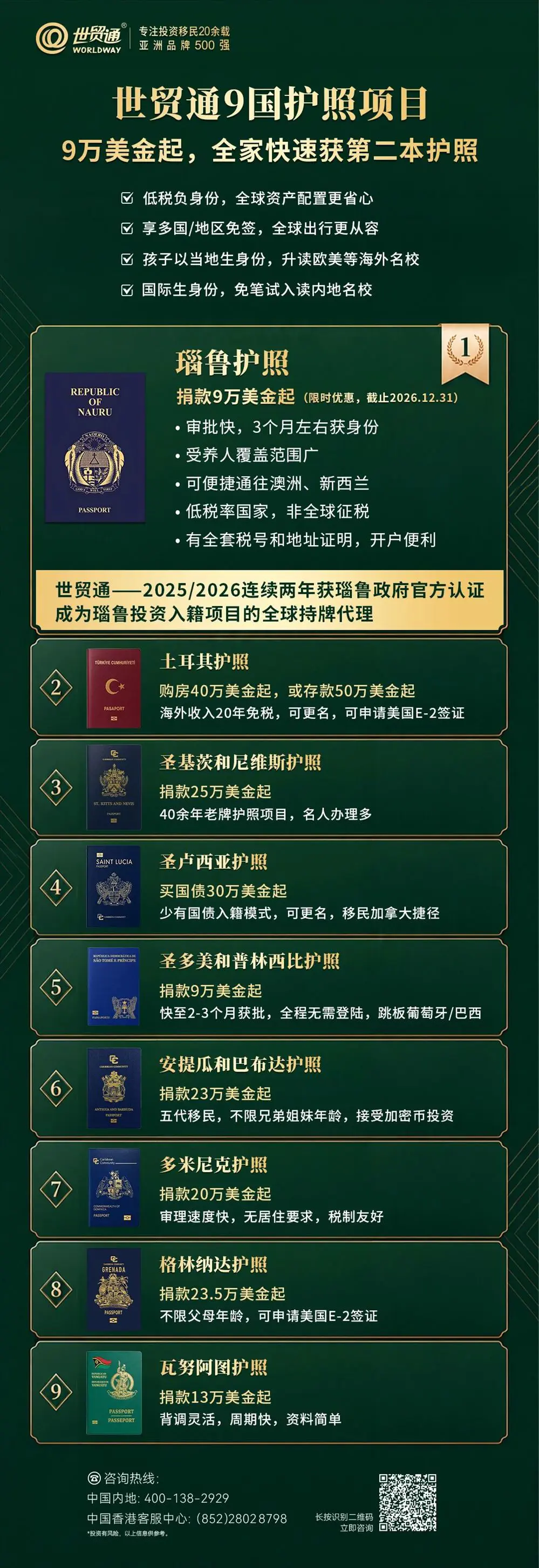
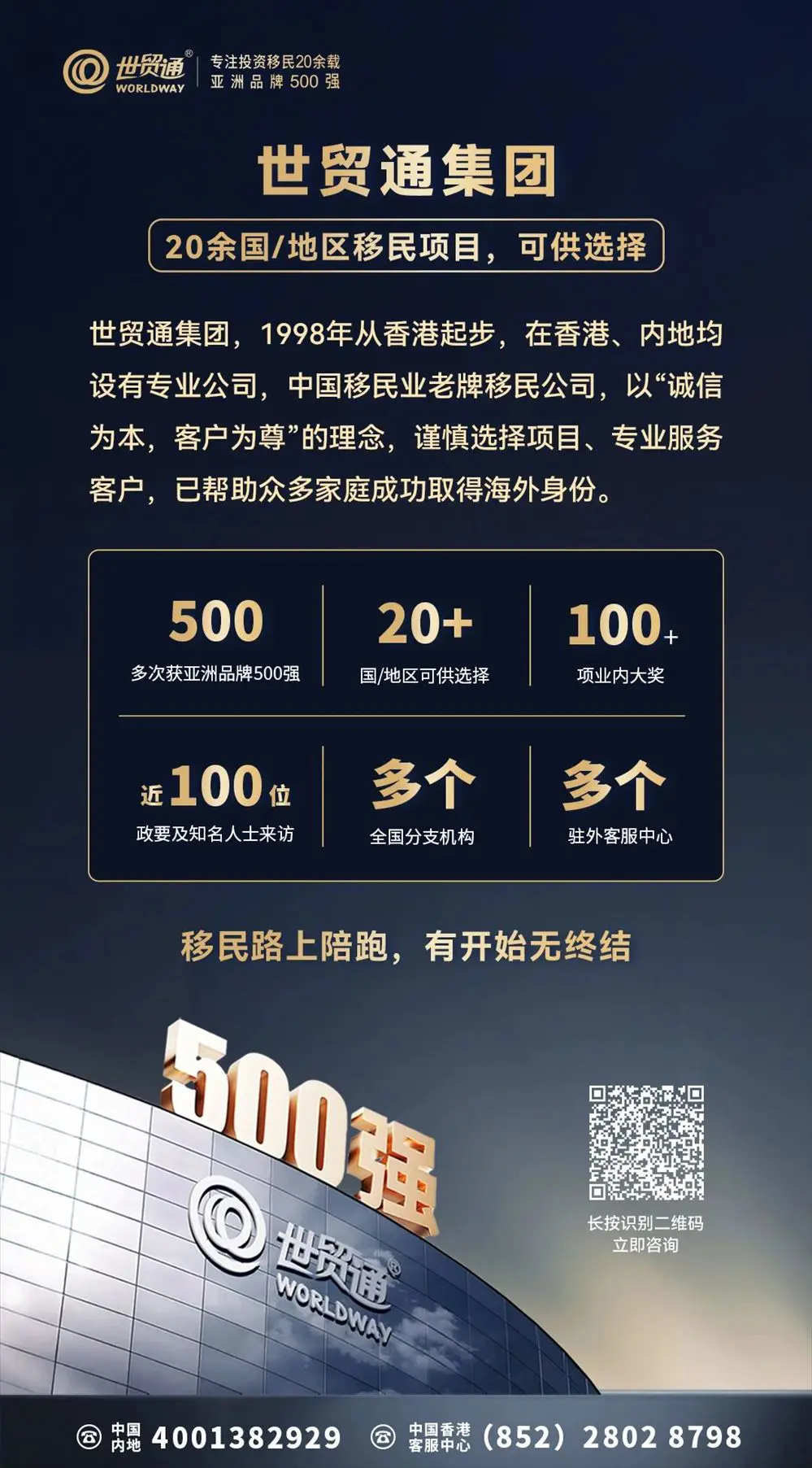
Recognized as one of Asia's Top 500 Brands and specializing in immigration for over two decades, WorldWay Group started in Hong Kong in 1998. Deeply rooted in Hong Kong for more than 20 years, it operates professional offices in both Hong Kong and Mainland China. With over 20 years of deep expertise in global immigration services, WorldWay integrates the practical needs of various families in international travel, children's education, global business, and long-term status planning. By conducting comprehensive comparisons across program policies, investment routes, processing timelines, and family member arrangements, WorldWay helps families identify the second status solution best suited to them.
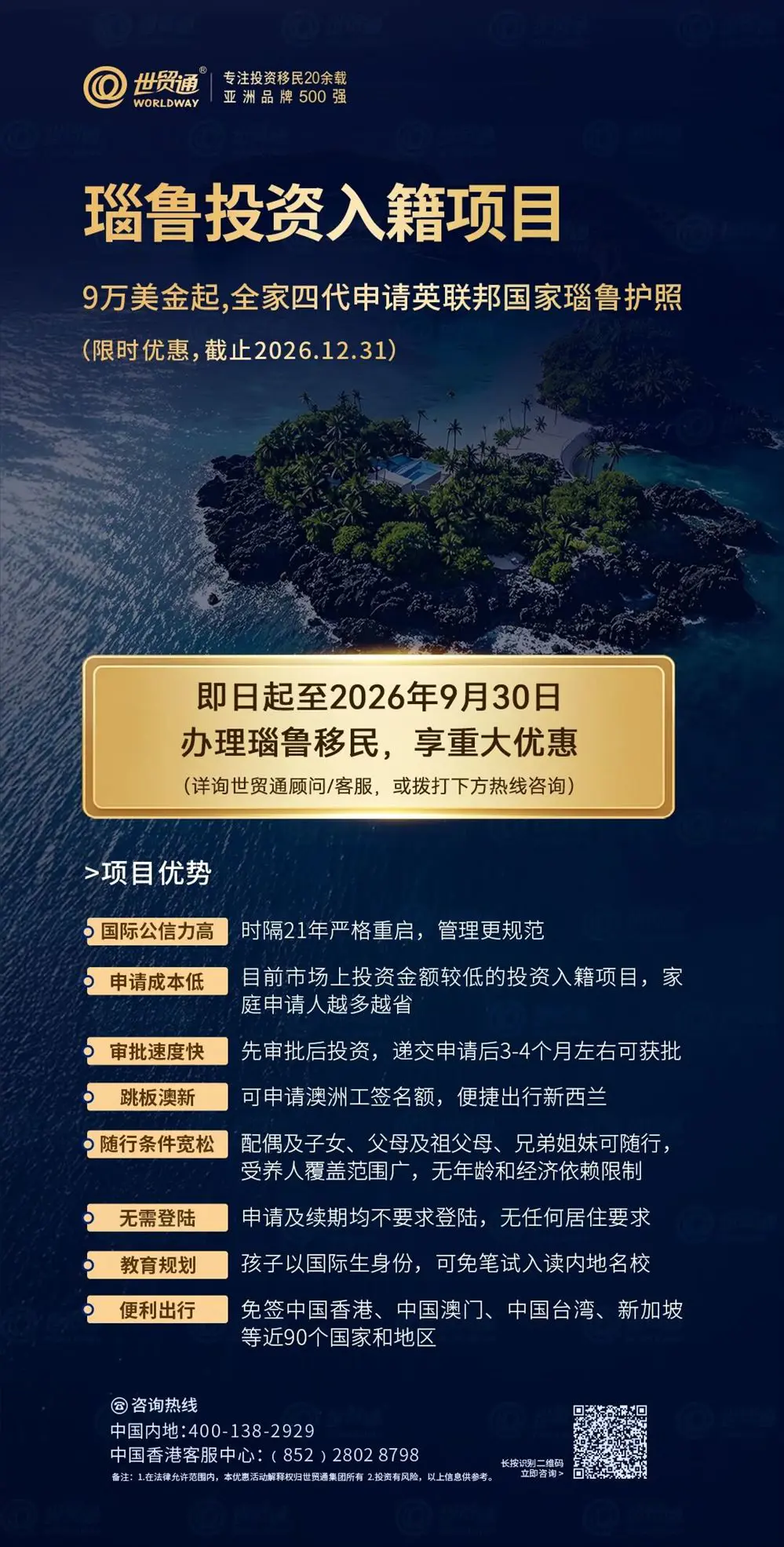
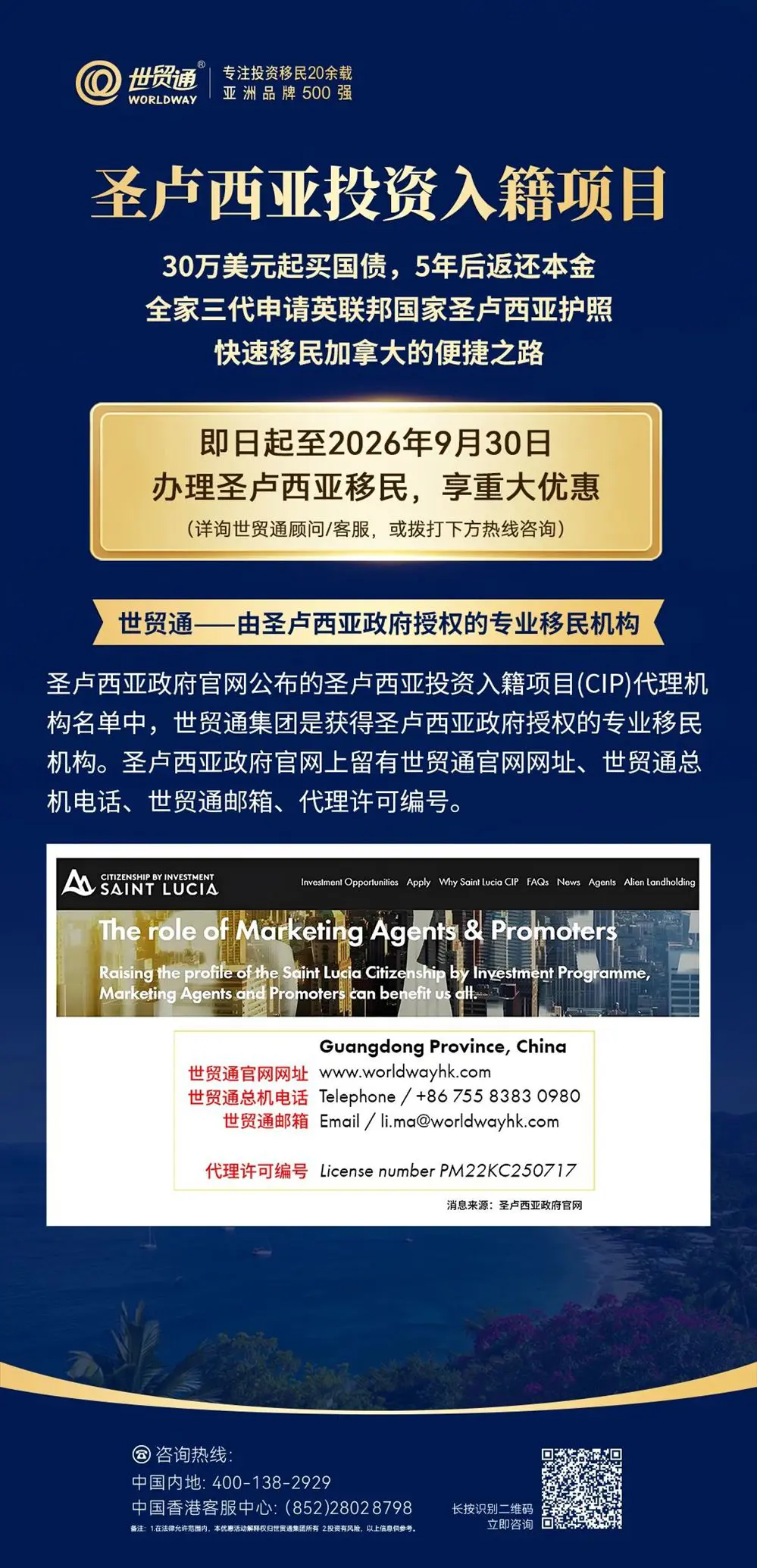
Special Notice: From now until September 30, 2026, applicants for the Citizenship by Investment programs of Nauru, St. Lucia, and St. Kitts and Nevis can enjoy limited-time exclusive offers, further reducing processing costs. A rare opportunity.

For detailed inquiries, Mainland China: 400-138-2929; Hong Kong SAR Customer Service Center: (852)2802 8798