





Property purchasing costs in Greece may see a significant increase.
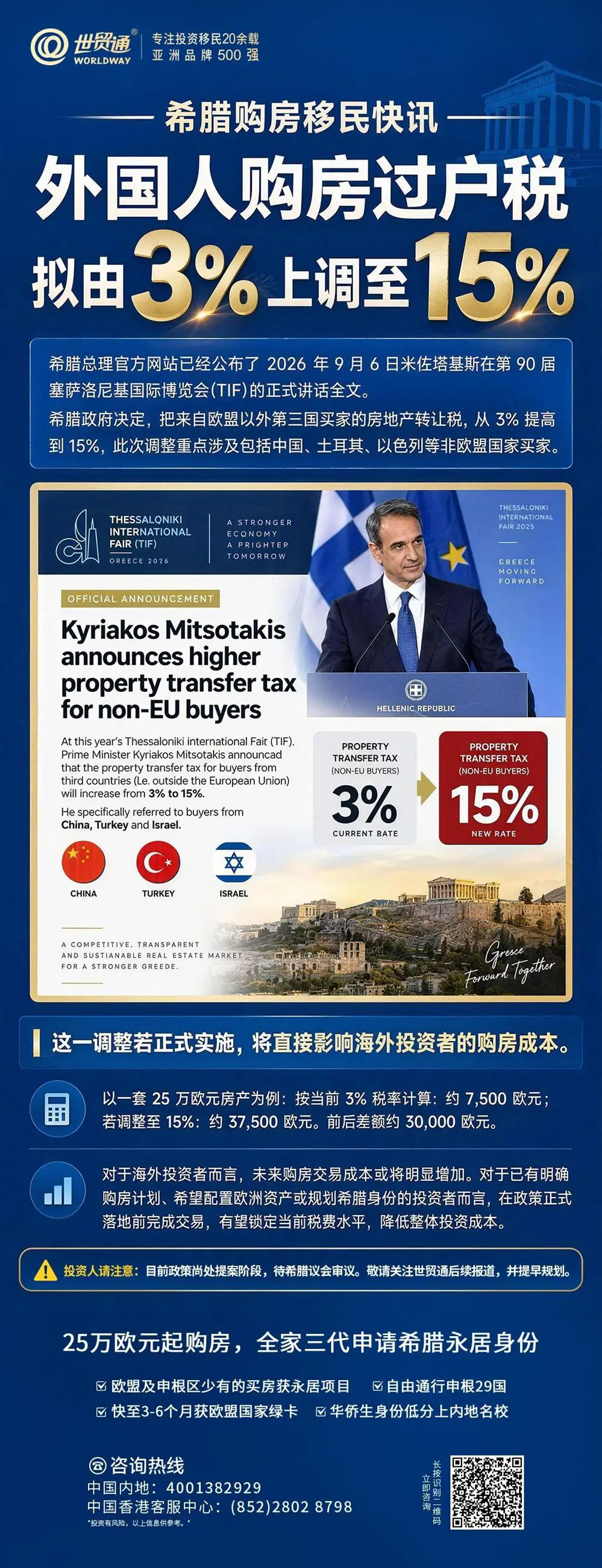
On September 5 local time, Greek Prime Minister Mitsotakis announced in his opening speech at the Thessaloniki International Fair (TIF): The government has decided to increase the property transfer tax (i.e., property transaction tax) for non-EU third-country buyers purchasing residential properties from the current 3% to 15%. The new tax rate is scheduled to take effect on January 1, 2027.
WorldWay Immigration has closely followed and compiled relevant public information. For families currently applying for or planning to apply for the Greece Golden Visa through property purchase, the most direct impact of this policy change will be on property purchasing costs and transaction timelines.
If the policy is implemented according to the current proposal, there are less than 4 months remaining before the new tax rate takes effect. For families currently considering Greek property purchases, Golden Visa applications, or European asset allocation, greater attention needs to be paid to the pace of upcoming contract signings and transactions.

I. Tax Rate Quintuples
Properties Worth €250,000 May Require an Additional €30,000 in Tax
Currently, the standard rate of Greek property transfer tax is 3% of the taxable value of the property, borne by the buyer, with relevant declarations and payments completed prior to signing the property transfer contract.
If the new policy is officially implemented, the standard tax rate for eligible non-EU buyers purchasing residential property will directly increase from 3% to 15%.
Taking a property worth €250,000 as an example, a simple calculation based on the standard tax rate shows:
Under the current 3% rate, approximately €7,500 is payable;
After the adjustment to 15%, approximately €37,500 will be payable;
A difference of approximately €30,000.
If purchasing a residential property worth €400,000, calculated in the same way, the tax difference will reach approximately €48,000; for an €800,000 property, the difference will be approximately €96,000.
For investors, this is no longer a minor adjustment of a few thousand euros, but a cost that must be directly factored into the property purchase budget.
II. Why Greece Is Raising Property Taxes for Non-EU Buyers
This tax rate adjustment is related to the ongoing housing pressure faced by Greece in recent years.
The official website of the Greek Prime Minister subsequently published Mitsotakis' full speech. Speaking about the local real estate market, he noted that while home purchase demand from third-country buyers such as China, Turkey, and Israel is welcome, it has also driven up property prices in certain areas, increasing homeownership pressure for local residents.
Therefore, the Greek government hopes to regulate overseas purchasing demand to a certain extent by raising the property transfer tax for non-EU buyers.
Recent policy changes also demonstrate that Greece is continuing to attract overseas capital while strengthening regulation of the residential property market in popular regions.
III. Countdown to the New Tax Rate: Current Applications Require Urgent Action
According to the currently announced timeline, the new tax rate is scheduled for implementation starting January 1, 2027, leaving less than 4 months from now until the end of the year.
For families with clear plans for Greek property purchases or Golden Visa applications, the most crucial step now is to initiate the application as soon as possible and advance processes such as property selection, legal review, tax number application, and contract preparation.
After all, from selecting a property to completing the transaction, multiple steps are involved, and any delay in one step could impact the overall schedule.
If you already have plans for Greek residency, rather than waiting until the new policy is officially implemented and incurring higher purchasing costs, it is better to take advantage of the current policy window to complete project selection and transaction preparations early, aiming to finalize key stages before the policy changes take effect.
IV. The €250,000 Window Remains Open: Quality Properties Should Be Secured in Advance
In recent years, the Greece Golden Visa has undergone multiple policy adjustments—from raising investment thresholds in certain areas to redefining investment criteria for different property types—and now property purchasing taxes are facing new changes as well.
The signal sent by continuous policy adjustments is increasingly clear: Greece still welcomes overseas investment, but management of the residential property market continues to tighten.
Currently, the eligible €250,000 property pathway still exists and remains attractive for families wishing to acquire European residency through a lower investment threshold.
It is worth noting that quality "commercial-to-residential" properties in the current market that meet the policy requirements of the Greece Golden Residency Program and can be transferred quickly are relatively limited. For families with clear plans for Greek residency, the ability to select projects and execute transactions has become even more critical.

WorldWay Group, a top 500 Asian brand with over 20 years of focus on immigration, started in Hong Kong in 1998. Deeply rooted in Hong Kong for more than two decades, it has professional companies in both Hong Kong and Mainland China. Over the years, WorldWay has continuously monitored global immigration policy changes and overseas residency allocation needs of different families. Regarding this adjustment to the Greek property transfer tax, WorldWay will also closely follow subsequent legislation and tax implementation details, promptly share policy updates, and assist clients with tailored Greece Golden Visa and property purchasing planning based on their residency needs, investment budgets, and property preferences.

For details, please inquire: Mainland China: 400-138-2929, Hong Kong Customer Service Center: (852)2802 8798