





The US government is further tightening the definition of the scope of birthright citizenship. 《Sudden Change! A New Draft Law on US Birthright Citizenship Is Here》《Alarm Bell for US Status! Birth Tourism in the US Faces a New Round of Strict Scrutiny》(Click to read WorldWay's previous report for details)
On September 4 local time, the US Department of Homeland Security (DHS) issued a temporary final rule, establishing new provisions for the status determination of children born in the United States to certain foreign government employees.
WorldWay Immigration has noted that under the new DHS rule, if neither parent is a US citizen at the time of the child's birth, and at least one parent qualifies as a "foreign government employee" as defined by the rule, the child may not automatically acquire US citizenship by virtue of being born in the United States. Meanwhile, eligible children may apply to register as US permanent residents.
I. What Are the Key Changes in This Adjustment?
In the past, there were already a few exceptions to US birthright citizenship.
The Fourteenth Amendment to the US Constitution provides that persons born in the United States and "subject to the jurisdiction thereof" acquire US citizenship in principle. However, children born in the US to foreign diplomats have long been a classic exception due to their parents' special diplomatic status and immunity.
The biggest change in this rule is the further expansion of this scope from traditional "foreign diplomats" to certain employees of foreign governments and international organizations. According to the DHS definition, the relevant personnel mainly include:
• Foreign diplomats accredited by the United States;
• Personnel employed by foreign embassies or consulates in the US who are nationals of that foreign country;
• Personnel employed by a foreign government in an official capacity;
• Personnel serving in international organizations that enjoy relevant immunities.
II. Automatic Citizenship Unavailable, Eligible Children May Register for a Green Card
This new rule also includes an important provision.
For relevant children who cannot automatically acquire US citizenship under the above rules, the US government simultaneously provides a pathway to register for permanent residence.
Eligible applicants can apply to register as US permanent residents via Form I-485, and DHS has simultaneously adjusted the relevant application rules and forms.
According to the provisions, applicants must meet corresponding conditions, including being born in the United States, neither parent being a US citizen at birth, at least one parent being a foreign government employee within the specified scope, and continuously maintaining a residence in the United States.
If the child enjoys diplomatic privileges or immunities, they are also required to waive such privileges and immunities in accordance with regulations before permanent resident status officially takes effect.
Simply put, for children affected by the new rule, the status pathway may shift from "obtaining US citizenship at birth" in the past to "not automatically obtaining citizenship, but being eligible to register as a permanent resident if conditions are met".
It should be noted that this new rule is currently subject to judicial litigation. On September 2, the US District Court for the District of Maryland issued a preliminary injunction in a related case; therefore, DHS will currently not take measures against populations protected by the injunction that conflict with the court's ruling. The extent to which the new rule can be implemented depends on the further development of judicial proceedings. WorldWay will closely monitor the situation and share any new updates promptly.
III. Scrutiny of Birthright Citizenship Continues to Tighten
Viewing this new rule in the context of recent policy changes, the US government's direction toward tightening birthright citizenship has become increasingly clear.
Although this new rule targets specific groups, from previous executive orders on birthright citizenship to restrictions on "birth tourism", and now to DHS further refining applicable rules, the US government's scrutiny and criteria regarding "who can acquire citizenship by being born in the US" are becoming continuously stricter.
While some measures still face legal challenges, a key trend deserves serious consideration for families with plans for US education, living, and long-term development:
The scope for obtaining status certainty through a child's birthplace is shrinking, making it even more important for parents themselves to hold stable, long-term US status.
Compared to visas, temporary statuses, and status pathways vulnerable to policy changes, planning long-term status in advance gives families greater initiative in children's education, living in the US, and career development.
As a Top 500 Asian Brand with over two decades of focus on immigration, WorldWay Group started in Hong Kong in 1998 and has been rooted in Hong Kong for over 20 years, with professional companies established in both Hong Kong and Mainland China. Over the years, WorldWay has continuously monitored changes in US immigration policies and provided status planning and project services for families planning long-term moves to the US.
Currently, for families seeking long-term US status through investment, EB-5 remains one of the key pathways worth prioritizing.
Currently, under the new law, rural EB-5 projects still enjoy reserved visa quotas and priority processing. For eligible applicants who are physically present in the US maintaining legal status, when there is no visa backlog, adjustment of status can be advanced simultaneously through "concurrent filing".
At the same time, EB-5 is approaching two critical deadlines: the grandfathering clause deadline on September 30, 2026, and the investment amount adjustment deadline on January 1, 2027.
For families with clear long-term plans in the US, rather than placing status hopes on future policy relaxation, it is better to establish a more stable and controllable status plan early on, tailored to their individual circumstances.
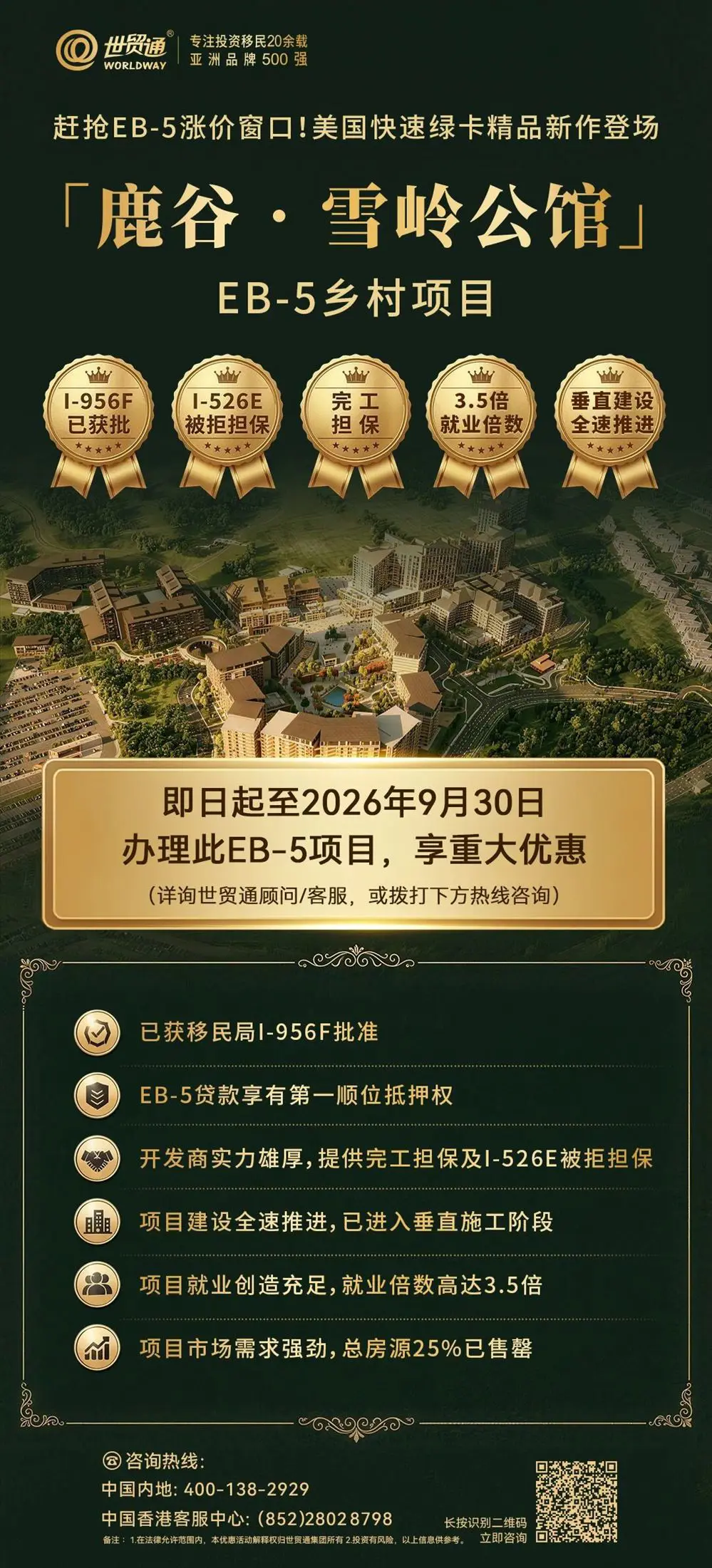
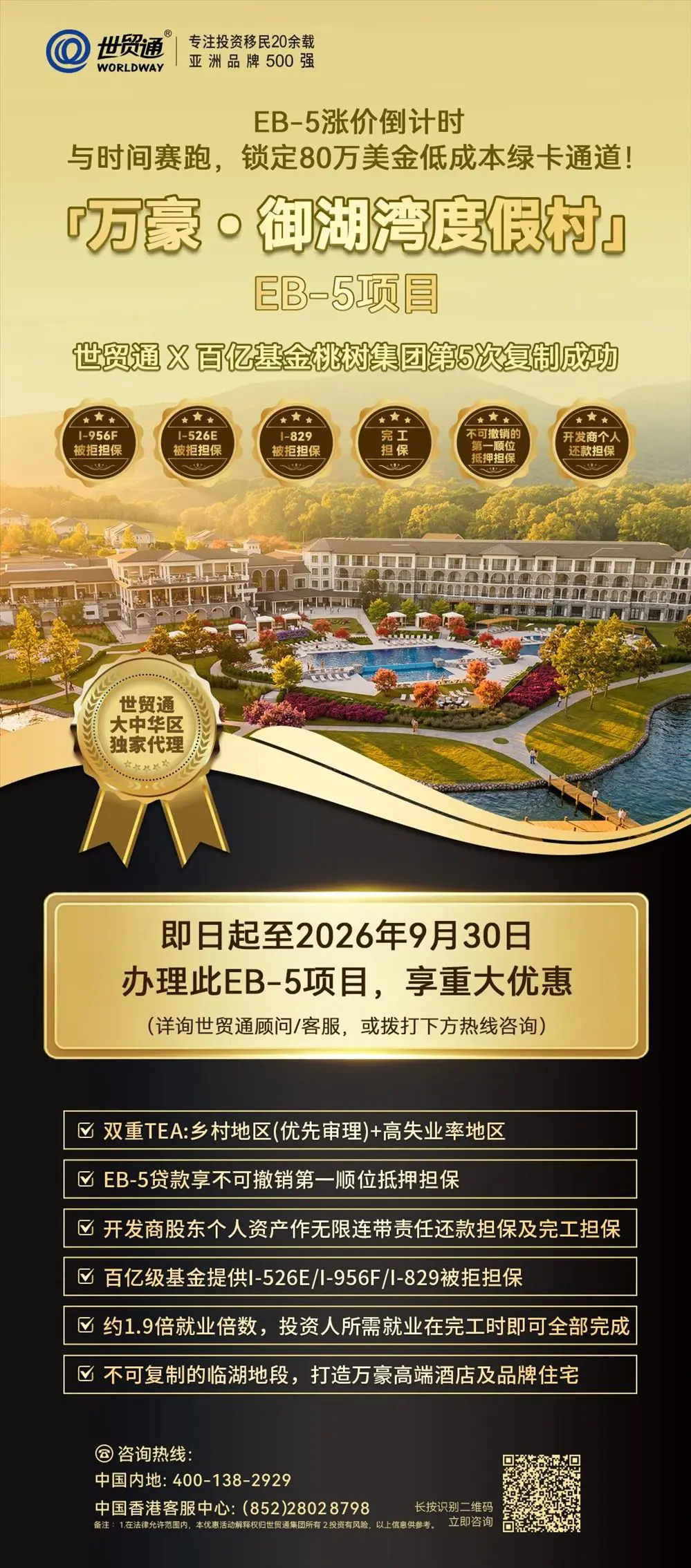
WorldWay highlights the I-956F-approved 「Deer Valley · Snowridge Residences」 EB-5 rural project, as well as the 「Marriott · Royal Lake Bay Resort」 EB-5 project launched in partnership with Peachtree Group for the fifth time, offering diverse project choices for different families. From now until September 30, 2026, applying for EB-5 immigration entitles you to a limited-time exclusive promotion, further reducing application costs during the current window.
For details, please call Mainland China: 400-138-2929; Hong Kong SAR Customer Service Center: (852)2802 8798