





Another noteworthy shift has emerged regarding U.S. birthright citizenship.
WorldWay Immigration notes that according to a Reuters report on September 1, the U.S. Department of State has drafted a new set of passport vetting guidance. Under the draft guidance, in the future, when parents apply for a U.S. passport for a child born in the United States, in addition to proving parentage and identity, they may also need to submit documentation of the parents' own U.S. citizenship or lawful immigration status.
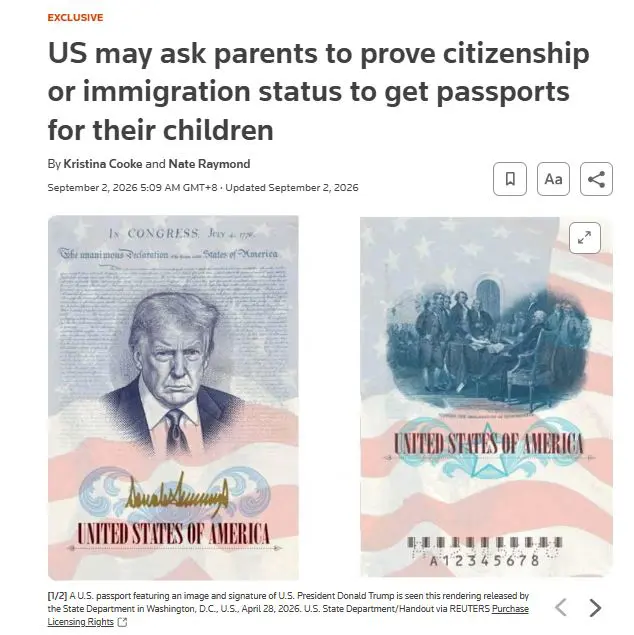
If the parents are U.S. citizens, they may be required to provide documents such as U.S. passports or birth certificates; if they are not U.S. citizens, they may need to provide an I-94, Green Card, or other proof of legal immigration status.
Simply put, when a child applied for a U.S. passport in the past, the vetting focused primarily on the child; in the future, the status of the parents may also be incorporated into the review process.
Currently, this guidance remains in draft form and has not been officially implemented. Behind it lies an ongoing policy and judicial struggle over U.S. birthright citizenship involving the Trump administration.

I. From Executive Order to the Supreme Court
Ongoing Tug-of-War Over Birthright Citizenship
The United States has long practiced birthright citizenship. The Fourteenth Amendment to the Constitution, adopted in 1868, stipulates that all persons born in the United States and subject to the jurisdiction thereof are U.S. citizens.
In its second term, the Trump administration has once again sought to narrow the scope of birthright citizenship. This tug-of-war between policy and the judiciary has continually escalated:
• January 20, 2025: Trump signed an executive order restricting birthright citizenship.
• June 30, 2026: The U.S. Supreme Court struck it down in a 6-3 ruling.
• August 6, 2026: Trump signed a new executive order with a narrowed scope, specifically targeting groups such as “birth tourism,” “foreign government personnel,” and “individuals from hostile nations.”
• September 1, 2026: Reuters disclosed the State Department's draft guidelines on vetting children's passports, indicating that parental status may be included in the review.
However, the matter does not end here.
II. September 2
New Executive Order Blocked Again by Court
Just after the draft passport vetting guidelines were exposed, new developments emerged in this battle over birthright citizenship.
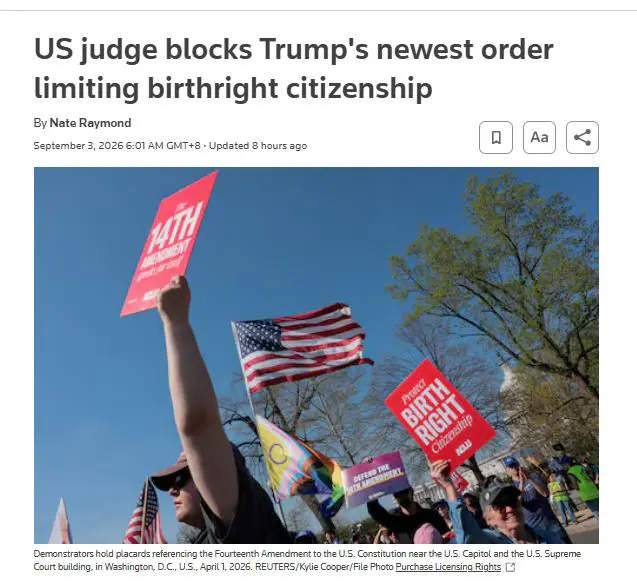
On September 2, U.S. District Judge Deborah Boardman in Maryland issued a preliminary injunction, blocking the government from enforcing Trump's latest August 6 executive order on birthright citizenship against the affected children.
The judge noted that the Supreme Court had already affirmed on June 30 that the children in question are U.S. citizens at birth, concluding that the new executive order is “almost certainly unconstitutional” as applied to the class action members.
However, although the court halted the execution of the new executive order, it did not prevent the relevant departments from continuing to formulate implementation guidelines.
In other words, while courts continue to delineate the boundaries of birthright citizenship, the administration is still attempting to advance restrictions through more specific rules.
This ongoing policy and judicial tug-of-war also introduces greater uncertainty into the determination and processing of birthright citizenship status.

III. Growing Uncertainty
Status Planning Should Be Done Even Earlier
In such a policy environment, for families with plans for U.S. education, living, career, or long-term development, making immigration status arrangements earlier allows for more options in the future.
After all, birthright citizenship only resolves the child's status and cannot replace long-term status planning for the entire family. Rather than relying on a single policy that may change, it is better to establish a clearer, more stable immigration pathway in advance.
EB-5 offers precisely such an option. Aiming for U.S. permanent residency, an eligible principal applicant can include their spouse and qualifying children in the application, achieving holistic status planning for the entire family.
Currently, under the new law, rural EB-5 projects still benefit from reserved visa quotas and priority processing. For eligible applicants residing in the United States in lawful status, concurrent filing allows them to advance their adjustment of status simultaneously when there is no visa backlog.
Right now, EB-5 also has two key milestones worth watching. Starting January 1, 2027, the minimum EB-5 investment amount will increase from $800,000 to $900,000–$950,000 or even higher. Meanwhile, the September 30, 2026 grandfathering clause deadline is also approaching.
As a Top 500 Asian Brand with over 20 years of focus on immigration, WorldWay Group started in Hong Kong in 1998 and has been rooted in Hong Kong for over two decades, with professional companies established in both Hong Kong and the Chinese Mainland. Over the years, WorldWay has continuously tracked changes in U.S. immigration policies, providing status planning and project services for families planning long-term moves to the United States.

Currently, WorldWay is highlighting the I-956F-approved “Deer Valley · Snowridge Residences” EB-5 rural project, as well as the “Marriott · Imperial Lake Bay Resort” EB-5 project launched in partnership with Peachtree Group for the fifth time, offering diverse project choices for different families. From now until September 30, 2026, applying for EB-5 immigration comes with a limited-time exclusive offer, further reducing processing costs during the current opportunity window.


For detailed inquiries, Mainland China: 400-138-2929; Hong Kong Customer Service Center: (852)2802 8798