



There are new updates regarding the suspension of U.S. immigrant visa interviews.
Previously, we followed the news regarding U.S. embassies and consulates adjusting immigrant visa appointments and interview schedules. At the time, the U.S. Department of State did not provide a clear timeframe for resumption. (For details, click to view the WorldWay report: U.S. Immigrant Visa Interviews Urgently Halted! Interpretation of the Truth)
Now, further information has emerged regarding the issue everyone is most concerned about: “How long will the suspension last?”
According to the latest report by the Associated Press (AP), an anonymous U.S. State Department official who was not authorized to comment publicly revealed that the suspension began in early August and is not expected to last beyond early to mid-September.
The official also stated that most affected applicants were originally scheduled for interviews in August, and the relevant interviews have not been canceled, but will be rescheduled to September, October, and November.
Based on the information disclosed so far, this adjustment appears to be a phased change in interview scheduling.
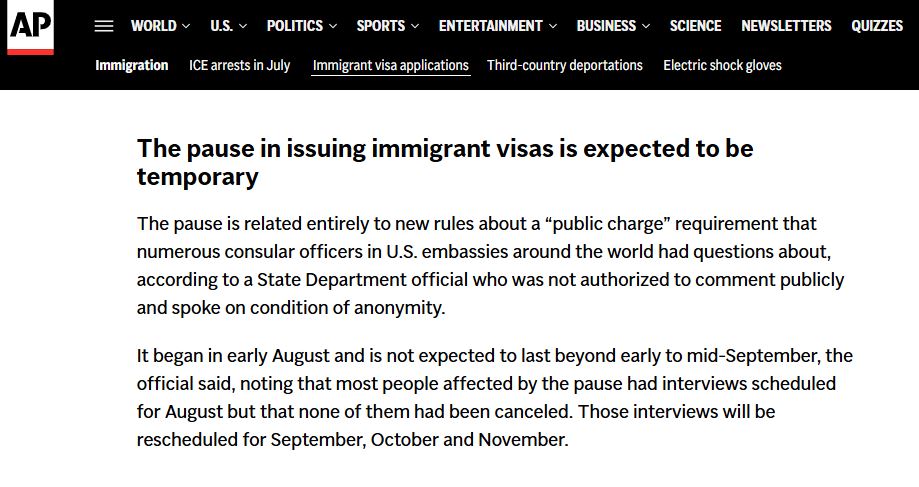
However, it should be noted that “early to mid-September” remains an estimated timeline disclosed to the media by an anonymous State Department official, rather than an officially announced unified resumption date by the U.S. Department of State. For individual applicants, the specific timeline will still be subject to subsequent notices issued by their respective embassy or consulate.
I. Rescheduling of Interviews
Does Not Equal Application Rejection
This adjustment mainly affects applicants processing immigrant visas through U.S. embassies and consulates abroad—that is, individuals outside the United States who need to complete consular interviews before traveling to the U.S. to obtain permanent resident status. Reuters also explicitly reported that the suspension targets immigrant visa appointments at U.S. embassies and consulates worldwide.
For individuals who are already inside the United States, qualify, and are applying for adjustment of status via Form I-485, their cases are adjudicated by the U.S. Citizenship and Immigration Services (USCIS) and are not within the scope of this overseas consular interview adjustment.
Therefore, interview delays do not mean that the immigration application has been rejected or automatically voided. Applicants who have already received rescheduling notices should continue to monitor their emails and subsequent notices from the embassy or consulate, and prepare or update their documentation based on the progress of their case.
II. Behind the Suspension
"Public Charge" Scrutiny Is Tightening
The focus behind this suspension still points to “Public Charge”.
According to the AP citing the aforementioned State Department official, this suspension is related to new public charge requirements. As some consular officers at overseas embassies and consulates had questions regarding the new requirements, centralized training was needed to further unify the adjudication standards.
Judging from a series of recent actions, the U.S.'s emphasis on “public charge” is also visibly strengthening.
On August 5, the U.S. Department of State officially launched the “Public Charge Bond” pilot program; USCIS also readjusted its public charge review rules to conduct a more comprehensive assessment of applicants' family circumstances, assets, financial capabilities, and other factors.
Therefore, this interview adjustment may only be short-term. What truly deserves attention is how public charge reviews will be executed once interviews resume.

III. Another Background: The Suspension of Immigrant Visas for 75 Countries Was Just Overturned by Court
Just before this global interview adjustment, another U.S. immigrant visa policy related to “public charge” also saw changes.
Earlier this year, the U.S. Department of State temporarily suspended the issuance of immigrant visas to applicants from 75 countries.
On August 21, the U.S. District Court for the Southern District of New York overturned this policy, ruling that completely suspending immigrant visa issuance based solely on an applicant's nationality exceeded the Secretary of State's statutory authority.
A few days later, the U.S. Department of State confirmed again that embassies and consulates worldwide were adjusting immigrant visa appointments and conducting “public charge” training for consular officers.
The back-to-back occurrence of these two changes releases a signal worthy of attention: compared to the previous practice of blanket restrictions based on nationality, U.S. immigrant visa adjudication is placing greater emphasis on the specific evaluation of individual applicant circumstances.
As “public charge” standards tighten further, consular officers may scrutinize factors such as an applicant's family situation, financial capability, asset status, and likelihood of becoming dependent on public benefits in the future even more meticulously.
IV. Adjudication Is Tightening
Immigration Planning Demands Early Preparation
Based on current information, this interview adjustment is not expected to last long.
Compared to “when it will resume”, what deserves long-term attention is the ongoing shift in U.S. immigration adjudication standards.
For families who clearly have long-term needs to go to the U.S. and possess the corresponding financial capacity, immigration planning should be considered even earlier.
In the current policy environment, the three set-aside visa categories under the EB-5 Reform and Integrity Act—rural, high unemployment, and infrastructure projects—currently remain free of visa backlogs; eligible applicants inside the United States can also concurrently advance I-526E and I-485 through “concurrent filing”. Meanwhile, two key milestones are approaching: September 30, 2026 is an important deadline for the “grandfather clause”, and on January 1, 2027, the minimum EB-5 investment amount will rise from the current $800,000 to $900,000–$950,000 or higher. For families with clear U.S. residency planning needs, making application and financial arrangements in advance is all the more crucial.
Currently, WorldWay is highlighting the I-956F approved “Deer Valley · Snow Ridge Residences” EB-5 rural project, as well as the “Marriott · Royal Lake Bay Resort” EB-5 project launched in partnership with Peachtree Group for the fifth time, offering diverse project choices for families with long-term U.S. residency planning needs. From now until August 31, 2026, applying for EB-5 immigration entitles you to a limited-time exclusive offer, enabling you to advance your U.S. residency planning at a more optimized cost.
Policies are constantly evolving; the tighter the adjudication becomes, the more necessary it is to plan out the residency pathway, financial arrangements, and application timing well in advance.
WorldWay will also continue to monitor the recovery status of U.S. immigrant visa interviews and the subsequent execution of the “public charge” policy, and will share updates promptly as new official information becomes available.


For detailed inquiries in Mainland China: 400-138-2929; Hong Kong, China Customer Service Center: (852)2802 8798