



The Trump administration has sent another strong signal: a B1/B2 visa revocation campaign that could mark the largest in U.S. history is brewing.
• Up to 200,000 —— B1/B2 visas proposed to be revoked (involving certain visas issued between 2016 and 2026)
• Largest in history—— If fully implemented, it may set a new U.S. record for a single visa revocation action
• Ongoing effort——Reviews are still underway, and the final number may continue to change


1. Up to 200,000 B1/B2 Visas
May Face Large-Scale Revocation
Reported on August 24 local time, the Trump administration is planning a large-scale revocation operation targeting up to 200,000 B1/B2 business and tourism visas.
U.S. Department of State Spokesperson Tommy Pigott stated: “We are coordinating with the Department of Homeland Security to identify and revoke the nonimmigrant visas of foreign nationals who claimed temporary entry to the United States and subsequently applied for asylum to reside permanently.”
According to reports, Pigott declined to comment on the specific number of visas that may be revoked, stating only that “because this process is ongoing, the number of revocations remains fluid.”
A U.S. official revealed that the Department of State is expected to announce the revocation of certain B1 and B2 visas in the coming weeks. These visas were issued between 2016 and 2026, and their holders have sought or are currently seeking asylum.
2. Behind a Series of Actions
Policy Signals Are Accumulating
Looking at this news item alone, many people might feel it is “irrelevant to them.”
After all, this measure does not target everyone who uses B1/B2 visas normally, but focuses on scrutinizing those who entered under temporary visitor status and subsequently applied for asylum.
However, taking a broader view, one realizes this is not an isolated event, but part of the U.S.'s ongoing effort to strengthen visa and immigration oversight:
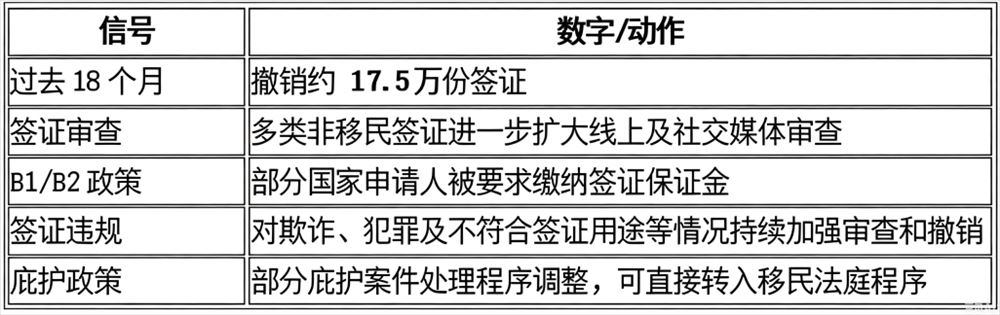
Remarks by U.S. Deputy Secretary of State Christopher Landau were even more direct. He publicly criticized foreign nationals who enter the United States on tourist or business visas and subsequently file for asylum, stating: “People in the United States and around the world are tired of fraudulent asylum claims. Asylum should not serve as a loophole to evade immigration laws.”
3. The Trend Is Clear
Scrutiny of Temporary Status Is Becoming Increasingly Strict
Connecting these developments, what truly deserves investors' attention is not merely a single visa revocation policy, but the increasingly strict U.S. scrutiny over visa usage, status adjustment, and intent of long-term residence.
Visa fraud, asylum abuse, and visa usage inconsistent with the original purpose of application are all becoming primary targets of regulation.
In short——the leeway to enter on a short-term visa and subsequently seek temporary ways to remain long-term is being squeezed further.
Pathways that can still be used normally today do not guarantee that policies will not be adjusted in the future; and visas already obtained do not mean they will remain exempt from re-examination throughout their validity period.
4. Residency Status Requires “Planning”
Do Not “Leave It to Chance”
In the past, many high-net-worth families were accustomed to using tourist and business visas to flexibly enter and leave the U.S., employing them as tools to meet periodic travel needs.
However, the current trend is already clear: a temporary visa is just a temporary visa; it solves the issue of visiting, not long-term residency.
As the U.S. steps up follow-up scrutiny of existing visa holders, even if a visa remains within its validity period, any subsequent actions that blatantly conflict with the original visa purpose could lead to re-examination or even revocation.
True certainty comes not from a temporary visa, but from a compliant, transparent, and predictable long-term residency pathway.
5. Where Is the Certainty?
Turn Your Attention to EB-5
If B1/B2 addresses short-term travel to the U.S., then EB-5 addresses long-term status planning.
The 2022 EB-5 Reform and Integrity Act established reserved visa categories: 20% for rural projects, 10% for high-unemployment areas, and 2% for infrastructure projects. Currently, under the new law, these three reserved visa categories remain unreserved/no-visa-wait-list for applicants born in Mainland China, with rural projects also enjoying priority processing.
With an investment starting at $800,000, the entire family can apply for U.S. permanent resident status without relying on schools, employers, or repeatedly addressing status issues via temporary visas.
For applicants already residing legally in the U.S. (such as H-1B, L-1, F-1, etc.), under the no-backlog status, they can concurrently file Form I-526E and Form I-485 while applying for an Employment Authorization Document (EAD) and Advance Parole, providing greater flexibility for working and living in the U.S.
As U.S. scrutiny of temporary visas and status usage grows increasingly strict, the importance of planning long-term residency in advance becomes ever more prominent for families with legitimate long-term needs for education, work, and living in the U.S.
Right now, EB-5 itself is in a crucial window of opportunity worth seizing. The current minimum investment threshold for eligible EB-5 projects remains $800,000, but starting January 1, 2027, the minimum EB-5 investment amount will increase from $800,000 to $900,000–$950,000 or higher.
Trends wait for no one; the earlier you plan your status, the more initiative you gain
The proposed revocation of 200,000 visas is a warning and a reminder
Want to secure a reliable Plan B for your family?
The compliant pathway of EB-5 is worth exploring right now
Currently, WorldWay is prominently featuring the I-956F approved “Deer Valley · Snow Ridge Mansion” EB-5 rural project, as well as the “Marriott · Lakeview Bay Resort” EB-5 project launched in its fifth collaboration with Peachtree Group, offering more project options for different families. From now until August 31, 2026, applying for EB-5 immigration enjoys a limited-time exclusive promotion to advance your U.S. status planning at a more favorable cost.

For detailed inquiries in Mainland China: 400-138-2929; Hong Kong SAR Customer Service Center: (852)2802 8798