



Does securing an offer from a prestigious university mean that the path to studying in the U.S. is completely set?
In the past, when planning to study in the U.S., many families focused primarily on school selection, majors, academic grades, and background enhancement.
However, an increasingly realistic question is now coming to the forefront:
School admission solves the issue of “whether you can go to study,” while legal status determines whether you can walk this path more comfortably and confidently in the future.
Recently, according to statistics compiled by the Center for Immigration Studies based on visa data released by the U.S. Department of State, from May to August 2025, the U.S. issued 40,034 F-1 student visas to Chinese citizens, a 34% decrease compared to 61,075 during the same period in 2024; and issued 22,149 to Indian citizens, a year-on-year drop of 62%.
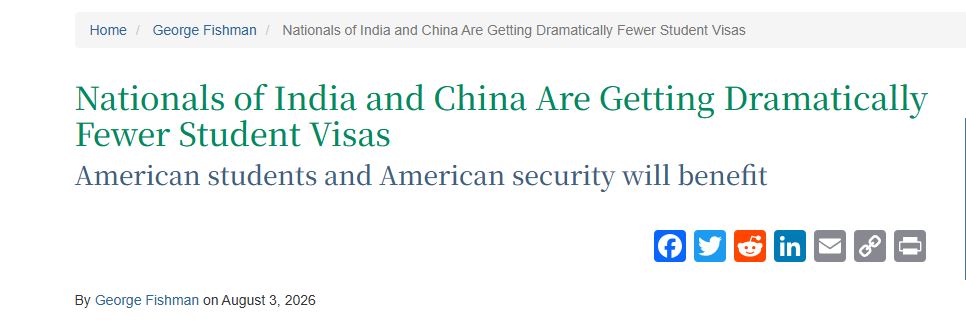

I. Decline in Visa Numbers
The Appeal of Studying in the U.S. Remains Strong
An interesting phenomenon is that:
While the number of student visas has undergone significant changes on one hand, the U.S. still boasts one of the largest international student populations in the world on the other.
According to "Open Doors 2025" published by the Institute of International Education (IIE), during the 2024-2025 academic year, there were 1,177,766 international students enrolled in U.S. higher education institutions, accounting for 6% of the total higher education student population in the U.S.
Among them, Chinese students reached 265,919, remaining the second largest source group of international students in the U.S.; 57% of international students chose STEM-related majors. Meanwhile, the number of international students in the OPT phase during that academic year reached 294,253, representing a year-on-year increase of 21%.
This set of data actually highlights one point: American education remains attractive, but “studying in the U.S.” and “developing a career in the U.S. in the future” are becoming two separate issues that require distinct planning.
In the past, many families were more concerned about: How can the child get an offer? How to enter their ideal university?
Now, one must think a step further: After graduation, how will the next stage be connected?
II. Studying Abroad Is Not a Single Ticket to the End
It Is a “Relay Race”
In the past, many families had a very clear path in mind:
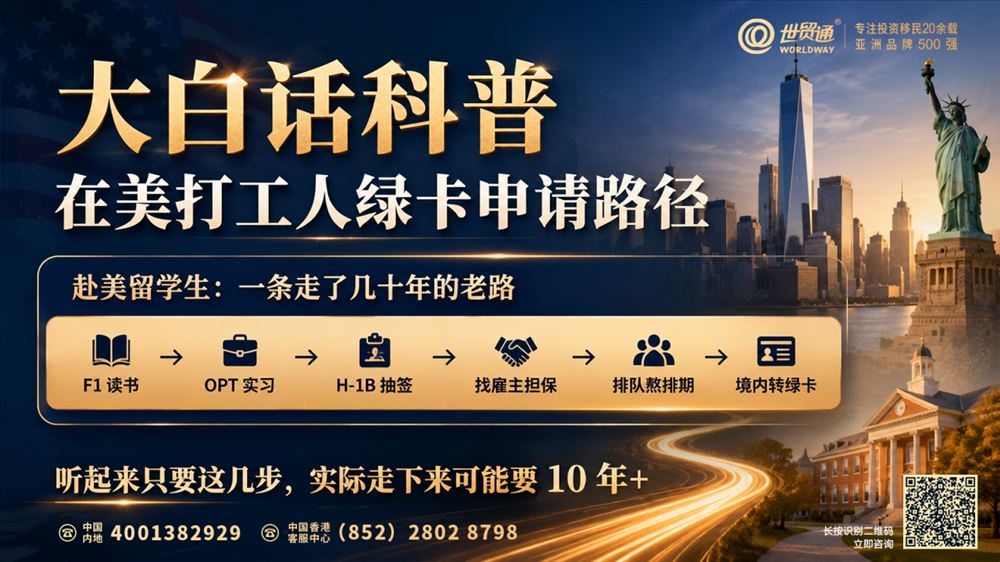
Get Offer → Apply for F-1 → OPT after graduation → Find a job → Resolve subsequent immigration status.
It looks like a straight line.
Only when actually walking the path do people realize that studying abroad is more like a relay race——each leg has its own rules when you reach it.
Leg 1: Academics.
Getting an offer and securing an F-1 visa is just the beginning; maintaining student status as required during university is also necessary.
Leg 2: Internship.
If students wish to stay and work in the U.S. after graduation, eligible students can apply for OPT; under qualifying conditions for STEM majors, they can obtain an OPT employment period of up to 36 months.
Leg 3: Employment.
If one wishes to continue developing a career in the U.S. after OPT, they must face the immigration status transition for the next stage. Choosing H-1B may involve issues such as employer sponsorship and quota lottery selections.
Every leg moves you forward, but no leg automatically connects to the next.
This is also something that many study-abroad families easily overlook:
When the child is 18, the schools, majors, and application timelines are planned meticulously; but when graduating at 22, it is the first time they seriously ponder——what status will allow them to continue forward from here?
This is also where study-abroad planning today most warrants reflection and change.
III. Don't Wait Until Graduation to Feel Anxious
Incorporate “Immigration Status” into Your Plan
If the child's future plan is simply to complete a study experience in the U.S. and return home or move to another country after graduation, then an F-1 visa can naturally meet regular academic needs.
However, if the family's goals are:
• Looking for a job in the U.S. comfortably after graduation without being held hostage by “immigration status”;
• Pursuing long-term career development in tech, finance, healthcare, engineering, and other industries without being at the mercy of employer sponsorships;
• Or even intending for the whole family to live in the U.S. in the future……
Then, status planning must be done in advance! In advance! And in advance!
Imagine when looking for a job upon graduation, the child's confidence comes from asking “Is this company right for me?” rather than humbly asking “Can you sponsor my visa status?” This is not just an upgrade in choice, but a leap in taking control of one's life!
When a family secures a long-term and stable status arrangement, educational and career planning can shift from “status-first” to “development-first.”
This may well be the deeper value of status planning for study-abroad families.
IV. Holding the “Trump Card” of Legal Status
Leave More Choices to Your Child
For families with clear goals, the smartest approach now is to plan “immigration status” and “studying abroad” in the same basket.
EB-5 is one such option. Eligible families can apply for U.S. permanent resident status through investment, and the main applicant's spouse and unmarried children meeting age requirements can apply together.
Currently, the minimum EB-5 investment amount remains at $800,000, and the current investment threshold is in an important window period. Starting January 1, 2027, the minimum EB-5 investment amount will increase from the current $800,000 to $900,000–$950,000 or even higher.
Currently, WorldWay offers two major EB-5 projects: the I-956F-approved “Deer Valley · Snow Ridge Lodge” and “Marriott · Royal Lake Bay Resort,” jointly launched for the fifth time by WorldWay and Peachtree Group. From now until August 31, 2026, applying for EB-5 immigration can also enjoy limited-time exclusive discounts from WorldWay.
Education is a long-term journey, and legal status is also a long-term commitment. Rather than frantically scrambling during graduation season, it is better to arrange legal status well ahead of demand now. After all, an offer determines where a child starts from, while legal status determines how high they can fly and how far they can go in the future!


For inquiries in Mainland China: 400-138-2929, Hong Kong SAR, China Customer Service Center: (852)2802 8798