



U.S. immigration applications have reached another important milestone.
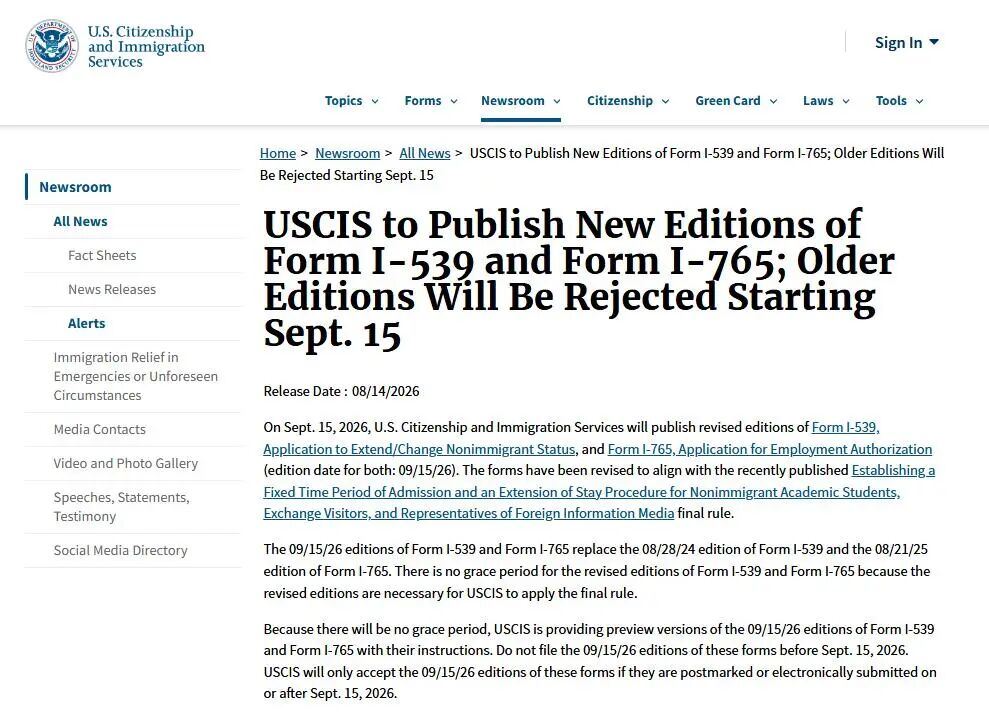
U.S. Citizenship and Immigration Services (USCIS) announced: Starting September 15, 2026, Form I-539 (Application to Extend/Change Nonimmigrant Status) and Form I-765 (Application for Employment Authorization) will officially adopt the new 09/15/26 edition.
More importantly, there is no grace period for this form update, nor is there a transition period where old and new editions are accepted concurrently.
In other words, September 15 serves as a clear “cutoff line”: Before September 15, use the current edition; starting September 15, you must switch to the new edition.

1. Two Important Forms Updated Simultaneously
Strict Cutoff on September 15
This update involves two frequently used immigration forms.
1. Form I-539: Application to Extend/Change Nonimmigrant Status
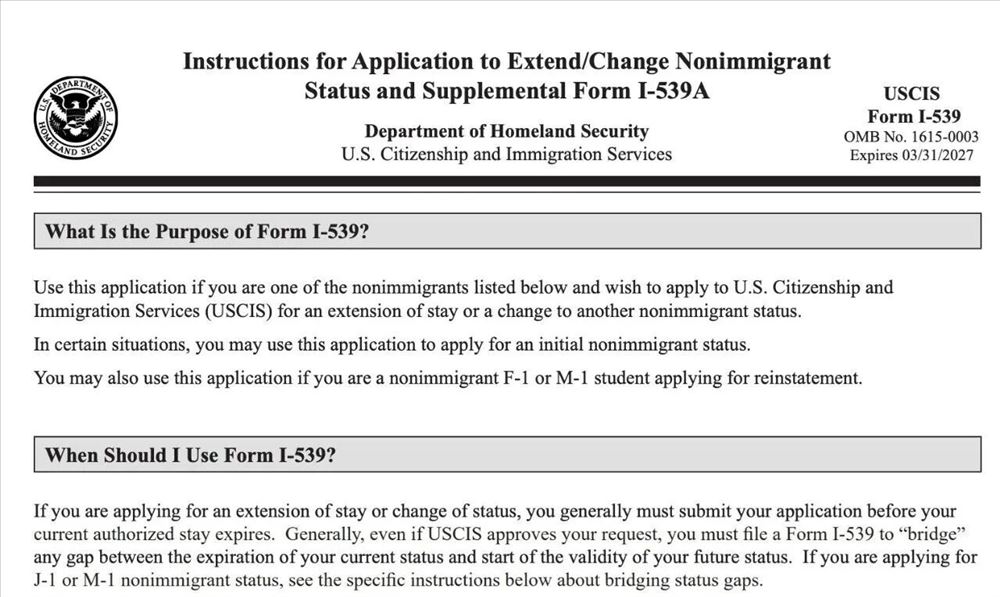
Currently, the 08/28/24 edition is in use.
If submitted before September 15, the current edition may still be used; however, starting September 15, 2026, the new 09/15/26 edition must be used, and the old edition will no longer be accepted.
Form I-539 is primarily used for extending or changing certain nonimmigrant statuses, such as for certain F and J status holders, as well as dependent status applications like H-4 and F-2.
2. Form I-765: Application for EAD Card
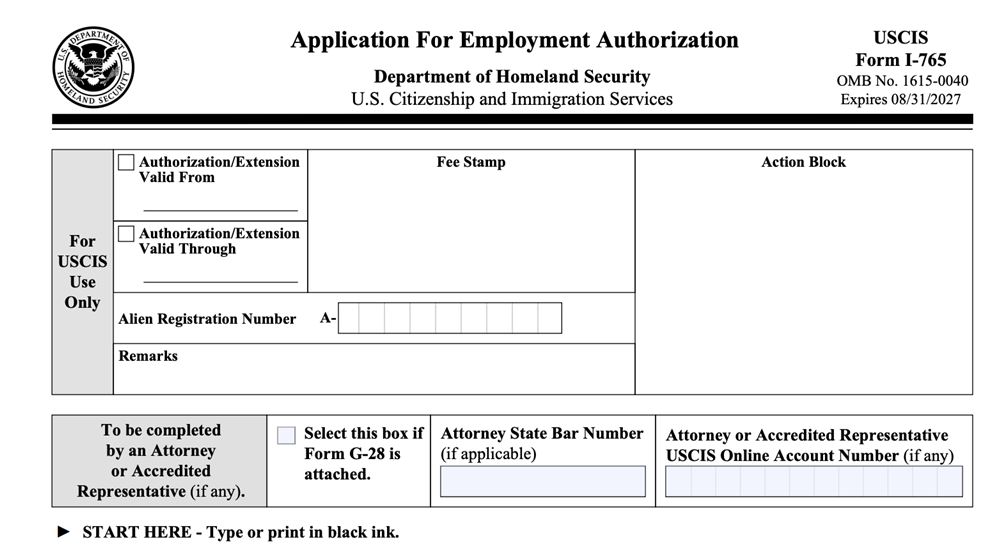
Currently, the 08/21/25 edition is in use.
Likewise, starting September 15, applicants must switch to the new 09/15/26 edition. Continuing to use the old edition will result in direct rejection by USCIS.
For many international students, Form I-765 is very familiar.
F-1 students applying for OPT or STEM OPT, as well as eligible individuals such as certain H-4 spouses applying for EAD cards, may all use this form.
Therefore, the two scenarios to avoid most during this form update are:
Submitting the new edition too early, or submitting the old edition too late.
In particular, applicants who are accustomed to downloading forms to their computers in advance to prepare slowly should double-check the edition on the official USCIS website before formal submission, to avoid delaying the entire application due to an expired PDF.
2. Why Update Forms Specifically on September 15?
This form update is not merely a simple formatting adjustment.
Behind it lies a major change in how U.S. nonimmigrant status is managed——the new rules establishing fixed periods of stay for F, J, and I nonimmigrants will take effect on the same day.
In the past, upon entry into the U.S., many F-1 students and J-1 exchange visitors had their stay duration on the I-94 recorded as “D/S”, meaning Duration of Status.
Simply put, as long as the applicant continuously and lawfully maintains their status and complies with school or program requirements, they generally do not need to repeatedly apply to USCIS for extensions due to a fixed I-94 expiration date.
However, starting September 15, these rules will begin to change.
For individuals subject to the new rules, after entering the U.S. in the future, their I-94 will more frequently display a specific expiration date. F and J nonimmigrants will generally be admitted for the duration of their program, but a single period of stay will typically not exceed 4 years; I foreign media representatives will be subject to an even shorter fixed period. (For details, click to read WorldWay's previous report: Major New Rule Implemented! The U.S. Ends the D/S Status Validity System)
If they still need to remain in the U.S. after their originally authorized stay expires, they may need to apply for an extension.
Precisely because status durations and extension procedures are changing, related forms such as I-539 and I-765 must be updated synchronously.
Therefore, what is truly worth paying attention to this time is not just the “form update.”
Behind the form changes, nonimmigrant statuses such as F and J are shifting from the relatively flexible D/S management of the past to a management system with clearer time milestones.
3. More Status Milestones
U.S. Stay Planning Must Be Done Further in Advance
Looking at recent changes together reveals an increasingly obvious trend: status management for studying, interning, and working in the U.S. is becoming more meticulous.
For those who are going to the U.S. merely for temporary study or exchange, simply adhering to the latest rules at each milestone is sufficient.
However, if a family's goal goes beyond having their child complete a course of study in the U.S. and includes interning, gaining employment, or even pursuing long-term development in the U.S. after graduation, what really needs to be considered in advance is: planning long-term legal status early.
This is because F-1 resolves study status, OPT addresses temporary post-graduation employment, and if one wishes to continue living and working in the U.S. thereafter, it may involve transitioning to a new legal status.
When policies change, timelines may change accordingly.
For families with clear long-term U.S. goals, rather than figuring out the next step at every milestone, it is far better to align education, employment, and long-term status along a single timeline early on.
4. Beyond Studying Abroad
Long-Term Legal Status Should Also Be Planned in Advance
If a family's goal goes beyond studying in the U.S. to include having the child intern, work, and live in the U.S. in the future, long-term status is well worth considering early.
EB-5 Investment Immigration offers a Green Card application pathway that does not depend on schools, employer sponsorship, or participating in the H-1B lottery.
√ No Visa Backlog Dividend: The set-aside visa categories are currently still in a “no backlog” golden window, and rural EB-5 projects also enjoy priority processing.
√ Concurrent Filing Advantage: International students inside the U.S. with lawful entry status can concurrently file Form I-526E and Form I-485 to quickly obtain lawful status.
√ One Application, Family-Wide Benefit: Synchronize children's education planning with family status planning.
Additionally, please note that on January 1, 2027, the minimum investment amount will be raised from $800,000 to $900,000–$937,500 or higher.
Currently, WorldWay offers two major EB-5 projects: the I-956F approved “Deer Valley · Snowridge Residences”, and “Marriott · Royal Lakefront Resort”, presented through the fifth collaboration between WorldWay and Peachtree Group, providing families looking to plan U.S. status with more high-quality project choices.
At the same time, from now until August 31, 2026, applying for EB-5 immigration through WorldWay also comes with limited-time exclusive offers. With the no-backlog window still open and the $800,000 investment threshold not yet adjusted, interested families can seize the current policy and offer window to start their status planning as early as possible.


For details, please call Mainland China: 400-138-2929, Hong Kong, China Customer Service Center: (852) 2802 8798