



Those applying for a Green Card within the United States have another new policy to pay attention to.
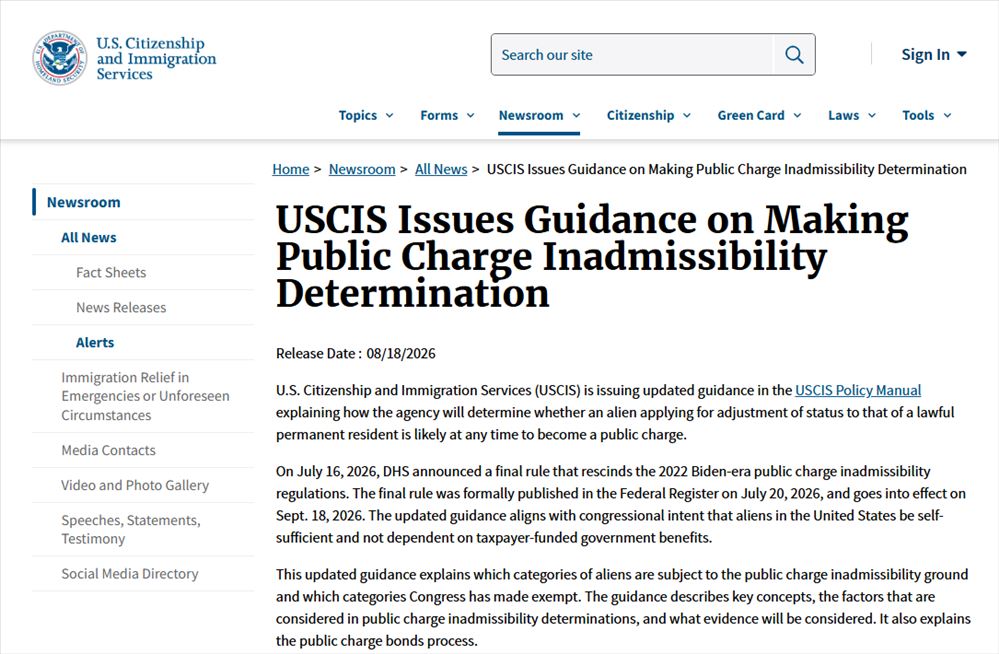
On August 18, 2026, local time, U.S. Citizenship and Immigration Services (USCIS) issued new policy guidance, re-clarifying the review standards for “Public Charge”.
The new policy will officially take effect on September 18, 2026, applying to relevant I-485 Adjustment of Status applications submitted by mail or electronically on or after that date. The biggest change in this policy can be summarized in one sentence: in the future, when immigration officers determine whether an applicant is likely to become a “public charge”, there are more factors they can consider, and the scope of public benefits subject to review has expanded significantly.

1. What is a “Public Charge”?
In simple terms, a “public charge” refers to the determination by U.S. immigration authorities on whether an applicant is likely to depend on government public assistance for subsistence in the future.
Therefore, USCIS does not simply look at whether an individual has “ever received public benefits”, but considers the applicant's totality of circumstances to determine whether they have the ability to achieve financial self-sufficiency in the future.
2. What aspects will USCIS evaluate to determine “Public Charge”?
When evaluating whether an applicant is likely to become a public charge in the future, immigration officers mainly consider 5 statutory factors:
√ Age;
√ Health status;
√ Family status;
√ Assets, resources, and financial status;
√ Education level and skills.
In addition, if the applicant's immigration category requires the submission of Form I-864 Affidavit of Support, the immigration officer may also include it in the overall determination.
3. Use of public benefits will become an important review factor
In addition to the above factors, the applicant's receipt of public benefits may also serve as an important reference for immigration officers.
Examples provided in the USCIS document include:
√ Cash assistance for income maintenance;
√ Housing assistance benefits;
√ Food assistance benefits;
√ Financial aid for higher education;
√ And other similar means-tested public benefits.
It should be noted here that not all government services, subsidies, or scholarships will be counted. The new policy focuses on means-tested public benefits—that is, government assistance where eligibility is typically determined based on the applicant's income, assets, and other financial conditions.
4. Where are the main tightenings in this update?
Under the 2022 rule: The benefits primarily considered by USCIS were public cash assistance for income maintenance and long-term institutionalization at government expense. The scope of benefits was relatively specific, and immigration officers faced more limitations when making public charge determinations.
Under the 2026 new rule: This relatively fixed scope is broken. Starting September 18, in addition to cash assistance and long-term institutionalization, more means-tested public benefits such as housing assistance, food assistance, and certain educational assistance may also be taken into consideration. At the same time, immigration officers can make a more comprehensive evaluation by combining the applicant's age, health, family status, income and assets, education and skills, as well as other case-relevant factors.
Another notable change: Form I-864 remains important, but it cannot single-handedly determine the result of the public charge review. Even if an applicant has a qualifying Affidavit of Support, the immigration officer may still conduct an overall evaluation based on the applicant's individual circumstances.
Therefore, the key areas where the policy has truly tightened can be summarized in two points:
The scope of benefits under review is broader, and immigration officers have greater discretion for holistic evaluation.
5. September 18 is an important cutoff date
The new rule clearly specifies that relevant I-485 applications submitted by mail or electronically on or after September 18, 2026, will be subject to the new policy.
For public benefits received prior to September 18, USCIS will still determine the scope of review in accordance with the previous 2022 rule, primarily considering cash assistance for income maintenance and long-term institutionalization at government expense.
However, starting September 18, other means-tested public benefits received by applicants may also be included in the totality of circumstances evaluation for public charge.
Therefore, for applicants who are planning to file Form I-485 in the near future, both the timing of the I-485 submission and their personal receipt of public benefits are worth reviewing in advance.
6. If there is a public charge issue, is there still a remedy?
Yes.
If USCIS determines that an applicant is likely to become a public charge, and public charge is the sole ground of inadmissibility preventing approval, the immigration officer may offer the applicant an opportunity for remedy:
Submitting a Public Charge Bond.
Simply put, the applicant provides a bond as required by USCIS to serve as financial assurance that they will not rely on government public benefits in the future.
The bond can be posted via cash bond or a surety bond provided by an acceptable surety company, with the exact amount determined by USCIS based on individual case circumstances.
However, special attention should be paid: applicants cannot proactively file Form I-945 in advance, nor can they pay the bond on their own initiative.
Only after USCIS determines eligibility upon adjudication and explicitly invites the applicant to submit a bond via a NOID, which is a “Notice of Intent to Deny”, can the applicant submit Form I-945 as required.
Therefore, a public charge bond is more of a remedial mechanism under specific circumstances, rather than a routine application step.
Adjudication places greater emphasis on financial self-sufficiency
The value of EB-5 becomes even more prominent
This public charge policy adjustment further reinforces the review of applicants' financial self-sufficiency.
Against this backdrop, the advantages of EB-5 investment immigration stand out even more. Although EB-5 applicants filing Form I-485 within the U.S. are also subject to public charge review, EB-5 itself centers on investing in the U.S. economy and creating jobs. Applicants typically possess a solid foundation of assets and finances, aligning well with the current adjudication direction that emphasizes economic capacity.
For families with sufficient financial resources and long-term plans to relocate to the U.S., EB-5 remains a pathway to permanent residency worth considering in advance.
At the same time, EB-5 is currently in an important policy window. The minimum investment amount remains $800,000, but will increase to $900,000–$937,500 or higher on January 1, 2027; rural EB-5 projects currently maintain a no-visa-backlog status and enjoy priority processing.
Currently, WorldWay features two major EB-5 projects: the I-956F approved “Deer Valley · Snowridge Residences”, and the “Marriott · Royal Bay Resort” launched in partnership with Peachtree Group for the fifth time, offering families with diverse needs richer options for status planning. From now until August 31, 2026, processing EB-5 immigration also entitles you to limited-time exclusive offers from WorldWay.


For details, please inquire in Mainland China: 400-138-2929, Hong Kong Customer Service Center: (852)2802 8798