



Once you have obtained a US visa, can you comfortably use it until its expiration date?
Right now, that is not necessarily the case.
According to the latest data released by the US Department of State: Since the Trump administration took office, the US has revoked more than 175,000 visas held by foreign nationals.
And a statement issued by the US Department of State is even more worthy of attention for all US visa holders:
“A US visa is a privilege, not a right.”
In other words, visa approval does not mean it is a “once and for all” deal. As long as issues such as criminal offenses, visa violations, fraud, or national security arise later, an already obtained visa can still be revoked.

An Increase of At Least 75,000 in Six Months: US Visa Revocations Noticeably Accelerate
What does a figure of 175,000 signify?
In January 2026, the US Department of State announced that since Trump returned to office, over 100,000 visas had been revoked, setting a new record at the time.
By August, this number had risen to more than 175,000.
In other words, in just over six months, at least another 75,000 visas were revoked.
Looking further back, the trend is even more obvious.
In November 2025, the US Department of State disclosed that about 80,000 nonimmigrant visas had been revoked at that time. Among them, approximately 16,000 involved drunk driving, about 12,000 involved assault, and another 8,000 involved theft, with these three categories combined accounting for nearly half of the revocations at the time.
In this latest announcement, the US Department of State once again clarified that the vast majority of visa revocations are related to law enforcement records. Common reasons include assault, drunk driving, theft, and drug-related offenses.
In addition, violations of visa conditions, immigration fraud, and threats to national security can also serve as grounds for revocation. The Department of State specifically cited serious criminal cases such as kidnapping, human trafficking, and child sexual abuse material, as well as over 100 cases involving birth tourism suspected of being primarily intended to obtain US citizenship for children.
Therefore, this round of visa revocations is not targeting just one type of visa, nor is it investigating only a single type of behavior.
The US is weaving its screening net tighter and tighter.
Obtaining a Visa Does Not Mean the Vetting Is Over
In the past, many people understood it as: prepare materials, attend the visa interview, successfully obtain the visa——and the hurdle is cleared.
But now, US visa screening is gradually shifting from a one-time “application review” to longer-term continuous vetting.
In January 2026, the US Department of State disclosed that it had established a “Continuous Vetting Center” to continuously verify relevant information of foreign nationals in the US and take action against visas deemed to pose a risk.
What does this mean?
Simply put: passing the visa interview does not mean the vetting is over.
Whether information was truthfully filled out during the application, whether activities after entry comply with the permitted visa purpose, whether there are criminal records, and even the publicly available online information of applicants in certain visa categories may all become part of subsequent reviews.
In fact, the scope of US screening of social media and online information has also been expanding.
Effective December 15, 2025, the US Department of State expanded public online information vetting to all H-1B and H-4 dependent applicants, whereas F, M, and J student and exchange visitor visa applicants had already been included in this scope; relevant applicants were also required to adjust their social media privacy settings to public. In March 2026, the US further extended online information vetting to cover additional nonimmigrant visa categories, including certain H-3, K, R, T, U, and others.
From “review at application” to “continuous monitoring after visa issuance,” the logic of US visa management has become increasingly clear: as long as you are utilizing the US visa system, you may remain under continuous scrutiny.

As Visa Screening Tightens, Long-Term Status Deserves Early Planning
If a family's goal is to have their children study and work in the US long-term, or if they themselves plan to live in the US in the future, relying solely on temporary visas means constantly facing uncertainties such as policy shifts, renewal reviews, and status transitions.
This is also why, as US visa management becomes increasingly strict, the importance of long-term status planning rises even further.
Unlike temporary status such as F-1 or H-1B, the EB-5 Investor Visa directly targets US permanent resident status, independent of school admissions, lottery results, or specific employer sponsorship. A single application allows the principal applicant and qualifying spouse and children to obtain Green Cards together.
For families with clear long-term goals of going to the US, incorporating Green Card planning into their overall arrangements in advance can provide greater control over future education, employment, and lifestyle decisions.
It is worth noting that starting January 1, 2027, the minimum EB-5 investment amount will increase from the current $800,000 to $900,000-$950,000 or even higher. This means the countdown for the current $800,000 investment threshold has begun.
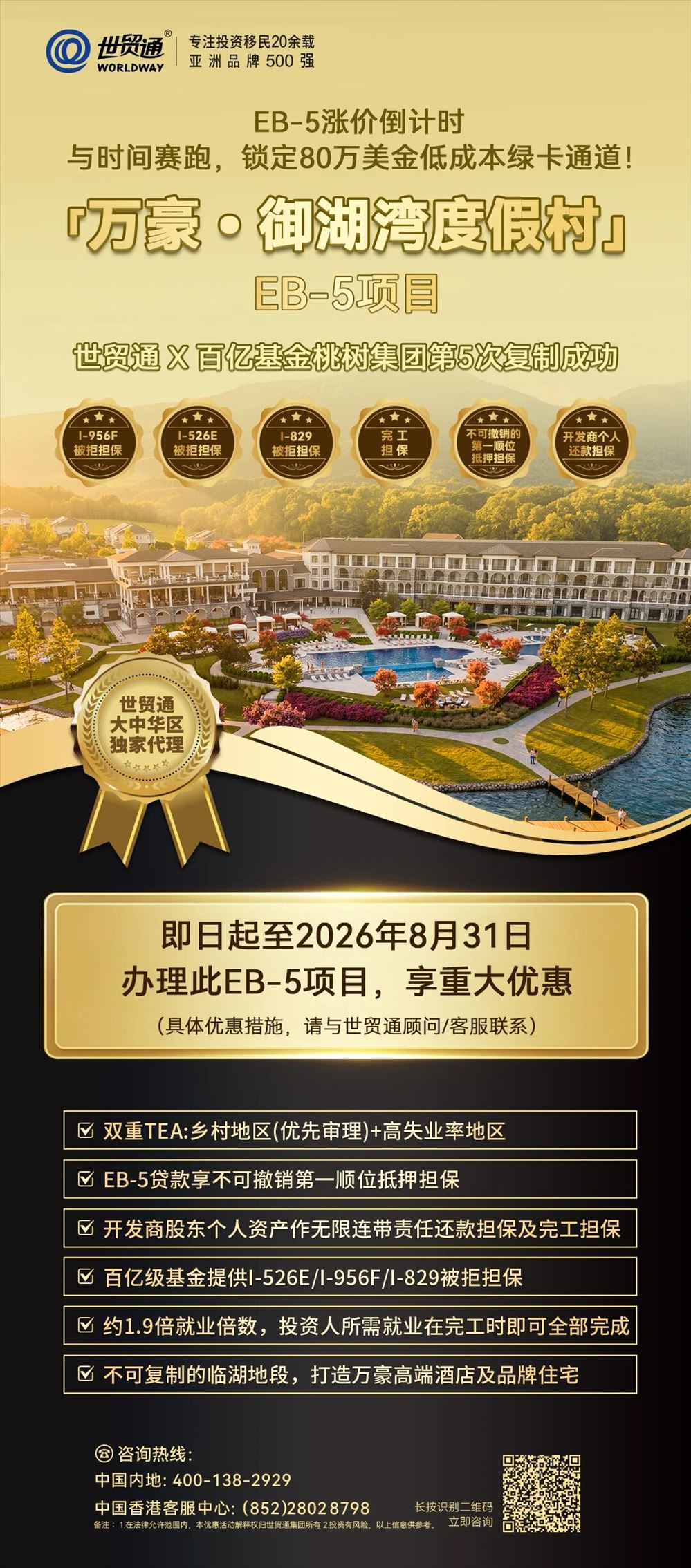
WorldWay currently offers two prime EB-5 projects: the I-956F-approved “Deer Valley · Snowridge Residences” and the “Marriott · Royal Lake Bay Resort,” representing WorldWay's fifth collaboration with Peachtree Group, providing more high-quality project choices for families seeking US residency planning. From now until August 31, 2026, applicants applying for EB-5 immigration can also enjoy limited-time exclusive offers from WorldWay.
Visa policies change, and vetting standards may be continually adjusted.
For families with clear long-term goals for the US, seizing the current $800,000 investment window to initiate status planning as early as possible is a way to secure greater certainty for the future.

For details, please inquire in Mainland China: 400-138-2929; Hong Kong, China Customer Service Center: (852)2802 8798