



U.S. immigration applications are accelerating their farewell to the “paper age.”
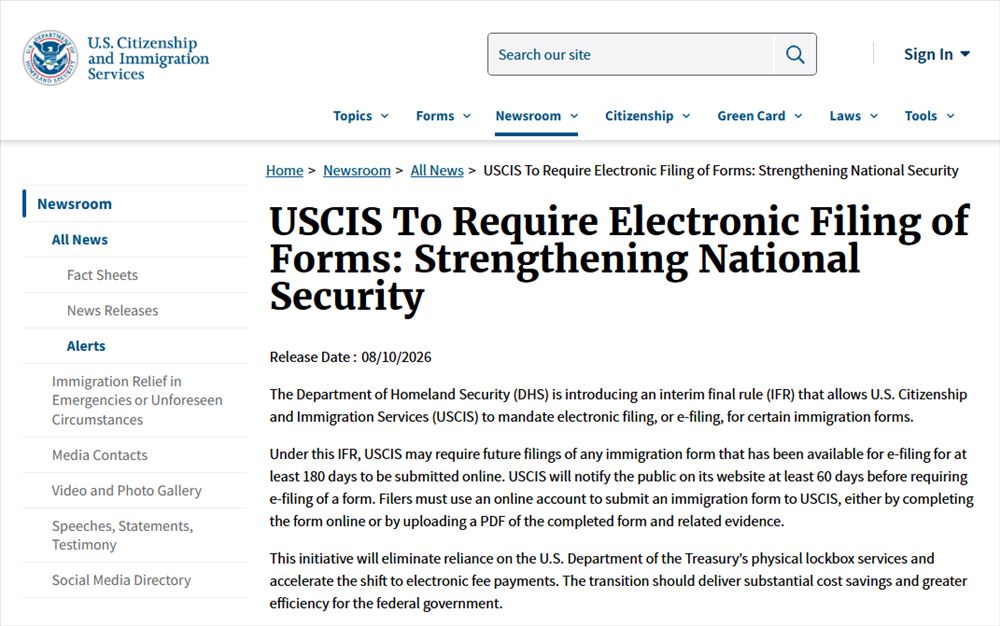
On August 11, 2026, local time, the U.S. Department of Homeland Security (DHS) officially published a Temporary Final Rule titled "Mandatory Electronic Filing (e-Filing)" in the Federal Register, which took effect on the same day.
According to the new rule, in the future, for immigration forms that have been open to electronic filing for a certain period, the U.S. Citizenship and Immigration Services (USCIS) may further require applicants to submit online, no longer accepting standard paper applications.
Following the announcement, many applicants began to worry: Will green cards, work permits, naturalization, family-based immigration, and other applications no longer be acceptable via mail in the future? Will investors currently undergoing the EB-5 process also be immediately required to switch to mandatory online filing?
In fact, it is not happening that quickly.
What the new rule actually changes is that USCIS has obtained the institutional framework to implement “mandatory online filing,” rather than eliminating all paper applications in one go starting August 11.

1. Paper Applications Are Not Being Cancelled Immediately
The Key Lies in "180+60"
To understand the new rule, remembering two numbers is enough: 180 days + 60 days.
First, an immigration form must have been open for electronic filing for at least 180 days before USCIS can further consider mandating online filing.
Even if the 180-day condition is met, paper submissions will not cease immediately.
USCIS must also publish an announcement on its official website at least 60 days in advance, specifying exactly which forms and application categories will be subject to mandatory electronic filing, as well as the specific date when paper submissions will no longer be accepted.
In other words, this new regulatory framework is not a “master list of completely phased-out paper applications.”
What is more likely to happen in the future is that forms that have already been open for online filing for a longer period will be adjusted first, with other forms following suit gradually according to USCIS arrangements.
2. Which Applications May Be Affected Sooner?
In fact, the digitization of U.S. immigration applications did not just start today.
Currently, USCIS already allows a variety of common immigration forms to be submitted online, including N-400 applications for naturalization, I-90 green card renewals, I-130 family-based immigration petitions, I-765 employment authorization applications, and certain I-485 adjustment of status applications.
However, special attention should be paid to the fact that: “a form being available for online filing” does not mean all subcategories under that form can be filed online.
Many forms are currently open for electronic submission only for specific application categories.
Therefore, in the future, USCIS may also implement mandatory online filing in batches based on different forms and categories, rather than applying a simple "one-size-fits-all" rule by form number alone.
For individuals who are genuinely unable to complete electronic filing, the new rule also retains a hardship waiver mechanism, allowing eligible applicants to request continued paper submission under qualified circumstances.
So, more accurately speaking: paper applications will not disappear overnight, but electronic filing is gradually shifting from an “optional choice” to the “default method.”

3. Will EB-5 Investors Be Affected in the Short Term?
This is also the question that concerns many EB-5 investors the most.
From the current perspective, there is no need to be overly concerned about this new rule.
The core applications most commonly involved for EB-5 investors, including I-526/I-526E petitions and I-829 petitions, are currently still submitted to physical addresses designated by USCIS and have not entered the scope of existing online filing.
This means that these application types have not even met the prerequisite of "being open for electronic filing for 180 days," so they will not directly transition to mandatory online filing in the short term due to the new rule.
Therefore, at the current stage: the filing methods for core EB-5 applications have not immediately changed due to this new rule, and investors may proceed according to existing regulations.
Of course, this does not mean that EB-5 will not gradually digitize in the future. If the relevant forms are opened for online submission in the future and satisfy the requirements of the new rule, they may likewise be included under mandatory electronic filing. WorldWay will closely monitor developments and share updates at the earliest opportunity.
4. From "Paper to Online"
Adjudication is Also Becoming More Refined
DHS explicitly stated in the rule that expanding electronic filing is intended not only to reduce paper handling costs and enhance administrative efficiency, but also to leverage digital data to further strengthen immigration system integrity, fraud detection, and national security screening.
As more paper materials are transformed into standardized digital data, cross-referencing information submitted across different applications and at different times will become easier.
This means that future U.S. immigration applications will face increasingly stringent requirements regarding information consistency, document completeness, and overall compliance.
Submission methods are changing, and adjudication methods are changing as well.
Considering recent changes in U.S. immigration policy, a trend is becoming increasingly clear: U.S. immigration management is moving further toward digitization, standardization, and refined adjudication.
5. Continuous Policy Adjustments
Long-Term Status Requires Advance Planning Even More
For families who have already clearly planned to study, work, or live in the U.S. over the long term, what truly warrants attention is not just how application methods are changing, but whether long-term status arrangements are sufficiently stable.
Temporary statuses such as F-1, OPT, and H-1B each have their appropriate use cases, but they also carry varying degrees of uncertainty in areas such as graduation, employment, the lottery system, employer sponsorship, and status transitions. In contrast, incorporating green card status into the family's overall planning in advance can provide greater initiative for future education, employment, and lifestyle arrangements.
As one of the pathways directly targeting U.S. permanent resident status, EB-5 can be comprehensively considered within a family's long-term status planning.
Currently, the minimum EB-5 investment amount remains $800,000, and the existing investment threshold is in an important window period. Starting January 1, 2027, the minimum EB-5 investment amount is expected to be raised from the current $800,000 to $900,000–$950,000 or higher.
Currently, WorldWay features two major EB-5 projects: the I-956F-approved "Deer Valley · Snowridge Residence", as well as the "Marriott · Imperial Lake Bay Resort", launched through WorldWay's fifth collaboration with Peachtree Group. From now until August 31, 2026, processing an EB-5 immigration application also comes with limited-time exclusive offers from WorldWay.
Policies will adjust, and application methods will change. For families who have already defined their U.S. status plans, what is more important is to combine their own situation, seize the current window, and make arrangements in advance.


For detailed inquiries in Mainland China: 400-138-2929; Hong Kong SAR Customer Service Center: (852)2802 8798