H-1B visa holders' “60-day grace period” after losing employment may be facing major changes.
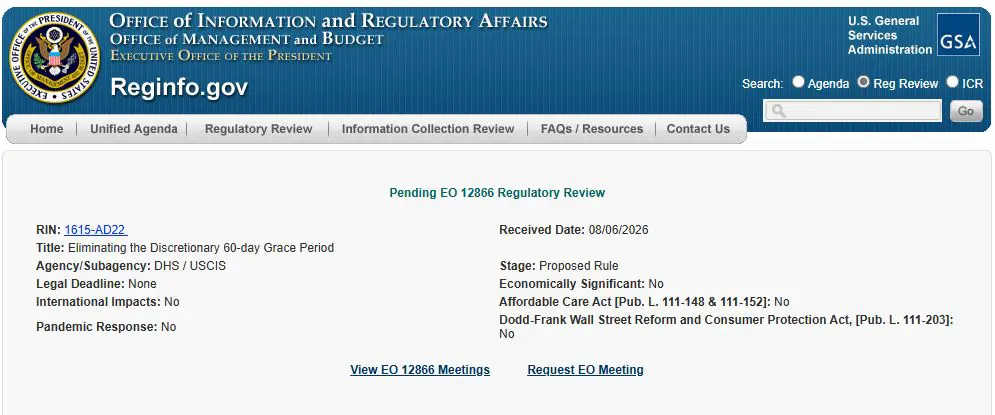
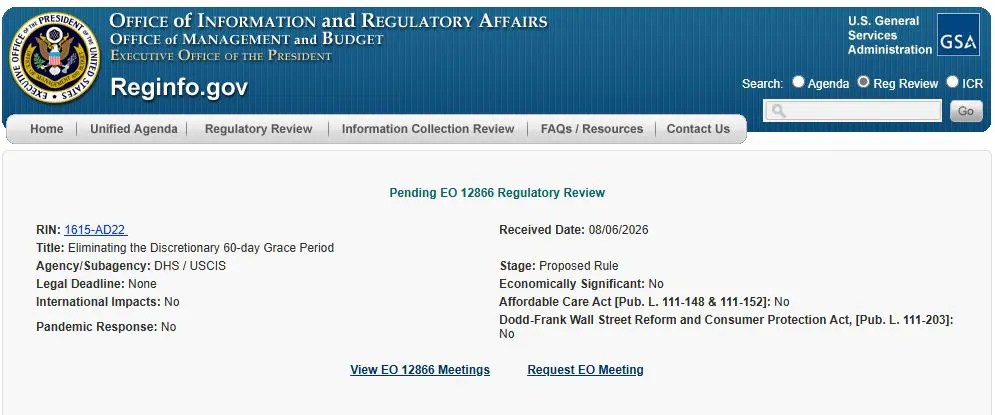
The U.S. Department of Homeland Security (DHS) has introduced a proposed new rule (RIN:1615-AD22) planning to completely eliminate the 60-day lawful grace period for H-1B visa holders following unemployment. The proposal was submitted to the White House Office of Information and Regulatory Affairs (OIRA) for review on August 6, 2026.

I. How Important Is the 60-Day Grace Period
to H-1B Visa Holders?
The current 60-day grace period took effect on January 17, 2017, and has been in place for nearly ten years. Under this provision, holders of certain employment-based visas, including H-1B, are granted a status grace period of up to 60 days following the termination of employment.
During these 60 days, H-1B holders typically need to accomplish one of the following: find a new employer who files an H-1B transfer petition; apply to change to another lawful status; if eligible, proceed as quickly as possible with a green card or adjustment of status application; or depart the United States to re-plan their future.
In other words, the 60 days served as a buffer between “finding a new job” and “maintaining lawful status.” Now, this buffer may be removed entirely.
If this proposed rule is finalized, the status buffer for H-1B holders following job loss may cease to exist.
• In the past: Job loss → Enter grace period up to 60 days → Find a job → New employer files H-1B
• In the future, it may become: Job loss → Loss of lawful status
This means that for H-1B holders, losing a job will bring not only employment pressure, but also immediate status risk.
II. Behind Nearly 1.3 Million People
The Impact on H-1B Families Cannot Be Ignored
Once this policy is implemented, its impact could be far-reaching.
According to estimates by the immigration policy organization FWD.us, there are currently approximately 730,000 H-1B status holders in the United States, along with about 550,000 dependents including spouses and children, totaling nearly 1.3 million people.

For these families, the job and status of the primary H-1B applicant directly impact the entire family's living arrangements in the United States. If the primary applicant experiences a layoff and the 60-day grace period is eliminated, not only must the applicant transition jobs and status much faster, but the status of their dependents may also be impacted.
However, this change remains in the draft stage, and how the final rule will be adjusted or when it will take effect awaits the publication of official documents. WorldWay will closely monitor developments and share updates at the earliest opportunity.

III. Tightening Status Buffers
Long-Term Status Planning Becomes Even More Crucial
From the H-1B lottery and employer binding to potential changes to the post-unemployment 60-day grace period, it is evident that reliance on temporary work status to remain in the U.S. long-term carries increasing uncertainty.
For families with clear long-term plans to reside in the U.S., planning for green card status in advance can reduce status pressures arising from unemployment, job changes, or employer transitions, while securing greater initiative in education, career, and life arrangements. EB-5 has thus become a key long-term status pathway worth paying attention to.
Particularly under the new EB-5 law, rural EB-5 projects offer no visa backlog and priority processing benefits; the “concurrent filing” policy allows applicants residing lawfully in the U.S. without a backlog to file I-526E and I-485 simultaneously to quickly obtain a Combo Card, gaining lawful residence and employment authorization to enter the green card status adjustment process earlier.
For individuals holding F-1, OPT, H-1B, and other statuses, this means gaining an extra layer of protection for their subsequent employment and living in the U.S. while advancing toward long-term status, thereby mitigating the impact of career changes on status arrangements.
Meanwhile, the current $800,000 minimum investment threshold for EB-5 projects remains available. Under current policy provisions, the EB-5 investment amount will undergo a new round of inflation adjustment on January 1, 2027, and is expected to increase to $900,000–$950,000 or even higher.
WorldWay features two premier EB-5 projects: “Deer Valley · Snow Park Lodge” (with I-956F approval) and “Marriott · Imperial Lake Resort” (the fifth collaboration between WorldWay and Peachtree Group), providing more choices for families seeking U.S. status planning.
Starting today through August 31, 2026, applicants applying for EB-5 immigration can also enjoy limited-time exclusive offers. Slots for high-quality projects are limited. Families interested in U.S. status planning are encouraged to seize this window and initiate their applications as early as possible.


For inquiries, Mainland China: 400-138-2929, Hong Kong SAR Customer Service Center: (852)2802 8798