





Recently, U.S. News released its highly anticipated 2026-2027 Best Global Universities rankings.
This list covers 2,250 renowned universities from over 100 countries and regions. Judging by the ranking results, U.S. universities continue to maintain strong competitiveness, demonstrating sustained influence in the global higher education landscape.
U.S. Universities Perform Brilliantly
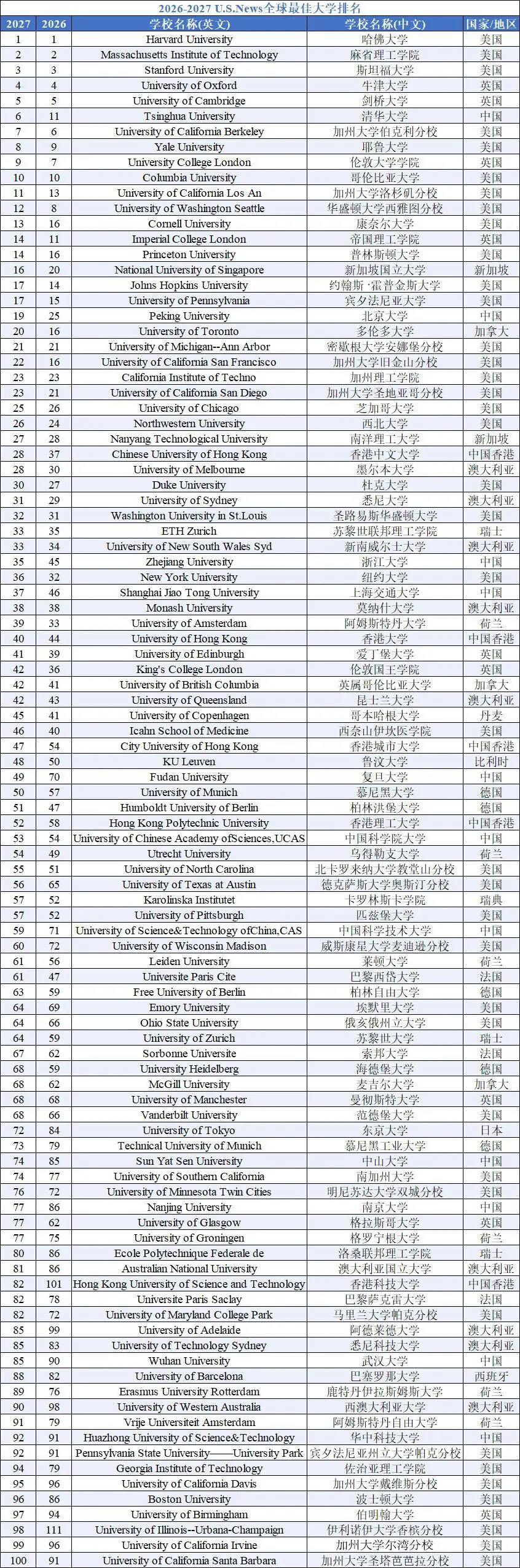
In this year's Top 10 list, U.S. universities still occupy the top 3 spots globally: Harvard University, Massachusetts Institute of Technology, and Stanford University.
Not only is their lead at the top obvious, but U.S. universities also show prominent leadership across the overall tiers:
• In the Top 10, U.S. universities occupy 6 spots;
• In the Top 50, U.S. universities occupy 22 spots;
• In the Top 100, U.S. universities occupy 39 spots;
• In the Top 200 list, the U.S. occupies 60 institutions.
U.S. News Top 100 Rankings
Behind the Rankings:
Where Does the Appeal of U.S. Education Come From?
The core evaluation indicators of the list include:
✔ Global research reputation: 12.5%
✔ Regional research reputation: 12.5%
✔ Publications: 12.5%
✔ Normalized citation impact: 10%
✔ Total citations: 10%
✔ Number of publications that are among the 10% most cited: 12.5%
✔ Percentage of total publications that are among the 10% most cited: 10%
✔ International collaboration: 10%
✔ Number of Ph.D.s awarded: 5%
✔ Number of Ph.D.s awarded per academic staff member: 5%
From the weighting structure, it can be seen that indicators related to publications, citations, and research influence account for nearly 50%.
This means that this ranking measures not only the reputation of the school, but also, to a certain extent, reflects the comprehensive performance of universities in research capability, knowledge creation, international influence, and talent cultivation.
The fact that U.S. universities have long received global attention is also closely related to the advantages of the educational system they have formed.
On one hand, the U.S. possesses a diverse structure of higher education institutions. From comprehensive research universities to specialized professional colleges, and from basic disciplines to cutting-edge interdisciplinary fields, it provides diverse choices for different development goals.
On the other hand, the value of U.S. education is not only reflected in the classroom and rankings, but also in the connections formed between education, research, industry, and career development. Students have the opportunity to participate in research projects, industry internships, interdisciplinary cooperation, and international exchanges, accumulating more possibilities for future development.
For many families, choosing U.S. education is essentially not just choosing a school, but preparing their children to enter a broader development environment.
Beyond Educational Planning
Status Planning is Gradually Being Prioritized
For more and more families focusing on U.S. education, admission is just the beginning. After entering university, how to reduce uncertainty and more smoothly bridge studies, internships, and future development is becoming a new focus of attention.
Especially in the current environment, many students still need to go through a series of uncertain links after graduation, such as OPT, H-1B lottery, and work visa transitions. Therefore, more and more families are beginning to realize that beyond educational planning, status arrangements also need to be laid out in advance.
Rather than waiting until the child enters a U.S. university to consider subsequent development, it is better to incorporate status factors into the overall plan earlier. Through early preparation, more room for choice can be reserved for future further studies, internships, employment, and long-term development.
Early Layout
Reserving More Room for Choice for the Future
In the current U.S. status planning path, EB-5 has become one of the long-term planning methods that many families are paying attention to. For families with clear U.S. educational planning needs, the value of EB-5 lies not only in the status itself, but also in providing more path choices for future education, life, and long-term development, allowing families to make overall arrangements from a longer-term perspective.
Under the new EB-5 law, rural EB-5 projects are exempt from visa retrogression and have priority processing advantages; the "concurrent filing" policy allows applicants in the U.S. to file I-526E and I-485 simultaneously, quickly obtaining a Combo card and realizing legal residency and employment eligibility.
However, this advantage will not last forever. As reserved quotas continue to be consumed, warnings of invisible retrogression have quietly appeared; at the same time, the grandfathering clause will expire on September 30; the minimum investment amount may also be raised from $800,000 to $900,000-$937,500 or even higher on January 1, 2027. Therefore, for families who have clearly identified U.S. educational planning needs, completing assessment and planning in advance is more conducive to forming a long-term, stable development path.
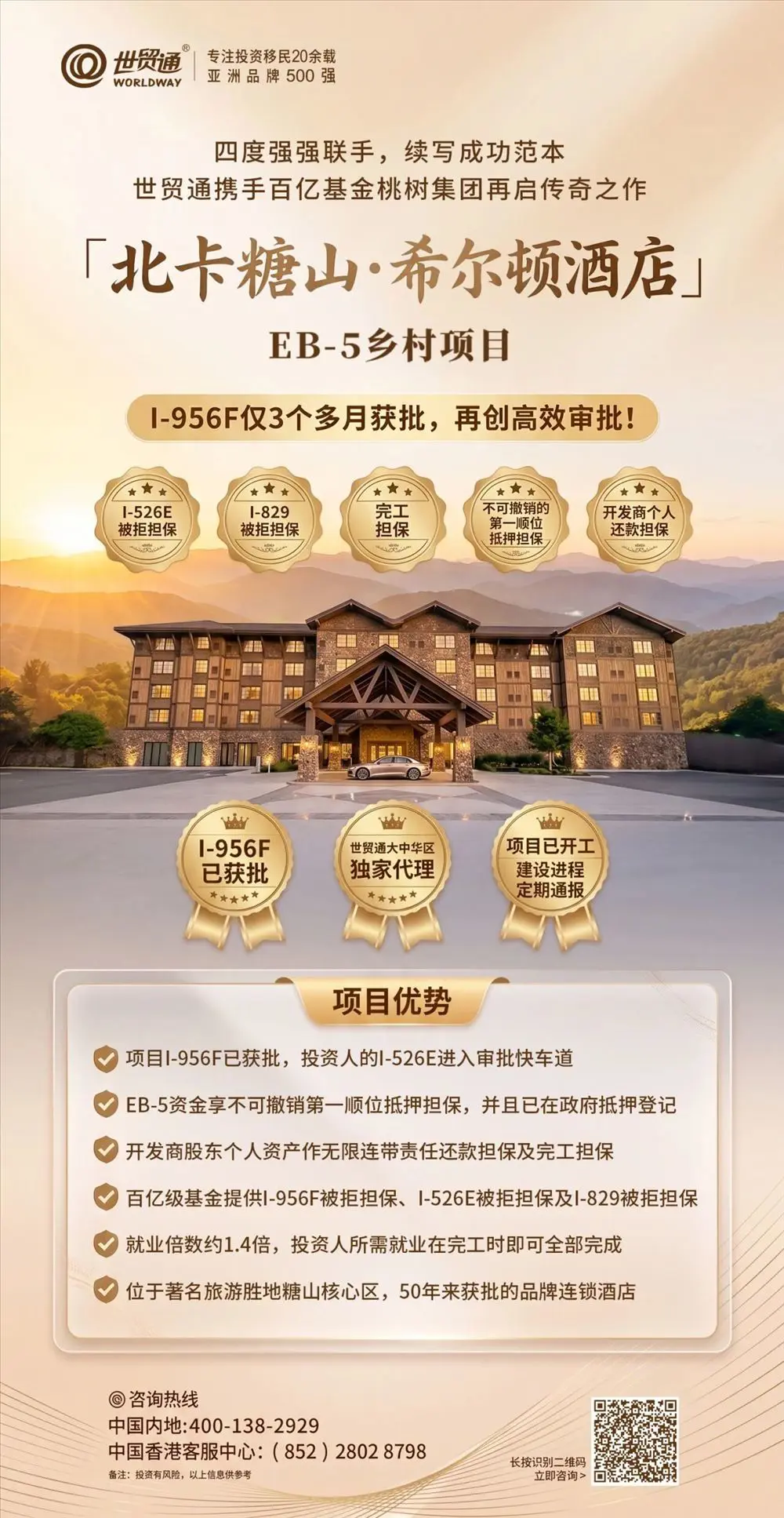
Education is a long-term investment, and early planning is reserving more possibilities for the future. WorldWay holds high-quality EB-5 projects such as "Marriott Lakeview Resort" and "Sugar Mountain Hilton Hotel", helping investors quickly realize their U.S. status planning.


For inquiries in Mainland China: 400-138-2929, Hong Kong, China Customer Service Center: (852)2802 8798