





An offer letter was once regarded by many families as an entry ticket for their children to remain in the United States.
However, a single round of layoffs can simultaneously impact employment, visas, and future green card pathways.
This is precisely the signal the U.S. job market is sending in 2026: opportunities in the U.S. still exist, but the traditional path of "studying to enter a major firm and relying on an employer to sponsor status" is becoming increasingly uncertain.
In the past, many families were accustomed to planning their children's development in the U.S. along a clear route: F-1 study → OPT internship → H-1B lottery → employer-sponsored green card.
But now, factors such as layoffs at large companies, AI substitution, organizational restructuring, cost control, and shrinking recruitment are continuously impacting this path. For international students, a layoff may affect more than just a job; it can disrupt their entire immigration status arrangement in the U.S.

1. A set of data to understand what is happening in the U.S. job market
According to a workplace employment report released by a well-known career consulting firm, the total number of layoffs in the U.S. reached 97,006 in May, a 16% surge from 83,387 in April, setting the highest monthly record since May 2020.
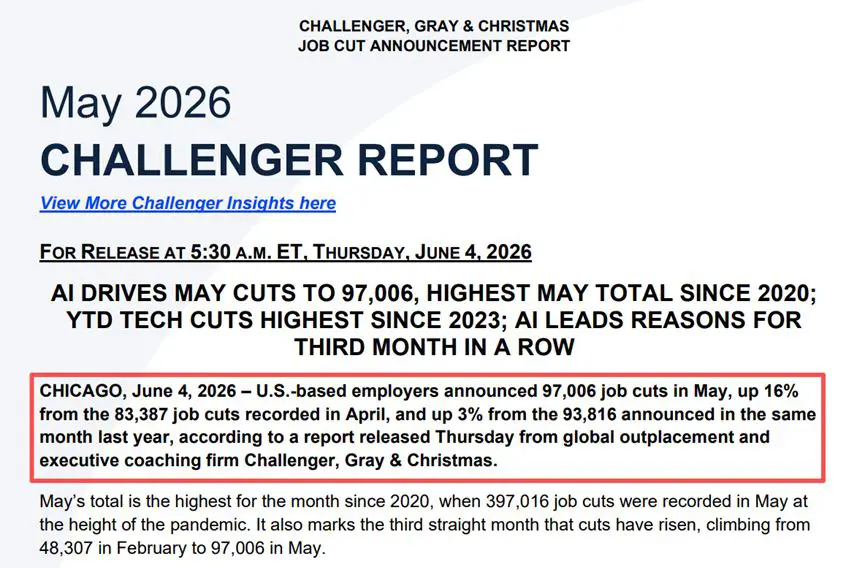
The technology sector remains the area where layoffs are concentrated. In May 2026, the U.S. technology sector announced 38,242 layoffs; in the first five months of 2026, the technology sector announced a cumulative total of 123,653 layoffs, an increase of 66% compared to the same period in 2025.
At the same time, U.S. corporate hiring plans are also shrinking. In the first five months of 2026, companies announced hiring plans for 80,472 people, with an average monthly hiring plan of only 16,094.
These data indicate that the U.S. job market is undergoing changes. Companies are still hiring, but they are more cautious in their employment, and job adjustments and organizational optimization are becoming the norm.
For international student families, opportunities in the U.S. still exist, but the future requires long-term planning in advance, rather than relying entirely on employers and the job market for the path to staying in the U.S.
2. Major firms no longer equal stability, and popular majors do not equal safety
In the past, many international student families regarded "entering a major U.S. firm" as a key step in their children's development in the U.S. As long as they entered a technology company, financial institution, consulting firm, or large multinational enterprise, it seemed they were one step closer to staying in the U.S. for the long term.
But today, major firms also lay off employees, popular industries also undergo restructuring, and technology companies also adjust teams for the sake of AI and automation.
Companies do not lack a need for talent; rather, they value job value, organizational efficiency, and long-term returns more. For U.S. domestic job seekers, this is professional competitive pressure; but for international students, it adds a more realistic problem: status risk.
This is because international students cannot stay just by finding a job. They also face multiple variables such as OPT expiration, H-1B lottery, employer sponsorship willingness, job stability, and company hiring plans.
Once they encounter layoffs, departmental adjustments, or company hiring reductions, it may affect not just a job, but their entire path to staying in the U.S.
This is also the most direct reminder from the U.S. layoff wave to international student families: It is not that the U.S. cannot be chosen, but that one can no longer bet their child's future entirely on employers and the lottery.
3. EB-5: Configuring a status channel for the family that does not rely on employers
Against this backdrop, EB-5 investment immigration remains one of the important paths for U.S. status planning. Compared with the traditional path to staying in the U.S., the difference with EB-5 is that it does not rely on employer sponsorship, nor does it rely on the H-1B lottery.
This is particularly significant for the planning of international student families:
• Studying abroad solves the education entry point;
• Employment solves the career starting point;
• And EB-5 solves the long-term status foundation.
For families who are already studying in the U.S. or planning to study in the U.S. in the future, EB-5 is not a "remedial plan" to be considered only after the child graduates and encounters status difficulties, but an active choice that can be incorporated into family planning in advance.
4. True initiative comes from advance layout
The greatest revelation from the changes in the U.S. employment environment for families is not to change the direction of long-term planning, but to plan for the U.S. earlier, more steadily, and more systematically.
For international student families, future competition is not just about academic qualifications, majors, or job positions, but also about the ability to plan for immigration status.
When H-1B lotteries, employer sponsorship, and the job market all have uncertainties, the significance of EB-5 is not just obtaining a U.S. green card, but locking in an initiative for the family's future in advance.
Currently, the EB-5 rural project is still in a critical stage with prominent policy advantages of no visa backlog. According to the new act, rural projects enjoy exclusive reserved visa quotas, the current quota is relatively sufficient, and they legally enjoy priority processing advantages.
It is worth noting that the protection period of the grandfather clause in the new EB-5 policy will expire on September 30, 2026. By submitting an application before this date, even if the policy changes in the future, the applicant can still be processed according to the current legal rules.



For inquiries in Mainland China: 400-138-2929, Hong Kong Customer Service Center: (852)2802 8798