





In recent years, with the changing global economic environment, an increasing number of families have begun to focus on overseas residency, global asset allocation, and long-term development planning.
Under this trend, countries that possess both economic vitality and residency value are receiving more attention from international investors, and Turkey is one of them.
Behind sustained economic growth, Turkey is unleashing long-term development momentum
According to data released by the Turkish Statistical Institute, in 2025, Turkey's GDP grew by 3.6% year-on-year, with the total annual economic volume reaching approximately USD 1.59 trillion and GDP per capita reaching USD 18,040.
Even more noteworthy is that the Turkish economy has maintained positive growth for 23 consecutive quarters.
This growth is not a short-term fluctuation, but is built upon multiple factors including demographic structure, industrial development, and sustained investment.
First, there is the long-term dividend brought by a young population. Turkey has a population of approximately 87 million, with a relatively young overall demographic structure. A young population means a continuous supply of labor, stable consumer demand, and stronger support from the domestic market, which is also an important foundation that many international capital sources have focused on for a long time.
Second, the advantages of the manufacturing industry and regional supply chains are continuously being unleashed. Over the past few years, as global supply chains have continued to adjust, an increasing number of European companies have begun to value production layouts that are "closer in distance, cost-controllable, and stable in supply." Spanning the Eurasian continent, Turkey naturally possesses the locational advantage of connecting European, Middle Eastern, and Central Asian markets.
At the same time, infrastructure upgrades and reconstruction investments continue to generate growth momentum. In recent years, Turkey has continued to advance large-scale infrastructure construction, and investment in post-earthquake reconstruction has further driven investment growth, with fixed asset investment continuing to rise, becoming one of the important drivers supporting economic growth.
Driven by the multiple factors of population, industry, and investment, Turkey today is gradually forming a more resilient foundation for long-term growth.
Behind wealth growth, Turkey's appeal is continuously rising
If economic growth represents a country's development vitality, then the flow of wealth often reflects the market's judgment of the future.
In recent years, several international wealth research institutions have observed that the growth rate of Turkey's high-net-worth population continues to rise. Among them, the "2026 Global Wealth Report" released by Knight Frank shows that over the past five years, the number of super-rich individuals in Turkey with a net worth exceeding USD 30 million has grown by 93.6%, ranking third globally in growth rate.
What is reflected behind this data is not just a change in wealth figures, but rather that more capital has begun to pay attention to Turkey's development potential and long-term value.
For entrepreneurs and high-net-worth families, what is truly important is not just short-term market fluctuations, but rather which regions are forming new growth opportunities, industrial opportunities, and global connectivity capabilities for the future.
And Turkey is gradually becoming an important node connecting Europe, the Middle East, Central Asia, and North Africa.
The value of residency, tax, and wealth planning is forming a new attraction
In fact, the attention Turkey has received from international investors in recent years is not solely due to economic growth.
For an increasing number of families focusing on global allocation, Turkey's appeal is gradually extending from simple residency planning to asset layout, tax arrangements, and long-term development opportunities.
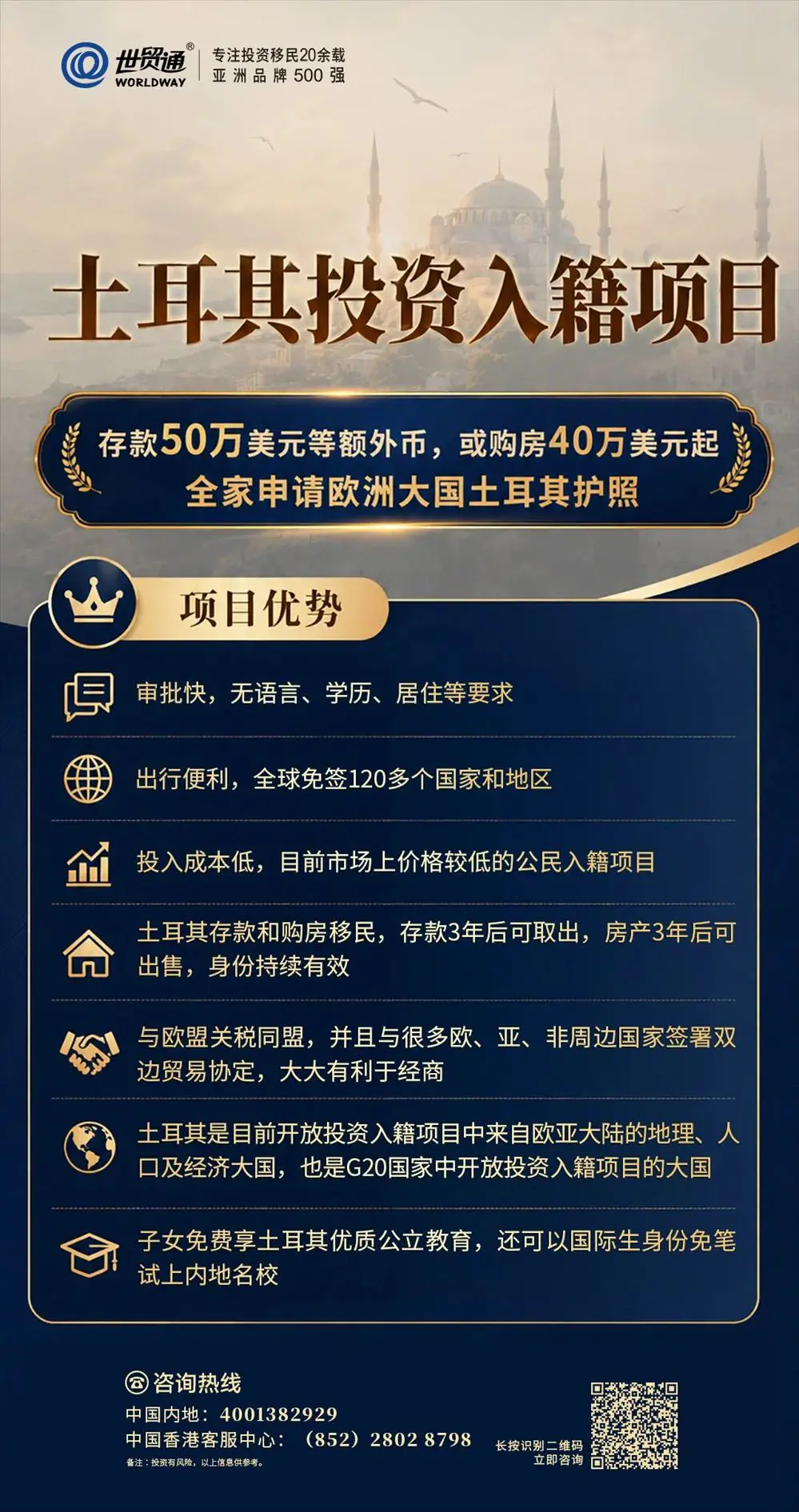
According to current policies, applicants can apply for a Turkish passport for the whole family by depositing USD 500,000 or more in foreign currency, or by purchasing property starting from USD 400,000.
At the same time, Turkey has continued to promote the optimization of its tax system and financial system in recent years, further enhancing the value of residency configuration.
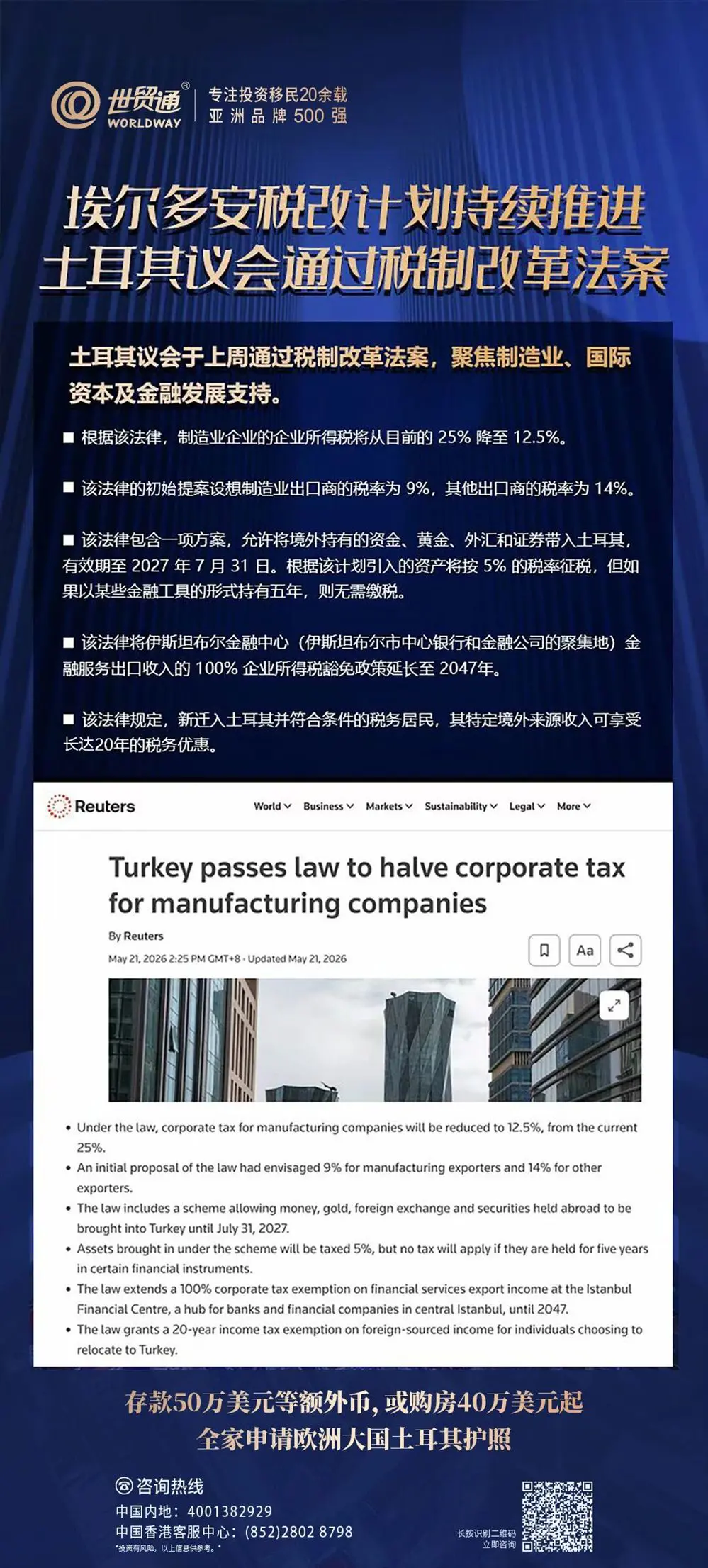
Recently, the Grand National Assembly of Turkey passed a tax reform bill, introducing a package of tax and investment incentive measures. According to public information, the key points of the bill include: eligible new tax residents can enjoy an exemption from income tax on foreign income for up to 20 years; inheritance and gift taxes for eligible individuals can be reduced to as low as 1%; and supporting policies for asset repatriation, corporate income tax optimization, and the Istanbul Financial Center have been introduced.
As relevant policies continue to be implemented, Turkey is gradually upgrading from a traditional destination for residency planning to a comprehensive international configuration platform that integrates residency configuration, tax arrangements, and wealth succession functions.
For investors who are considering a second residency, overseas asset allocation, and long-term family planning, Turkey is entering a new window of attention.
For detailed inquiries, please contact Mainland China: 400-138-2929, Hong Kong, China Customer Service Center: (852)2802 8798