






Recently, the U.S. Department of State officially announced a new visa pilot policy: From July 1, 2026, to December 31, 2026, applicants for U.S. business and tourist visas (B1/B2) may pay an additional fee of $750 to obtain faster visa interview appointment opportunities.
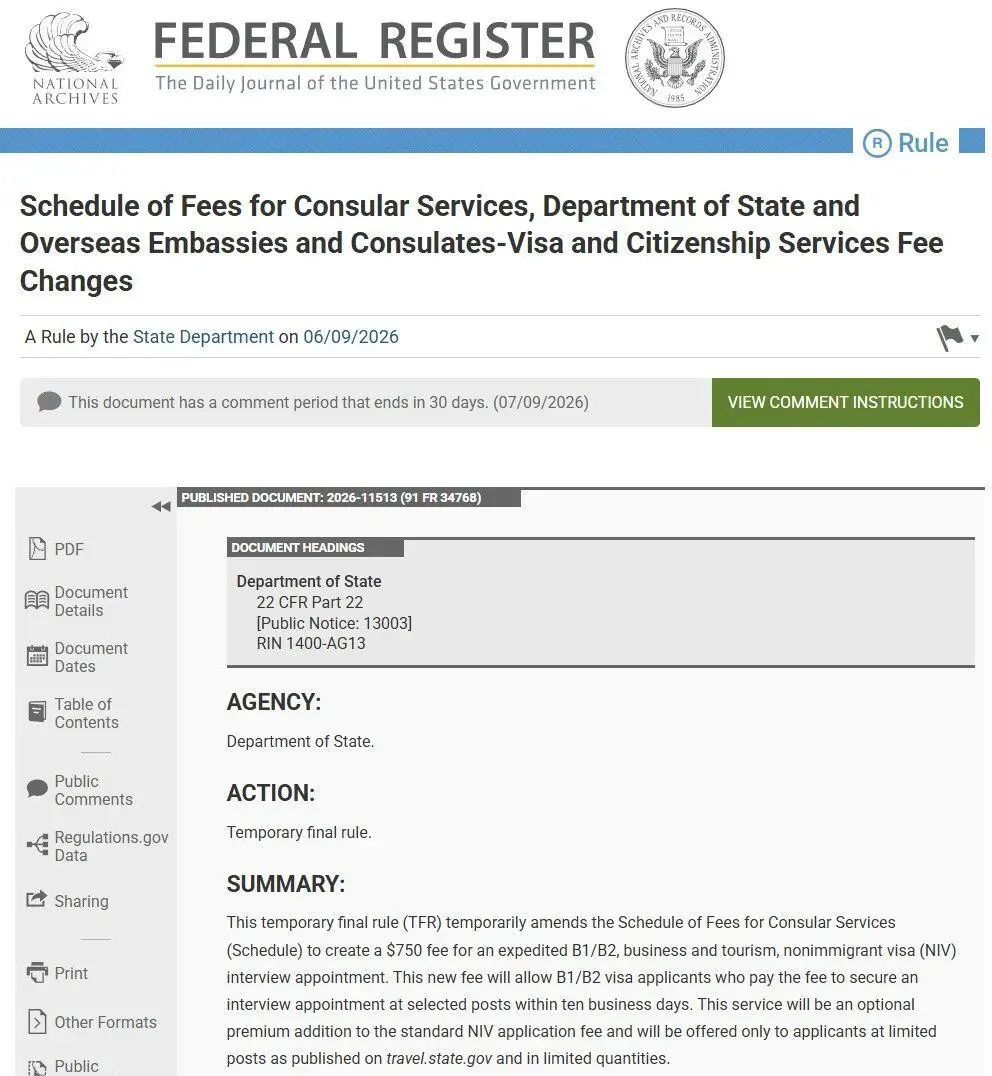
Pay an additional $750
Accelerating the appointment, not the approval
According to the currently announced rules:
• The standard B1/B2 visa application fee remains $185;
• Applicants can pay an additional $750 expedited fee;
• After successful payment, an interview opportunity can be obtained within 10 business days (subject to the specific participating consular posts);
• Visa approval is not guaranteed;
• It does not shorten subsequent administrative processing time;
• If the visa is denied, the expedited fee is non-refundable;
• The pilot period is from July 1, 2026, to December 31, 2026; whether it will be implemented long-term after the pilot ends will be decided based on operational performance.
In other words:
The additional $750 expedited fee paid by the applicant is not for the visa result, but for the opportunity to enter the interview appointment process faster.
Visa review standards, background checks, security screenings, and subsequent procedures will still be executed according to current rules.

Why is this service being launched now?
Over the past few years, U.S. visa backlogs have persisted, and appointment wait times in some regions have remained high for a long time. The U.S. Department of State has also publicly stated that it hopes to provide more flexible solutions for the World Cup, the Olympic Games, and temporary business travel needs through a fee-based mechanism.
It should be noted that what has been announced is currently a pilot program. The specific list of countries and embassies/consulates participating in the pilot has not yet been officially released.
For Chinese applicants, whether the U.S. Embassy in Beijing and the Consulates General in Shanghai, Guangzhou, Shenyang, etc., in mainland China will be included in the first batch of pilots still awaits further official notification.
WorldWay will continue to monitor relevant developments and synchronize the latest information in a timely manner.
From visa convenience to long-term status planning
For those with short-term travel needs to the U.S., this policy provides a new option. If there are urgent business arrangements or temporary travel plans, there may indeed be more appointment flexibility in the future.
However, it is also necessary to see that:
This adjustment addresses the issue of appointment efficiency, not status.
Tourist visas still belong to non-immigrant visas, and their core remains short-term stay purposes.
Visa appointments can be accelerated, but visa duration, entry rules, and subsequent status arrangements will not change due to the expedited service.
For many families, the need to go to the U.S. has long since gone beyond a single trip.
More and more families are beginning to consider simultaneously:
How to arrange the future educational path for their children;
Whether more flexible international mobility is needed;
How to reduce the uncertainty caused by status changes;
How to reserve space for future work, asset allocation, and family planning.
In this context, planning for long-term status paths in advance is also becoming a topic of concern for more and more families.
Seize the policy window, and even more, plan ahead
In the past, many families were accustomed to entering the U.S. first through tourist visas or student visas, and then considering long-term status based on the situation.
However, in recent years, with the continuous changes in visa appointments, status adjustments, and the employment environment, many families have begun to advance their status planning.
Among them, the new EB-5 investment immigration policy is becoming one of the compliant paths receiving continuous attention.
For eligible applicants, what EB-5 focuses on is not a one-time trip to the U.S., but long-term status arrangements.
Establishing long-term status planning in advance can help families have higher certainty in education, residence, life arrangements, and future development choices.
It is worth noting that the phased window of the new EB-5 policy is not permanent. With the growth in application volume, reserved visa quotas may be gradually consumed in the future, and there is a possibility of entering a backlog; at the same time, the grandfather clause will expire on September 30, and the minimum investment amount is expected to increase on January 1, 2027.
For families planning U.S. status, there may not be a need to decide immediately, but it is worth understanding policy changes and evaluating the timing as early as possible to reserve more initiative for subsequent planning.
Focusing on the current EB-5 policy window and project opportunities, the "Marriott · Imperial Lake Bay Resort" EB-5 project roadshow, exclusively represented in Greater China by WorldWay Group and jointly created for the fifth time with the U.S. multi-billion dollar fund Peachtree Group, is currently underway.
The Shenzhen stop on June 7 and the Hong Kong, China stop on June 12 received enthusiastic responses.

Next, the roadshow will visit:
June 13 | Shanghai, Qingdao
June 14 | Beijing
Seats are limited. It is recommended to book your attendance in advance to communicate face-to-face with industry experts and seize planning opportunities under the policy window.

Great news! To help investors sprint for the EB-5 "930" golden window, WorldWay has launched a limited-time promotional event. Customers who process U.S. immigration projects during June 2026 can enjoy exclusive WorldWay special offers. For details, please contact your exclusive WorldWay consultant or customer service.
Seat reservation hotline, for details please inquire in mainland China: 400-138-2929, Hong Kong, China Customer Service Center: (852)2802 8798