





Recently, news regarding reforms to U.S. non-immigrant status management has continued to circulate within the international student and immigration communities.
The U.S. Department of Homeland Security (DHS) has submitted the final version of rules concerning the management of F, J, and I non-immigrant statuses to the White House Office of Management and Budget (OMB). Following standard procedures, once the review is completed and published in the Federal Register, the new regulations will enter the implementation phase and could take effect as early as 60 days after publication.
The news has drawn significant attention from international students, visiting scholars, and overseas professionals.
Many initially assumed this was merely a routine visa management adjustment, but when viewed in the context of the overall shifts in U.S. immigration policy over the past few years, the signal it sends is far deeper than it appears—the United States is redefining the boundaries of "temporary status."
Covering three core groups, with a wide scope of impact
This rule adjustment focuses on three types of non-immigrant status:
• F-category visas (F-1)——International students, including those in undergraduate, master's, doctoral, language school, and vocational training programs;
• J-category visas (J-1)——Exchange visitor status, including visiting scholars, post-doctoral researchers, exchange students, and medical training and research programs;
• I-category visas (I Visa)——Foreign media and news organization personnel stationed in the United States.
These three types of status have long served as key entry points for the United States to attract international talent.
For the Chinese community in particular, F visas cover the vast majority of those studying in the U.S., while J visas are a vital channel for academic cooperation and scientific research exchanges.
By institutional design, these statuses are essentially "non-immigrant temporary statuses."
In the past, the United States long allowed significant flexibility in the conversion of these statuses in practice; however, the regulatory approach is now changing.
The D/S system, in operation for decades,
may face a historic adjustment
For the past several decades, F, J, and I statuses have widely operated under the D/S (Duration of Status) system.
Simply put: I-94 records typically do not specify a departure date. As long as studies continue, research projects remain valid, and the SEVIS system is in good standing, one can continue to stay legally. This system provided international students with a high degree of flexibility. Doctoral program extensions, joint training, academic deferrals, and status changes could all be completed within a certain scope.
One of the most concerning changes in the proposed rules is the potential cancellation of the D/S model in favor of fixed-duration management.
Directions frequently discussed by outside observers include: eliminating indefinite duration of status; setting fixed entry permit periods; requiring active applications for extensions upon expiration; subjecting extensions to background checks and qualification reviews; and triggering unlawful presence calculations earlier for overstays.
Although the final details are yet to be released, the signal sent is already very clear: status management is gradually shifting from school-led to government-approved.
What international students are truly worried about is not a year more or less, but the increased uncertainty in their study paths.
In the past: Research delays could extend a program; there was a buffer for finding a job; and if a status change failed, plans could still be adjusted.
In the future: Every extension could become an independent approval process. Every change in status will mean a new window for review.
The operational logic of studying abroad is also shifting from "adjusting as you go" to "planning first, then executing."
The familiar path to studying in the U.S.
is losing its certainty
In the past, education in the U.S. and long-term development formed a typical path:
Study in the U.S. → Graduate and find employment → OPT → H-1B → Long-term development.
However, in recent years, from visa reviews, status conversions, and employment cycles to immigration approvals, the overall signal released by the United States has become increasingly consistent:
Temporary status no longer defaults to having long-term extension attributes. In the future, going to the U.S. may no longer be suitable for a "go first and consider later" approach.
Instead, it requires earlier planning: study cycles; employment time windows; the pace of status conversion; and long-term family arrangements.
The earlier one plans, the better one can mitigate the risks brought about by policy volatility.
From "go first and plan later"
to "plan first and then set off"
U.S. universities, research resources, and industrial opportunities still exist; what has truly changed is that the development approach of relying on status flexibility and "wait and see" is gradually coming to an end.
In the future, academic qualifications will still determine the starting point, but the ability to plan one's status and design a long-term path is becoming a new competitive advantage.
Therefore, more and more families are beginning to advance their status planning. Long-term status solutions, including EB-5, are becoming an important part of integrated considerations for study, employment, and family planning, with the hope of securing more initiative and certainty for children's future education, employment, and long-term development through early positioning.
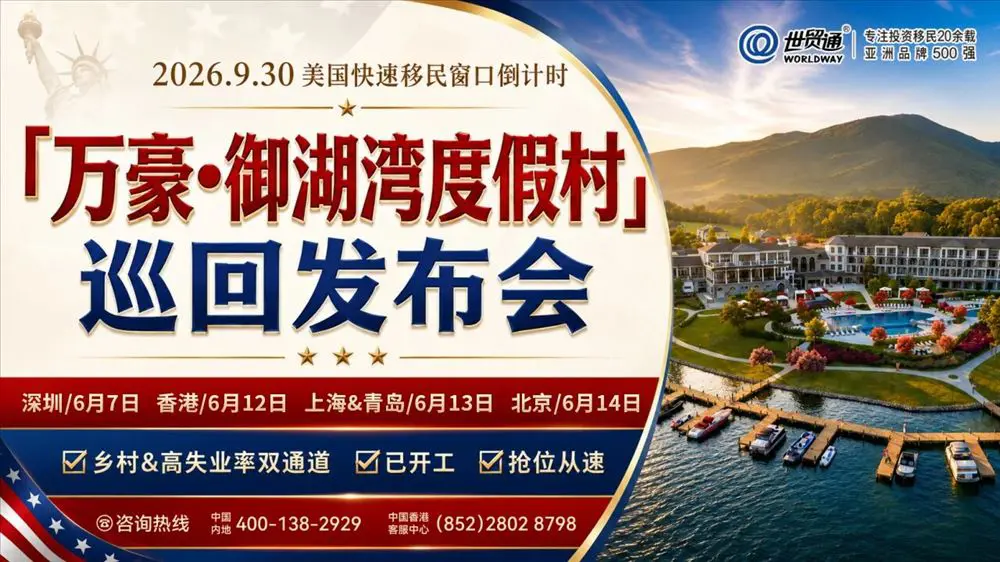
Regarding current policy changes and status planning trends, the WorldWay Group-exclusive "Marriott Lakeview Resort" EB-5 project roadshow for the Greater China region is ongoing.
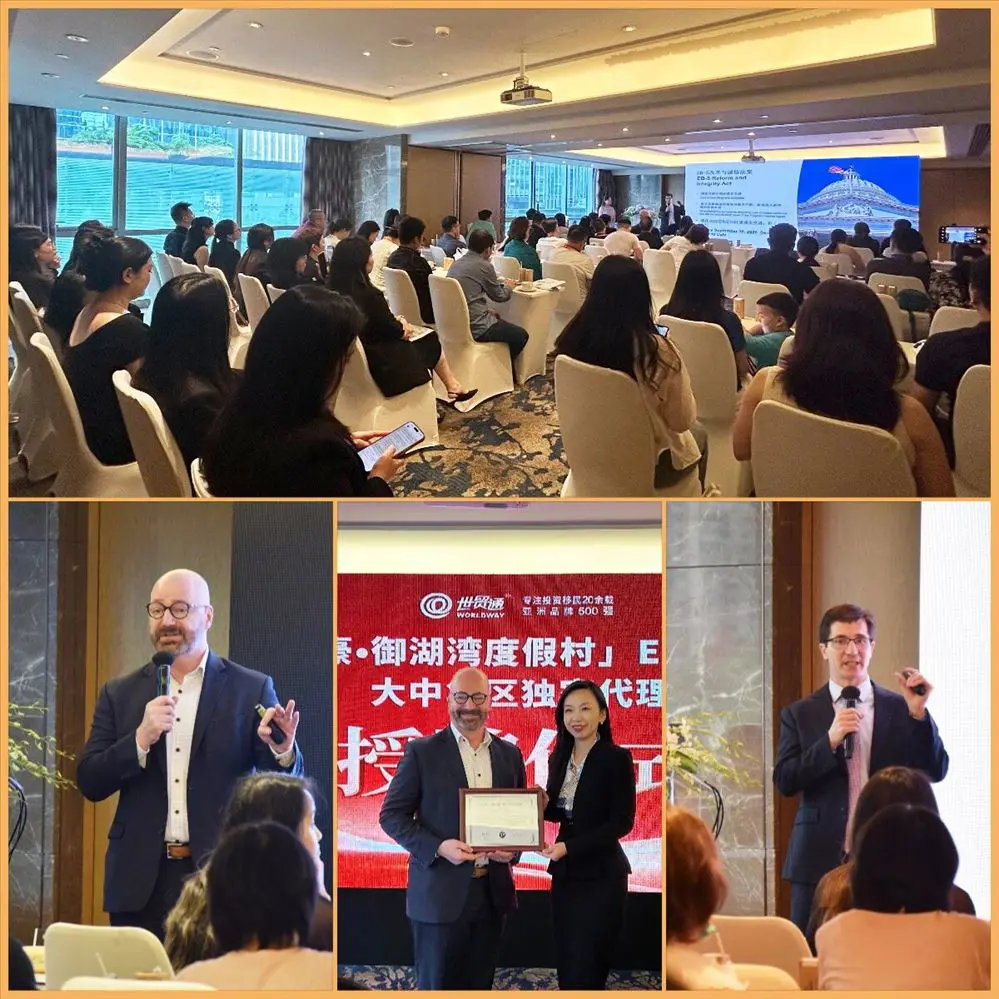
The Shenzhen stop on June 7 was successfully held, with an enthusiastic response on-site, attracting many families concerned about U.S. status planning, children's education, and overseas asset allocation to attend and exchange ideas. Focusing on core topics such as the latest EB-5 policies, I-485 window opportunities, and future visa bulletin trends, several high-profile guests shared in-depth insights, and on-site interaction continued to heat up.
Next, the following stops will be launched successively:
June 12 Hong Kong, China
June 13 Shanghai, Qingdao
June 14 Beijing
We cordially invite you to secure your seat in advance and seize the critical timing for U.S. Green Card planning.

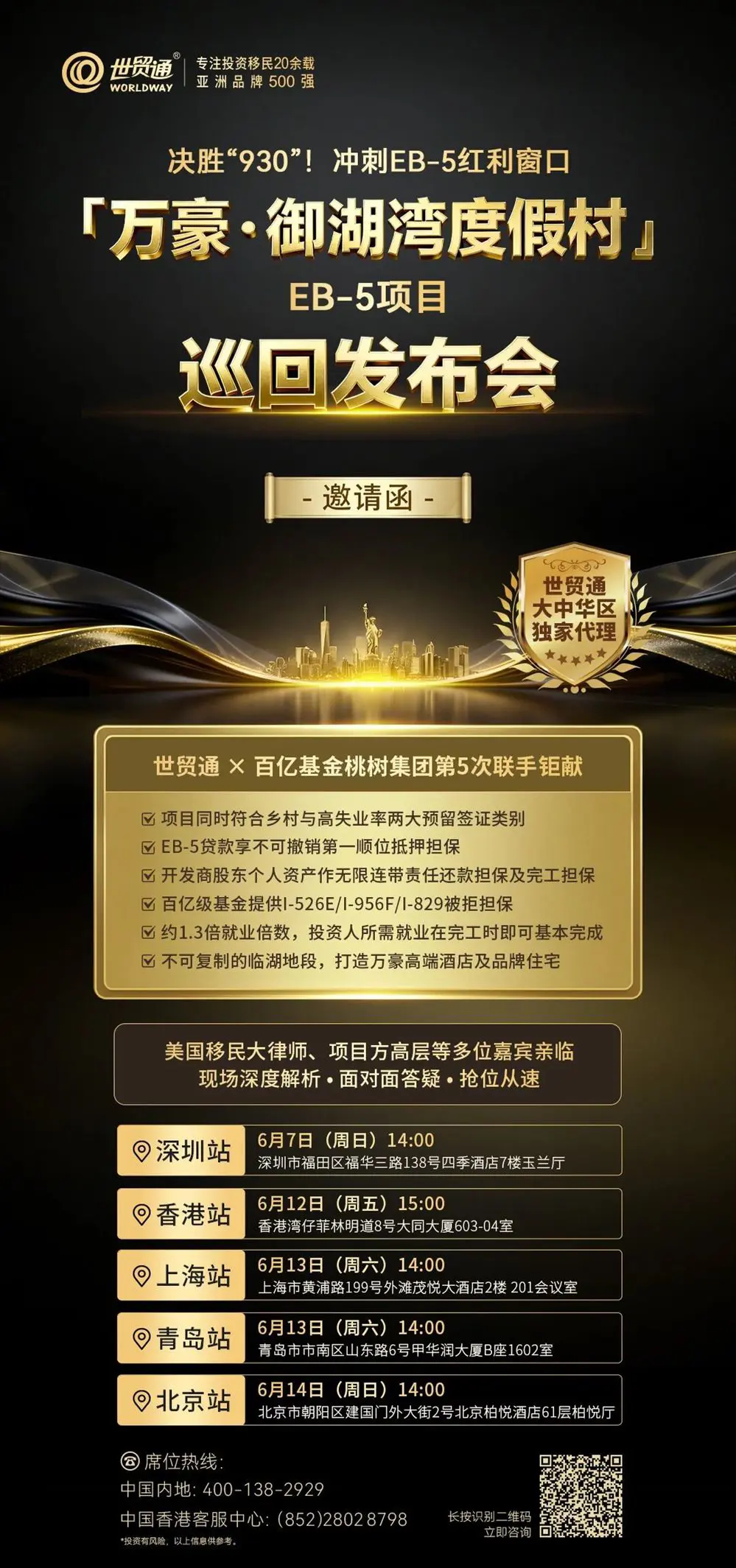
Great news! To help investors sprint for the EB-5 "930" golden window, WorldWay is launching a limited-time promotional event. Clients who process U.S. immigration projects during June 2026 can enjoy exclusive WorldWay discounts. For details, please contact your dedicated WorldWay consultant or customer service.
Seat reservation hotline, for details please inquire: Mainland China: 400-138-2929, Hong Kong, China Customer Service Center: (852)2802 8798