






Once upon a time, "Study in the U.S. — OPT Internship — H-1B Lottery — EB-2/3 Employment-Based Immigration to Green Card" was considered the golden rule for countless international students and overseas technical talent to establish roots in the United States.
However, this once-certain path is now facing an unprecedented structural collapse.
Local Signals and Federal Policy:
H-1B Environment Tightens
On May 26, 2026, local time, the results of the second round of the Texas Republican Attorney General primary were announced. State Senator Mayes Middleton, who supports the "America First" agenda, won the Republican nomination. During his campaign, he made "completely abolishing the H-1B visa program" one of his key policy proposals, and explicitly stated in a public interview: "We must strictly uphold the bottom line of the law, and even more so, directly abolish the H-1B program to reserve jobs for the people of Texas and native-born American workers."
This statement quickly drew market attention and reflects how certain conservative political forces are continuing to strengthen the policy expression of "local employment first."
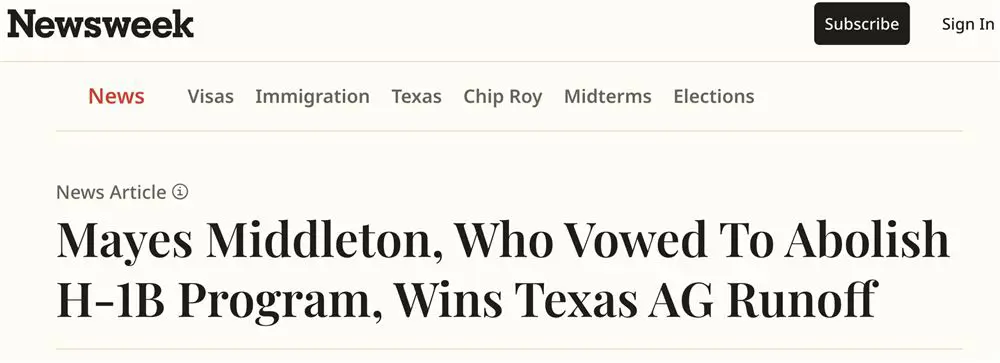
In fact, Texas has long been a "bridgehead" for the crackdown on foreign labor across the U.S. The current Attorney General has already launched a statewide special investigation into visa fraud, severely cracking down on the chaos of using "ghost offices" to falsely sponsor foreign workers; and the Governor has directly issued an executive order requiring all state government agencies and public universities to completely suspend new H-1B applications, with the ban lasting at least until the end of May 2027.
Multi-State Coordination to Build Walls
And "Dimensional Reduction Strikes" at the Federal Level
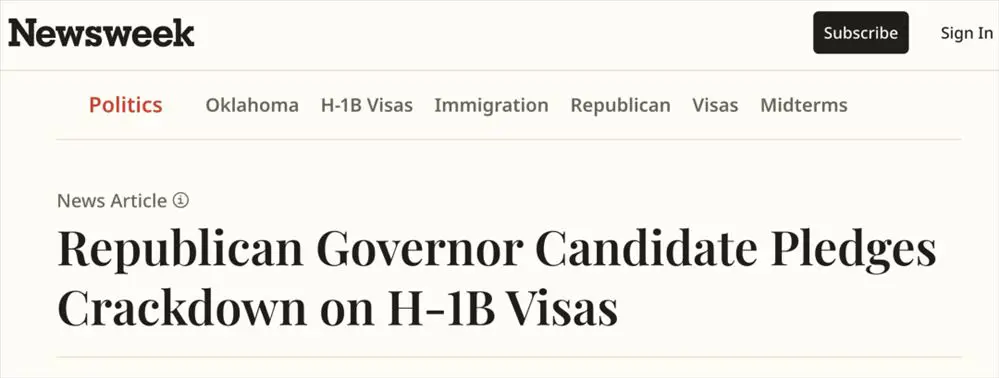
The aggressive measures in Texas are not an isolated case; conservative states across the U.S. are leveraging their autonomous jurisdiction over public administration and higher education to collaboratively build local barriers. In Oklahoma, Republican gubernatorial candidate Jack Merrick has proposed that in the future, H-1B and OPT should only serve as a "last resort" when companies cannot hire local residents, and companies that rely on foreign labor will be disqualified from undertaking state government contracts.
Meanwhile, Florida is also gradually requiring its public university system to phase out H-1B foreign labor and comprehensively reduce the recruitment of overseas talent.
If the "encirclement" at the local level is cutting off the employment path for international students, then policy adjustments at the federal level are a "dimensional reduction strike" against the entire H-1B system.
Since September 2025, the Trump administration has imposed a massive surcharge of up to $100,000 on new overseas H-1B applications, completely abolishing the long-standing random lottery system and replacing it with a weighted selection mechanism based on salary levels. This "combination punch" had an immediate effect, causing the volume of compliant applications for the 2027 fiscal year to plummet by nearly 40% year-on-year. The winning rate for low-wage positions has dropped off a cliff, and the space for ordinary international students to stay in the U.S. through work has been compressed to the limit.

The Way to Break the Situation:
EB-5, Mastering the Initiative in Status Planning
Facing the dual pressure from federal and local levels, the traditional path is not only full of uncertainty, but also forces applicants' careers to be cut off by their "status"—they cannot easily resign, cannot casually change industries, and even face the existential crisis of having to leave the country within 60 days of losing their job.
In this context, the new EB-5 law has become an important option for families in the U.S. to conduct status planning and reduce uncertainty. Since the implementation of the new EB-5 law, two major advantages have attracted attention: first, the opportunity for no visa backlog brought by reserved visas, and second, the "concurrent filing" policy that allows applicants in the U.S. to file I-526E and I-485 simultaneously, quickly obtaining a Combo Card to achieve legal residency and employment eligibility.
Meanwhile, with the recent policy adjustments to I-485 adjudication attracting widespread attention, the scope of approval discretion, filing pace, and potential impacts have also become topics of general concern for investment families. More and more families are beginning to hope that through professional interpretation, they can more systematically understand the relationship between policy changes and status arrangements.
June 7 in Shenzhen, June 13 in Shanghai, June 14 in Beijing
Exclusively represented by WorldWay Group in Greater China
"Marriott · Lakeview Resort" EB-5 Project
Roadshow Launch is About to Begin
At that time, senior attorneys from Miller Mayer and other heavyweight guests will be present in person
In-depth interpretation of I-485 policy changes
2026 Fiscal Year EB-5 data and 2027 visa backlog trends
How to break the situation under the tightening of H-1B policy
Seats for the three cities are now open for reservation, with limited spots available
We cordially invite you to lock in your seat in advance
Seize the critical timing for U.S. Green Card planning

Great news! To help investors sprint for the EB-5 "9/30" golden window, WorldWay is launching a limited-time promotional event. Customers who process U.S. immigration projects during June 2026 can enjoy exclusive WorldWay discounts. For details, please contact your exclusive WorldWay consultant or customer service.
Seat reservation hotline, for details please inquire in Mainland China: 400-138-2929, Hong Kong, China Customer Service Center: (852)2802 8798